

Inside a Hostile Planet: A Look into Current Research on Venus with Dean Gilmore
Humanity lives within a diverse neighborhood of planets with unique mineralogies and chemistries that scientists are eager to explore. While Mars has been the primary focus of exploration efforts due to its proximity to Earth and its habitability potential, Martha Gilmore, Dean of Natural Science and Mathematics and Professor of Earth and Environmental Science has focused her attention on Venus, our rocky neighbor closer to the Sun.
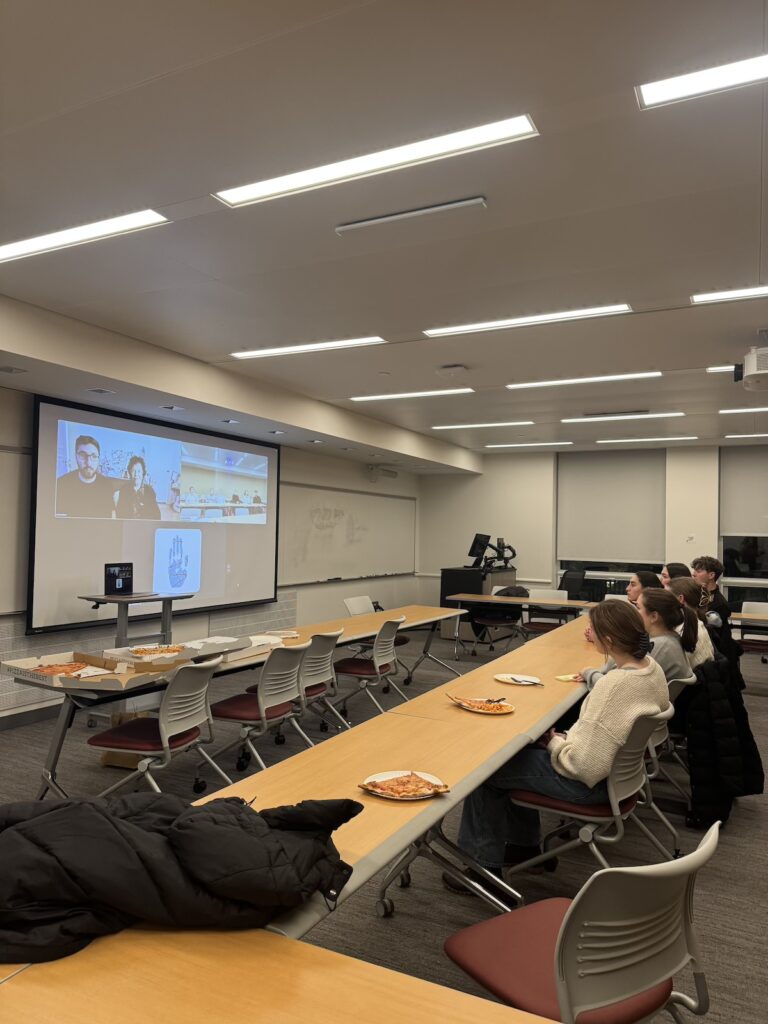
As a planetary spectroscopist and geomorphologist, Gilmore studies images of Venus and the way light is absorbed by the minerals on the surface of the planet to better understand the evolution of Venus’ geologic and mineralogical features. In an interview with The Argus, Gilmore described her research and its importance in gaining a deeper understanding of planetary morphology.
“I have been working with two individual teams to propose two different missions,” Gilmore said. “One is a new Venus orbiter. One is a Venus probe. We submitted those proposals several times. This has taken decades, about 10 years of proposal submissions and construction, and then we were finally selected, both missions the same year, a couple of years ago. It was astounding. … Since then, because of various things, the missions have been delayed. But … we’re getting funding again, so we have launch dates in 2030 and 2032 for the probe and orbiter, respectively.”
The Venus orbiter and probe that Gilmore’s teams are developing is called the Deep Atmosphere Venus Investigation of Noble Gases, Chemistry, and Imaging (DAVINCI). Once launched, DAVINCI will study Venus through a series of flybys. Notably, DAVINCI will use electromagnetic radiation with a wavelength of one micrometer, also known as a micron, to look through Venus’ clouds down to its surface. This novel imaging method has the potential to reveal new insights about the planet.
“I am working … on [the] detection of minerals from space using a new technique: looking through the clouds at one micron to look at these older terrains, see[ing] what their composition is,” Gilmore said.
Two years into the mission, DAVINCI will release a probe to the surface of Venus, allowing remote access to rocks that are billions of years old. The probe will undergo an hour-long plunge, relaying information back to the orbiter before crashing into the planet’s surface (as it is not designed to survive the impact).
“I study the oldest terrains on Venus; they’re called tessera terrains,” Gilmore said. “We’re interested in them because they are the best chance we have at finding rocks that may have interacted with a more water-rich world. Venus and Earth should have had oceans at the start, and Mars too. Where we’re dropping the probe is actually a place that I picked. … we’re going [to equip the probe] with a camera with two filters that can tell us something not only about … the mineralogy of the rocks, but it will also allow us to see the rocks [on Venus’ surface] … all the way down to centimeter scale.”
Though DAVINCI’s launch dates are several years away, Gilmore and her team are still hard at work. Recently, the team has been simulating the effects of Venus’ surface conditions on rocks and minerals.
“I take my rocks, and I put them in a Venus chamber,” Gilmore said. “The biggest Venus chamber in the world is at NASA Glenn in Cleveland. It’s huge, and it’s the only vessel where you can do Venus’ temperature, 460° Celsius, 90 bars [of] pressure, and nine Venus gases to simulate the Venus surface conditions.”
The researchers are analyzing how rocks and minerals react to the conditions of the Venus chamber in order to better understand Venus’ geographical evolution. Once DAVINCI completes its mission, the team will cross-reference the data obtained by the probe with the results of their Venus chamber studies.
“Right now, I’m in the process of analyzing what happened to [the rocks and minerals in the Venus chamber], because these conditions don’t exist on Earth,” Gilmore said. “It’s a CO2-rich atmosphere [on Venus]. … When you take a rock from Hawaii, a basalt, and you weather it on Earth, it oxidizes, it rusts; we have a sense of what happened. On Venus, it’s a different set of reactions. If we’re going to recognize mineralogy from [DAVINCI], then we need to understand what the rock becomes under those conditions, so that we can infer what the rock was.”
Gilmore explained the different roles within her lab group, including spectroscopists, who are working with igneous glasses formed via volcanic processes, and geologic mappers.
“One of my graduate students is looking at [what happened to] igneous glasses in the lab,” Gilmore said. “That’s using spectroscopy, our scanning electron microscope that we have at Wesleyan, [and other] instruments. It’s geochemistry; you take the rock, try to measure it with all these techniques, and model what the thermodynamics should tell you. The other half of my lab is mapping. That’s a lot of taking Venus imagery and overlaying different data sets on it to try to understand how […] the morphology of the surface is related to some indicators of mineralogy that we have from [DAVINCI].”
She also described the data set her team received from the Parker Solar Probe. This probe used Venus’ gravity to accelerate on its journey to the Sun, and took images of the planet during its trip.
“When the Parker Solar Probe was on its way to the Sun, it had to do these Venus gravity assists,” Gilmore said. “And so they were nice enough—the team—to turn on their camera and look at Venus. So we have a couple of observations of Venus from Parker in this wavelength region, where you can sense something about the mineralogy [of Venus]. […] My graduate student, Rafael Uribe [MA ’27], is using those data to try to see these anomalous signatures mineralogically, and what they correspond to on the ground.”
Venus is commonly considered to be Earth’s evil twin, in the sense that the two have astoundingly similar masses, densities, and rocky compositions. However, Venus’ current surface and atmospheric conditions make it a hellish world devoid of life. Because of the planets’ similarities, Gilmore and her team are able to make comparisons between processes on Earth and Venus: if a rock is supposed to react in a certain way on Earth, why does it act this way on Venus?
Since Gilmore’s team is focused on Venus’ past, they are specifically digging into Venus’ habitable era, when water was present on the planet.
“We want to understand habitability across the solar system, right?” Gilmore said. “So I’m trying to look for signs of rocks that could have formed during that habitable era that require water in their formation. Some igneous rocks require water, … we could find clays or evidence of actual water weathering the surface at a time when the atmosphere wasn’t as hostile as it is now… I have a couple of papers and some preliminary data that suggests that those rocks might be the type of rocks that need water to form. If we can confirm that, that’d be amazing.”
Gilmore’s research represents a new frontier in humanity’s understanding of Venus and lies at the cutting edge of our expanding reach into the solar system. Her data has the potential to reconstruct a period on Venus when water, a vital ingredient for life, was present.
Remi Peltzman can be reached at rpeltzman@wesleyan.edu.




Leave a Reply