
Democracy 250 Series Brings in Faculty Panel to Discuss Identity, Democracy, and History
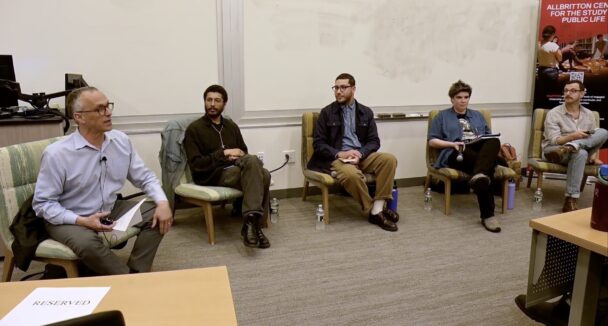
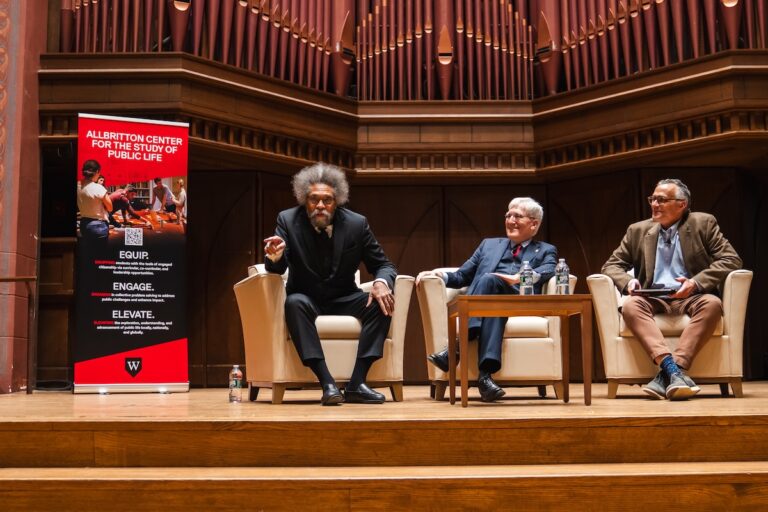
Over a hundred students and faculty gathered in the Frank Center of Public Affairs on Wednesday, April 1 to hear four professors from the University discuss America’s identity, political history, and future in a panel moderated by President Michael Roth ’78.
This panel was the first event in the Democracy 250 program, a four-part series on the current and future state of democracy in the U.S., and was sponsored by the Allbritton Center for the Study of Public Life, the American Studies Department, the Government Department, the Philosophy Department, and the College of Social Studies.
The event series was born out of a conversation between Gray West ’28 and Donovan Lave ’27, two of its student organizers. Each sought to expand the current offerings of events on campus to include more challenging discussions amongst students and faculty. After developing the idea for the project, West and Lave brought in Ted Greenberg ’26 and Kiran Bleakney-Eastman ’27 as co-organizers.
“We didn’t feel like there were a lot of events that were very contentious and that were bringing together [120] kids to delve into something as abstract and controversial as American identity,” West said. “I think we’re really happy about what the idea evolved into.”
The talk featured Associate Professor of American Studies Laura Grappo ’01, Chair of African American Studies Khalil Johnson, Associate Professor of Government Justin Peck, and Assistant Professor of Philosophy Nicholas Whittaker. They received questions from Roth on American civic and political identity, then held an open Q&A session.
After discussing what it means to be an American, panelists reflected on the role of the country’s founding documents at the cusp of the semiquincentennial on July 4.
“[The Declaration of Independence] is this glimpse right at something like the worldview of the [founders],” Whittaker said. “That’s more than just a political concept; that’s an existential concept, that’s a philosophical concept.”
Beyond a mere review of the United States’ founding documents, the discussion emphasized the role of activists and changemakers in national progress.
“We’re here today because there are people who have had it worse than all of us, [who] have fought like hell, and were smart as hell to change society,” Johnson said.
Roth asked the speakers whether they believed that the goal of universities is to create “better citizens.” Peck complicated the premise of the question, and responded by discussing the purpose of the university in creating a wider sense of identity.
“The role of [a] university is to teach people to not just think of themselves as primarily subjects of nations, and to try to transcend your national identity and see yourself as something much broader,” Peck answered. “Because nations fight wars over national identity, and I think that the aspiration should probably be to figure out how to overcome the things that cause us to kill ourselves, especially in a world in which those types of conflicts could end all human life on planet Earth.”
While many of the speakers discussed the ideological underpinnings of American identity, Grappo underscored the importance of articulating material concerns as part of a progressive vision for the future.
“As academics, we just keep sort of saying none of this is real … none of this is actually that meaningful,” Grappo said. “In doing so I think that we just make ourselves obsolete. This is why Trump won. Because we can’t articulate—leftists, liberals, progressives—a positive vision of going forward in the nation state where we live in, and we cannot say what this means, what we should do, [or] why you should even care. I think that we’re verging on nihilism on the left, and I think that it’s dangerous.”
Roth, who had to leave before the open Q&A session, ended the first portion of the event with a call to action.
“It can get a lot worse, very quickly, and any student of history knows that,” Roth said. “I do hope you [all] feel the urgency of this time and think about how you, with your smarts and your compassion and your strength, can contribute to getting us through what is a very perilous time.”
Following the open forum, where attendees could submit questions for the panelists through a QR code, students in attendance reflected on the opportunity to hear from professors during a turbulent period in national politics.
“The topic at hand felt especially pressing given the political turbulence that has defined our cultural moment,” Miles Urban ’27 wrote in a message to The Argus. “I especially appreciated the [panelists’] efforts to question and challenge the role of higher education and institutions like Wesleyan in defining the future of America and our role in it.”
This event was the start of the Allbritton Center’s Speaker Series: The Current State and Future of American Democracy.
Subsequent events include “Future of US: 250 Years. A Panel Discussion on Defending & Defining Democracy For the Next Generation” with Secretary of State of Connecticut Stephanie Thomas, founder of Connecticut Youth Political Advocacy Center Ryan Engels, and Associate Professor of Government Logan Dancey. These panels will be followed by a Thursday, April 9 screening and discussion of “The Librarians,” a documentary about public libraries and the challenges they are facing, and a Youth Voting Rights book talk and workshop on Friday, April 10 at 12:00 p.m.
Organizers were happy with the start to the series.
“I was really impressed by the depth of the conversation, as well as the level of disagreement, which I honestly was hoping for,” Greenberg said. “It was a good foundation for this project, and it’s gonna be really exciting seeing what comes out of it in the next few weeks.”
Miles Craven can be reached at mcraven@wesleyan.edu.
Anabel Goode can be reached at agoode@wesleyan.edu.
Leave a Reply