
Continuing a Tradition, Holocaust Survivor Eva Brettler Speaks at the University
With next Monday, April 13 marking Yom HaShoah (Holocaust Remembrance Day), an annual commemoration of the six million Jews who perished in the Holocaust, Wesleyan University’s long and illustrious history of hosting Holocaust survivors to speak on campus takes a renewed focus. The day calls on us to never forget the atrocities of the Holocaust, and members of the campus community have embraced that mantle over the years by bringing a number of survivors to Wesleyan.
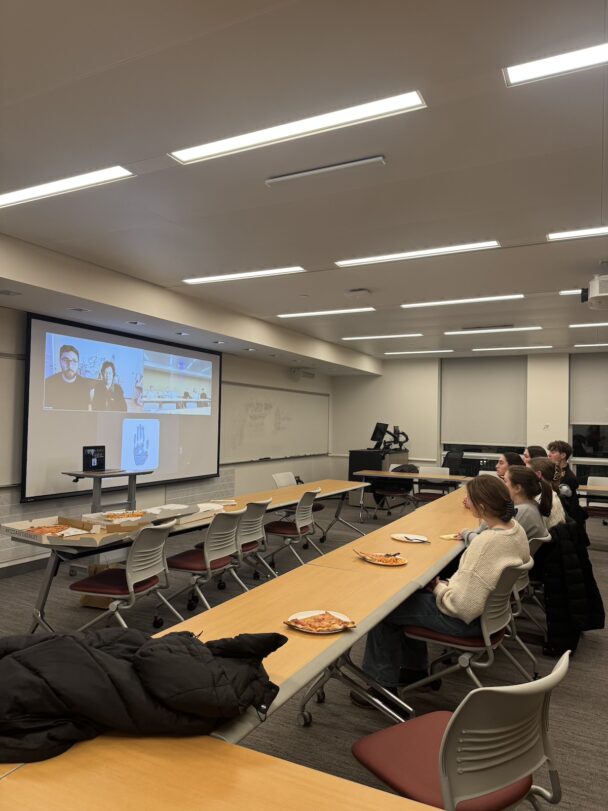
Most recently, Eva Brettler, a Holocaust survivor and the grandmother of a Wesleyan alumnus, spoke to students at Wesleyan about her experience of Nazi persecution.
Elie Wiesel, the author of “Night” and a Nobel Peace Prize laureate, was awarded an honorary Doctor of Humane Letters by Wesleyan in 1979. In an Argus article published on Oct. 29, 2010, Amanda Schwartz ’12 reported on Wiesel’s return to Wesleyan, his speech on building a moral society, and why he opposes capital punishment.
“In a moral society, death is never an answer,” Wiesel said. “What should be the answer? We cannot go around the law. It is the law that makes a society moral or immoral.”
Preceding a screening of “Schindler’s List” (1993) in 1994, Henry Tylbor, a Holocaust survivor, addressed Wesleyan students, as noted in an Argus article published Dec. 2, 1994, written by Sandy Nichols ’97.
Tylbor, who grew up in the Warsaw Ghetto and survived multiple concentration camps, spoke about the rise in antisemitism in Europe.
“It was vicious solipsism,” Tylbor said in his address. “We developed a belief that people are dying, but the community will live. It was one of the greatest illusions of all.”
In June 1996, Holocaust survivors Kuba and Helen Beck spoke at Wesleyan as part of its Upward Bound program. The Becks were saved through the efforts of Oskar Schindler, a German industrialist credited with saving the lives of about 1,200 Jews during the Holocaust.
Returning to the present, Brettler’s speech was delivered on Jan. 30, 2026, the day after International Holocaust Remembrance Day. It was sponsored by Students Supporting Israel (SSI), a campus group that holds programming related to Jewish history, fighting antisemitism, and supporting Israel.
Brettler, who is now 89 years old, was born in Cluj, Romania. She spoke about how the introduction of antisemitic laws quickly changed her family life.
“One day, when I was about four years old, my father came home and he said, ‘I lost my job,’” Brettler said. “I said, ‘Papa, how is that possible? Last week, they honored you as an outstanding worker.’ He [said], ‘I know, but I lost my job because we are Jewish.’”
To try and avoid these laws, the family moved to Budapest, Hungary. But by 1944, Germany invaded Hungary, which forced Brettler and her family into hiding. Brettler and her mother moved between Swiss and Swedish safe houses until local authorities ended those protections. Soon after, Brettler and her mother were captured by the Nazis. She recalled being sent on a forced labor march toward Germany.
“The march was very, very difficult,” Brettler said. “And every so often they took young children and they put them on a horse-drawn wagon. And one day, my mother’s feet were so badly injured and bleeding, and she took me and asked, ‘Could I please come with my daughter on the wagon?’”
During this march, the Nazis murdered Brettler’s mother.
“They put me on [the wagon],” Brettler said. “They pushed my mother away. A short time later, we heard shots. When we arrived to our temporary destination, every time the door opened, I waited for my mama to come. I [was] just seven years old. It never happened. I started to cry.”
In January 1945, Brettler arrived at Ravensbrück, a women’s concentration camp, where she was separated from the woman who was watching over her after her mother’s murder. Brettler had her head shaved, was sprayed with disinfectant, and given a uniform, which she described as “striped pajamas.”
Two months later, Brettler, at just eight years old, was then moved to Bergen-Belsen on a cattle car. The Soviet Army was approaching Ravensbrück, which they planned to liberate.
Brettler described the horrendous conditions in Bergen-Belsen, a Nazi concentration camp.
“As we arrived at Bergen-Belsen, we saw so many mountains of corpses,” Brettler said. “They assigned us to a barrack. We no longer slept in a bunk bed [like in Ravensbrück]. We were sleeping on the concrete floor, and the whole place was so badly infested [with bugs].”
In April 1945, Bergen-Belsen was liberated by the British Army.
“One day inside the barrack—it was so badly infested—I kind of sneaked out and the sun was shining on me,” Brettler said. “I stood very, very still, and somebody picked me up, and I could see in the man’s eyes, tears. It was April 15, 1945, and we were liberated by the British. This lovely soldier put me down, reached in his pocket and gave me a chocolate bar. I ate the chocolate bar all by myself.”
Soon after, Brettler became seriously ill with typhus and was treated at a clinic built by the British.
Following the war, and after 16 months in Sweden, Brettler started attending school for the first time, where she learned Swedish, Polish, and German, realizing that she had forgotten how to speak Hungarian. Brettler discovered that her father, who had been sent to a labor camp in 1944, had survived. They were reunited through the Red Cross and moved back to Hungary together. Brettler’s father ultimately remarried another survivor, and they had a baby boy. Brettler’s father cautioned her to never speak of the war.
After the Hungarian Revolution of 1956, Brettler immigrated to the United States in January 1957. Brettler, then 20 years old, stayed with the family of her stepmother, who became her new mother, the Goldhammers. Brettler settled in Los Angeles, Calif., earned a degree in psychology from the University of California, Los Angeles, and married Marten Brettler, a fellow survivor, in August 1957. They had four children who were educated as a rabbi, a physician, an architect, and a neuroscientist.
In the 1980s, Brettler joined a child survivor support group facilitated by prominent psychologists Sarah Moskowitz and Florabel Kinsler. Since then, Brettler has been speaking about her experience as a Holocaust survivor, consistently emphasizing the value of education and letting go of hatred.
The event organizers were deeply moved by Brettler’s speech and noted how impactful it was to hear the lived experience of a Holocaust survivor.
“Eva [Brettler]’s story was beyond meaningful, and stories like hers are so important to hear because Holocaust survivors will only be around for the next five to ten years,” SSI co-President Aviva Schnitzer ’28 said. “It’s our responsibility to make sure Eva’s story lives on.”
Other students saw Brettler’s speech as a sign of Jewish strength.
“I am so grateful to have heard Eva’s story,” SSI co-President Gaby Sorin ’27 said. “Her survival and courage in sharing it reflects the resilience of the Jewish people, and I feel honored to help carry her memory forward.”
Blake Fox can be reached at bfox@wesleyan.edu.


Leave a Reply