
Public Intellectuals Cornel West, Robert P. George Talk Civil Discourse in Hugo L. Black Lecture
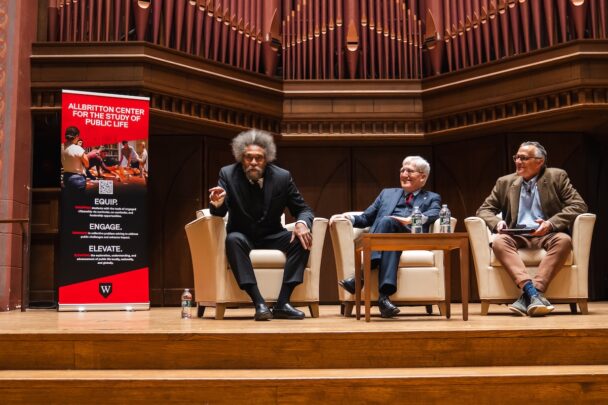
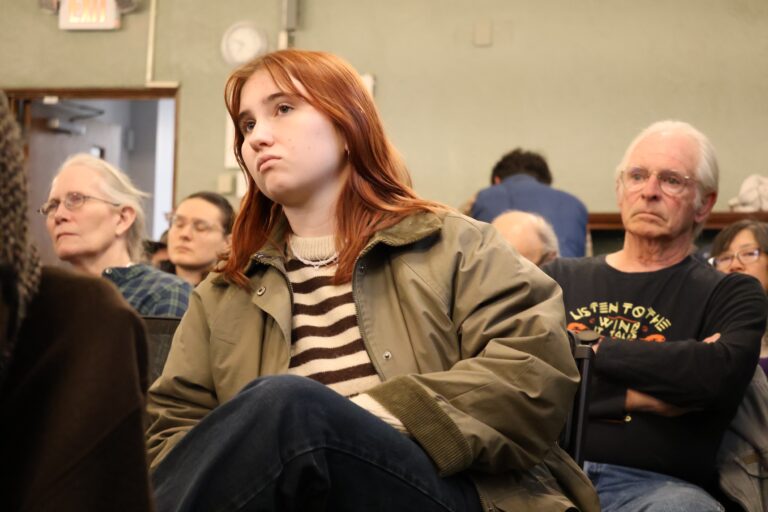
Hundreds of University students, faculty, alumni, and community members packed the Memorial Chapel for the annual Hugo L. Black Lecture on Freedom of Expression on Friday, March 27.
In conversation with President Michael Roth ’78 were two figures from opposite ends of the political spectrum—Cornel West Hon. ’93, Dietrich Bonhoeffer Chair at the Union Theological Seminary and Robert P. George, McCormick Professor of Jurisprudence at Princeton University.
Named in honor of former U.S. Supreme Court Justice Hugo L. Black, the lecture is focused on First Amendment issues such as freedom of speech, and is endowed by Leonard S. Halpert ’44. This year’s talk was organized by the Allbritton Center for the Study of Public Life. Former guests have included U.S. Supreme Court justices, prominent judges, and leading legal scholars.
West, one of the foremost progressive figures in the U.S., and George, a widely respected conservative Christian intellectual, began by discussing the origins of their close, if unexpected, friendship, which began when they were both professors at Princeton. A student arranged and recorded an interview between West and George for a student publication, a discussion which outlasted the student’s tape recorder.
“This was a rock ’em, sock ’em debate, conversation, dialogue on every issue that you can think of, political, philosophical, religious,” George said. “We began at two o’clock. I can’t remember the machine clicking off, but I assume at roughly three o’clock, the machine clicked off. But we were into it hot and heavy at this point, and the next thing I know, I looked down at my watch. It’s six o’clock.”
Their conversation continued, and eventually George and West taught a freshman seminar together at Princeton. Though West went on to teach at Harvard, the pair often still engage in public conversations about truth-seeking and the importance of open dialogue.
“Well, the first time I saw this brother, I was lovestruck,” West said of George. “Not the way I was with my wife, but lovestruck. Because I’d already heard him in the conversations. I’d already seen his witness. And even when I thought he was wrong and thoroughly wrong, when I thought he was right and thoroughly right, when I thought he was half right and half wrong, the love still flowed. And then when I got to know the brother, good God almighty.”
Much of the conversation was about the importance of good-faith discourse between those who share varying fundamental beliefs.
“To be open to the possibility that I can be wrong on the big stuff is hard,” George said. “I think that’s where people run into the wall. They actually wouldn’t consider that they might be wrong about the things that matter most to them. That’s very hard for us human beings, but Cornel and I share a recognition that we’ve got to acknowledge that.”
West framed such communication as a form of love.
“What kind of human beings do we really choose to be?” West said. “That’s always in what we’re willing to sacrifice, how we’re willing to empty ourselves, to be of service to others, to be of help to others, to grin, to touch, to hug, to affirm, to criticize. There’s no love without correction. Love is protection and correction, you see.”
One highlight of the event came early on, when West left the stage to hug Flynn Rorty ’28, the grandchild of the philosopher Richard Rorty, a friend and influence on West.
“I thought it was pretty remarkable when Richard Rorty’s grandchild presented themselves to Professor West, and the two of them were able to make that connection through time and space,” Dean of the Social Sciences Mary-Jane Rubenstein, who introduced the two speakers, said.
Rubenstein helped with the arrangements for the lecture, which began last fall. A list of potential guests was prepared by members of the faculty and administration and submitted to Roth. A decision was made, and a formal invitation was sent to George and West last December. Rubenstein noted that acceptance of the invitation came within a few hours.
“Professor West in particular has a fond set of memories of having come to Wesleyan,” Rubenstein said. “He said at the lecture that we kind of punch above our weight: The University has a lot of impact for how small we are. I think it’s also that both of them have really respected the stance that President Roth has taken publicly against the suppression of academic freedom, against the suppression of freedom of expression, and in defense of the University against the U.S. government.”
Some, while appreciating the pair’s message, felt that their cordial discussion was unlike the reality of many current political interactions in the U.S.
“I don’t think it was a good reflection of the polarizing climate that the country is currently undergoing,” David Tu ’26 said. “But that doesn’t mean I don’t think that there was still value. But there is at least a proximity, I think, in the way they approach dialogue in politics.”
While Roth observed that they didn’t argue over particular points of contention, what George and West offered was equally valuable.
“They talked more about their disagreements than they actually disagreed in front of everyone, and my questions were going to be the kind like, ‘Okay, Professor West, why is Professor George wrong about abortion,’ and ask Professor West vice versa, and it just wasn’t going that way,” Roth said. “As moderator, I was prepared to adjust, and I thought the vibe that they presented was really wonderful and interesting in a different kind of way than a debate would be, and also very instructive.”
Others found the conversation to be important, particularly at a time when such dialogue seems to be in decline.
“I think the event was outstanding,” David Robinson ’87, who has been to several past Hugo L. Black Lectures, said. “I really like constructive conversations between people with different views, and as you heard them say, that’s something that I fear is lacking in society today. [I’d like] less tribalism, less factions, and more honest, constructive conversation with people that don’t necessarily agree with you or that don’t share your upbringing or background.”
To Robinson, though, one of the most memorable moments came after the conversation concluded.
“I think it’s telling that all three speakers hugged each other at the end,” Robinson said. “That’s a pretty nice gesture.”
Spencer Landers can be reached at sklanders@wesleyan.edu.

Leave a Reply