
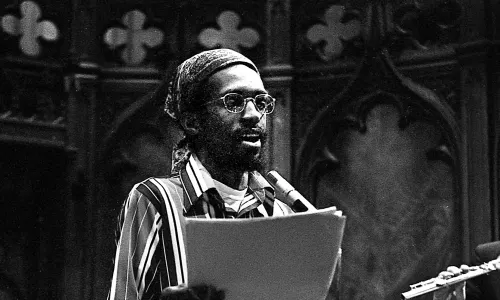
Unravelling the Life and Works of Julius Eastman: A Composer Beyond All Categories
“What I am trying to achieve is to be what I am to the fullest—Black to the fullest, a musician to the fullest, a homosexual to the fullest…. It is important that I learn how to be, by that I mean accept everything about me”
– Julius Eastman
The sound of 10 cello bows ripping and growling across the strings. The wild groove of many musicians locked squarely onto the beat. An off-stage jazz combo echoing under the cries of a full choir. Enter “The Holy Presence of Joan of Arc,” “Stay On It,” “Thruway,” the fearless work of composer Julius Eastman.
Born in 1940, Julius Dunbar Eastman was a queer, black composer, musician, performer, and artist. He grew up in Ithaca, New York before living in Buffalo and New York City as an adult. During his life, he was well-known within experimental music circles. However, after his untimely death in 1990, his name largely faded from public view until 2005, thanks to the publication of the album Unjust Malaise. Curated by composer and scholar Mary Jane Leach, it was the first publicly available recording of Eastman’s music. In the years following, interest in the life and work of Eastman resurged, and the University of Rochester’s aptly named Eastman School of Music (no relation) published a book, “Gay Guerrilla” (edited by Renée Levine Packer and Mary Jane Leach), featuring essays from friends and academics on Eastman’s legacy.
I first came across the music of Julius Eastman in a quest for composers who used composition as means to rebel against their circumstances. Eastman was a sort of chameleon who appeared in the worlds of other composers, whether in making rebellion against aesthetic sensibilities with avant-garde composer John Cage, working with and touring alongside Meredith Monk, or providing vocals and keyboards on Arthur Russell’s 1981 disco album 24→24 Music.
Eastman had found his way into many niches and communities, yet he seemed to have very little recognition. In the past two decades, however, thanks to the work of musicologists such as Mary Jane Leach and Renée Levine Packer, there has been a renewed interest in the life and work of Eastman among performers and academics, though he still is far from widely known outside of the niche community of “new music.”
On my first listen of his compositions, I was immediately entranced. His music hit me with a certain philosophical potency. I was also fascinated by how he used quotations and blended the worlds of improvised and composed music in the world of classical music. I also found his character to be mesmerizing. Eastman as a person completely interested me.
Yet there was one issue which eluded me and seems to elude all scholars and fans of Eastman…. I can’t pin him down! Any attempt at defining—that is, containing—Eastman seems to never be enough. It’s like trying to capture an ocean in a mug. The only label which seems to hold is that he resists being labelled by any single lens or method. That is, he lies beyond categories. To borrow the words of artist and Eastman scholar Jace Clayton, “Every person is multiple, but Julius Eastman amplified his multitudes by scattering them across enough categories to confuse any logic that might attempt to keep them separate.”
For example, even the labels of composer, musician, and artist seem to fail Eastman. Throughout his life, he was notorious for his mischievous performances, be it veering off script by suddenly painting his face silver or commanding the stage as the mad king George III in Peter Maxwell Davies’ “Eight Songs for a Mad King.” Eastman defied the boundaries afforded to musicians and composers.
“Okay, then he is a devil-may-care performer,” the skeptic might say. “So what?”
Well, he was a polymath! How about his ventures into filmmaking, graphic art, poetry, and dance choreography?
“Alright, well, just call him an artist, then?”
But the word artist feels too tidy for a personality as complex as Eastman’s. Artist suggests unswerving dedication to production, preservation, institutionalization, and cooperation. In a move that was quite the opposite of that, however, Eastman didn’t preserve his scores. All of the scores that we still have today are preserved by friends, performers, and SUNY Buffalo. Plus, he did many things to jeopardize his career. During a rehearsal with the S.E.M. ensemble, a group that performs contemporary classical music (of which Eastman was one of the founding members) Eastman abruptly got up and left, exclaiming, “I can’t stand this music anymore.”
Additionally, when hired for a church gig in the early 1980s, Eastman smeared dirt on a Steinway grand piano, purportedly because the dirt gave the keys better traction—an act which, unsurprisingly, left the church administrators furious. Near the end of his life, he even stopped composing altogether, telling his close friend Rocco Di Pietro on a phone call in 1987, “I don’t write anymore…. no, I have given up music…. How do you continue to compose when you don’t believe in anything anymore?”
This isn’t the grand arc we might expect of an artist’s work. But it doesn’t have to be: It’s the acceptance of clashing ideals, inner turmoil, and rupture. Eastman’s inner struggle deeply influenced much of the seemingly spontaneous actions he took earlier in his life. In the same phone call to Di Pietro, Eastman reflected on his departure from S.E.M.: “I could not take it anymore…all that Darmstadt crap, those white people’s TA-CHISTE marks on paper were KILLING ME! I want to feel something, Rocco. None of that shit makes my dick hard!”
Eastman’s struggle is grossly simplified within the container of the artist. I once again assert: Julius Eastman is beyond categories.
In the face of a man this complex, the only thing we can do is to try our hardest to resist the tendency of simplification and categorization. Eastman worked to resist and prevent categorization. He constantly pushed boundaries and challenged those around him. Not only is this important to keep in mind while listening to his music, but it is a perspective needed to understand his life.
Once more, I cannot help but think of how hard it is to capture Eastman in words. I deeply encourage you to go and learn more about him, to hear and experience sounds scarcely heard. In a world ruled by genre and categories, Eastman’s flat out refusal to comport with them is a radical and necessary act and an example for all to follow.
Please stop by my Eastman listening party on Thursday if you are able to or even reach out to me, Omri, to chat. Neither of those will give you a complete answer as to who Julius Eastman was. But that’s exactly the point.
On Thursday, Feb. 26, Omri Riss Chbarbi will be hosting a Julius Eastman listening party and discussion from 12:30–2:00 p.m. in the Belzberg World Music Hall in conjunction with the Campus Resource Center. Feel free to drop in and out at any point!
Omri Riss Chbarbi can be reached at orisschbarbi@wesleyan.edu.




Leave a Reply