
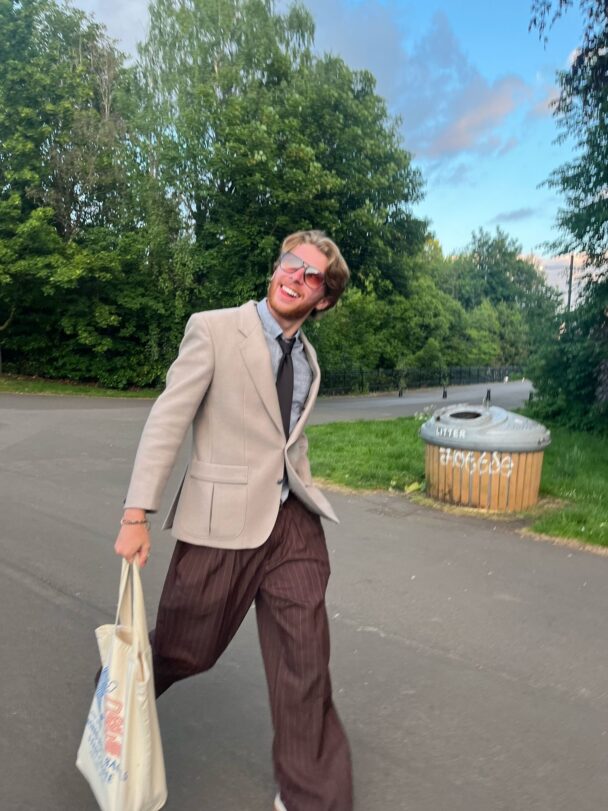
WesCeleb: Quincy Segal ’26 on Pervading Different Spheres, Saying Yes, and Directing His Own Path
Quincy Segal ’26 is a history and film studies double major who truly tries to make the most out of his time at the University. Whether he’s singing with the Wesleyan Spirits, working in Olin Library’s Special Collections & Archives, or directing productions, staying busy is part of the plan. Last week, The Argus spoke with Segal about balancing a demanding schedule and ultimately working towards a film career.
The Argus: Why do you think you were nominated for WesCeleb?
Quincy Segal: I feel like I pervade and exist in a lot of different spheres on campus. I’m a film major. I’m a history major. I’ve done theater here. I’m part of the radio station at WESU. I’m part of the Alpha Delta Phi Society. I’m part of the Wesleyan Spirits. There are a lot of different communities that I inhabit, and I think I just know a lot of people.
A: Wow, you are a jack of all trades. How do you even begin to manage all of that?
QS: That is an excellent question and something that I often ask myself when checking my calendar before I go to bed. I think it’s all about the Google Calendar in a lot of ways. For me, I really like being busy, and I like having a lot of things to do and go to. I mean, it’s obviously a double-edged sword. If I have a day filled with classes and meetings and all that sort of stuff, I don’t have time to do much else. But I try to fill my time with stuff that I really enjoy doing. Being at Wesleyan, there’s a finite period of time, and so I try to make very conscious decisions about what I’m going to participate in.
I think, coming into my senior year, I was really on the wavelength of wanting to participate in as much stuff as I could. And so I was like, “All right, what are the things that I haven’t done at Wesleyan so far?” Last semester, I did a stand-up comedy set for the first time, which was really fun, with Awkward Silence. I was part of this random orchestral performance of the Bill of Rights with the Music Department: I read the Fourth Amendment for it. I think I have really adopted a kind of “just say yes” mentality when it comes to a lot of stuff. There’s only so much time that you have, and I feel that there’s so much great stuff to do here, and there are so many great people to meet. I think it’s a crime not to be able to do as much as you can.
A: You’re a film studies and history double major; can you tell me more?
QS: Yes, and I’m doing a capstone for each of my majors. My history capstone—which I did last semester—was a documentary I made about Wesleyan during the World War I period. There was all this crazy training that was happening during World War I at Wesleyan. I was in this class, Wesleyan and War, and there was a lot of archival material we were looking at. A bunch of photos of literal soldiers in full uniform on Andrus Field digging trenches for the military certificate, which was a thing at Wesleyan back in the day. I learned a lot of really cool stuff about Wesleyan lore and history and stuff like that. And so as a result of that, I actually now work in the archives in Olin Library, which is pretty cool.
This semester, I’m working on my film capstone, and that is a short film about this college guy and his friend. They both end up being art thieves, and the main guy actually ends up falling in love with the detective who’s investigating his case. So it’s this sort of dynamic between him and the detective. That’s been a great process.
I really strive to find people who are great at what they do and people who are passionate about collaborating. This team that I’ve put together for this movie is some of the best people. The great thing about Wesleyan is that everyone loves doing what they do. I worked on a bunch of capstones and a thesis last semester, and the people who are the only ones getting any sort of credit or anything are the directors. Every single other person is just doing it for the love of the game. That’s really, really cool. They are giving their time and their energy and passion for a project, just to help somebody else and work together with other people, and I think that’s been one of my most rewarding takeaways from Wes.
A: Speaking of being a director, you directed Falsettos last year with Spike Tape. How was that experience?
QS: For me, that was my favorite artistic work that I’ve ever done. It was my whole semester, Fall 2024, and I worked with the best cast and the best crew. We had something like over 40 people working on that show, and most of that was crew, because we only had seven actors working on it. But it was a really wonderful process. I worked with some of, I think, the most talented actors, actresses, and crew members at Wesleyan. I want to be a director, career-wise. And so I think for me, having that experience was incredibly invaluable to know that this is something I can do, this is something I can pull off. Obviously, I could not have done what I did without everyone’s diligent help. It’s a lot of work, and I am appreciative of the fact that I know how much work it is now. But, if anything, it sort of reinforced this idea of like, “yeah, this is cool.” “This is a path that I’d love to go down.”
My whole reasoning for wanting to put on that show was just so I could see it. I love that show, it’s my favorite musical of all time. I’ve been involved with a number of theater productions here every semester. Before the show, I was acting in one or two shows a semester. I think the theater community here is really, really great. And people, again, like Spike Tape, which is the organization, put it on even though nobody gets credit, nobody gets paid.
A lot of the time, you’re sacrificing your own money, and everyone’s sacrificing their own resources to put on something like that. And so being able to put on a production like that was awesome. I didn’t really consider the audience or how it would be received. I just thought, let’s do this for us. Let’s do this to have fun, because we like making theater, and we like making art, and we like performing and hanging out with each other, and all that stuff about public reception comes afterward.
As it ended up coming about, it sold out super fast. It sold out in like seven minutes or something like that in Ring Hall, which is a pretty big venue. And so we were really, really, really excited about that, considering how much time and effort and energy that we put into it. [President] Michael Roth [’78] was there. He gave me a hug after the show because he liked it so much. He posted on Instagram, and everything was wild. I mean, that’s not why I do it, but it certainly was nice to see it well-received
A: You’re truly taking advantage of opportunities to get involved at Wesleyan; tell me more.
QS: I’ve been an orientation leader all three years that I could at Wesleyan. I’m a big fan of this school; there are pros and cons to Wesleyan, but I’m always just so pro-Wesleyan, and I think it’s such a great space. When I came to Wesleyan, I had such an amazing orientation experience, and I met some awesome people. I wanted to do that for the incoming freshmen, the years after that. I tried to create a really welcoming and friendly environment.
I generally think I’m a pretty upbeat, energetic guy, and so I tried to bring up energy when new students were feeling maybe uncomfortable or nervous. People are coming from all different backgrounds, across the world, and you don’t know what the person next to you has been through for the last 18 years of their life. I’ve had a great time, not only working with new students, but meeting a bunch of new people whom I still say hello to when I walk around campus. It’s great that those sorts of friendships continue and remain. And my goal as an orientation leader has always been to be a friendly presence.
Then there’s also the Alpha Delta Phi society (ADP), which has been an interesting journey for me. I joined my freshman spring, and I think that, with a lot of organizations on campus, the vibe is made up by the people who are in it. So the turnover from year to year is crazy. And honestly, I’ve met some of my favorite people ever through ADP; some of my best friends and people I respect so much are part of the society. I lived there for two years, and that house on campus is a place for students to gather, make music, party, and hang out. I think ADP kind of exists and is a haven for students. You got the Star and Crescent [eating club], and you got the Grotto. Stuff is always happening there, on any given week. On a Tuesday, there’s maybe a poetry reading for The Lavender; on Wednesday, there’s an a cappella kegcert; on Friday, there’s a band concert; and on Saturday, there’s a huge party. I think that space is so beautiful, and I think that being able to bring so many people to campus is also so great. I’ve really enjoyed my time there, and I’ve appreciated that step in my journey as somebody who’s been part of that society.
A: Plans post-grad?
QS: Directing is the dream. I would love to direct. I’d love to produce movies and television. I think there are a lot of people in New York who are Wesleyan grads, and I would love to get there in the future, but for the time being, I work freelance on film sets, commercials, documentaries, TV shows, and stuff like that around New England. I’m hoping to continue doing that until something really enticing comes my way.
A: Reflecting on your time at Wesleyan, is there anything you would have done differently, or are you content with how you did it?
QS: I’m pretty content. I think everything happens for a reason. If anything, I would have gotten more involved in film earlier. But I’ve been doing a lot of it this year, and I think I’ve been really appreciative of the people I’ve met and the connections I’ve made, and so yeah, no regrets.
A: Describe your Wesleyan experience in three words or phrases.
QS: Energizing, inspiring, and impassioned.
A: Any other comments?
QS: Rock on.
This interview has been edited for length and clarity.
Maggie Smith can be reached at mssmith@wesleyan.edu.
Leave a Reply