
The Professional Women’s Hockey League and the Gold Plan Might Have Just Solved the NBA’s Tanking Epidemic
Basketball has a tanking problem. The case could be made that the problem has existed since around 2010, but it has really caught on in the last five years.
Don’t believe me? Contributing writer Matthew Mish ’29 and I wrote an article last week about the biggest moves from the NBA trade deadline. Three of the four we discussed were deals towards long-term success rather than win-now moves.
Jaren Jackson Jr. was dealt to the 13th-placed Utah Jazz, which proceeded to shut him down for the rest of the year with a knee injury. Anthony Davis was sent to the last-place Washington Wizards and was expected to sit out the rest of the year until the general manager recently said otherwise. Ivica Zubac was dealt to the 14th-place Indiana Pacers, who are expecting to build a core around their rehabbing superstar Tyrese Haliburton, Zubac, and whoever they end up with in a top-heavy NBA draft. For this reason, they are playing the long game with Zubac to return from his ankle injury, and while it’s not likely that he rests for the entire season, it shouldn’t be ruled out.
Outside of James Harden to the Cleveland Cavaliers, the big names were not dealt to win-now teams like expected. They were traded to teams looking to combine their injured stars with their traded assets, hoping that they lose enough in the second half of the season to earn a high draft pick in the lottery and develop a core for the future. Just in case that doesn’t work, they could always dish off their high assets for serviceable pieces and do it all over again.
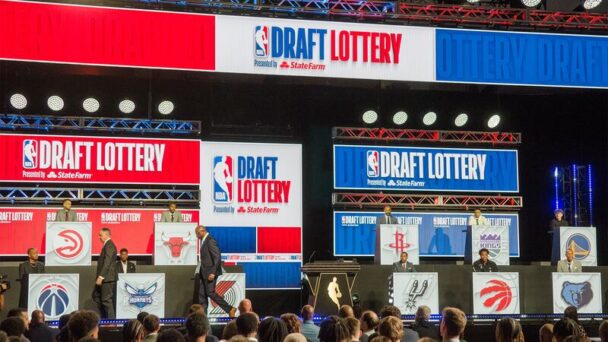
Since the NBA has a draft lottery, there’s still a level of uncertainty around whether or not teams will get a top pick. But, since a worse record gives a team a higher likelihood at the top pick, teams are incentivized to lose as much as possible once they know they aren’t making the postseason in an effort to increase their probability of hitting it big when April rolls around. This leads not only to players checking out past the halfway point of the season, but it minimizes fan engagement with teams. If a fan knows their team is going to try to lose, there’s no point in wanting to see them succeed. That’s not how sports should be.
It’s not just a basketball issue, but it seems to be most prevalent on the hardwood. So what can be done to prevent teams from doing this year over year? Women’s hockey may have the antidote.
The Professional Women’s Hockey League (PWHL) may only be three years into existence, but it’s revolutionized the draft lottery process. Their draft system goes by the “Gold Plan,” named for its creator, statistician Adam Gold, which presents a compelling way for teams to continue to compete even after being mathematically eliminated from the playoffs.
Here’s how it works: Once a team is statistically eliminated from playoff contention, they enter a new “competition” where they can earn points based on wins. In the PWHL, they “award three points for a regulation win, two points for an overtime or shootout win, one point for an overtime or shootout loss, and zero points for a regulation loss.” The team that earns the most points under the Gold Plan by the end of the season is awarded the first overall pick, and the teams that follow get the second, third, fourth, and so on.
Even though teams are eliminated, they still have to compete and win to get the top pick. It incentivizes players to compete for the sake of their team’s future success, even when they aren’t striving for the playoffs.
While there would be certain teams that would be in contention more than others, the amount of time they would spend would be conducive to how poorly they competed over the course of the season. For example, say the Sacramento Kings (who are currently last in the Western Conference) were the first team eliminated from playoff contention and had 20 more games to play. Because they were the first team out, they have the longest period of time to accrue points towards the draft.
At the same time, if the Memphis Grizzlies (currently 11th in the West) were mathematically eliminated with two games to go, they would get less time to earn points because they were closer to competing for a playoff spot. The system simultaneously gives ample time for the worst teams to earn their way towards a strong slot while not skewing the top picks towards the teams who compete for a while before being eliminated from postseason eligibility.
While the PWHL, consisting of eight teams, has shown how this works for smaller leagues, it would work equally well—if not better—in a league like the 30-team NBA. The rules would change slightly; for example, there would probably be fewer specifications for overtime games. But even as simple of a system as one point towards the Gold Plan for every win after you are eliminated from playoff contention could get players back into competition mode even when it’s not going towards the postseason.
The plan also gives teams who consistently find themselves in a rebuild an opportunity to play meaningful games where they’d be trying to win, not to lose. In years past, we’ve seen teams go through mass exoduses of their talent in an effort to tank for a couple of years and come back stronger to compete for championships.
Personally, I grew up a Philadelphia 76ers fan, so I was thrust into basketball fandom as Philadelphia began to experience “The Process” under Sam Hinkie. While I loved watching Tony Wroten and Hollis Thompson lace up every night for the red, white, and blue, my childlike joy for watching abysmal hoops was not shared by the rest of Sixers fans.
Athletes want to win. They want to succeed at the highest level, and tanking for the future year takes that away from the world’s greatest players. Basketball fans young and old want to see their teams win, too. We all initially hope that our favorite team’s actions lead towards championships, and while we can accept a bad season as a rebuilding year, some of us can only take it so long. Philly fans like myself were relieved when the team finally made the playoffs in 2018 after a five-year drought including a repugnant 10–72 record in 2015–16.
A change in the draft lottery process would get players on teams good and bad alike to compete during the NBA’s least popular period of the season (post-All-Star break to the end of the regular season in April) and drive up ratings for the NBA overall. The league experienced a 2% drop in ratings last season, as it looks to rebound from a slight decline since 2020.
While the ratings are back up this year with the new NBA on NBC and Amazon Prime packages, getting viewership up during the latter months of the season could significantly help the league as it prepares for the future. Getting players and fans invested late in the season, whether they are 1st or 15th in the conference standings can help revitalize the league and its popularity among the biggest sports.
Max Forstein can be reached at mforstein@wesleyan.edu.


Leave a Reply