

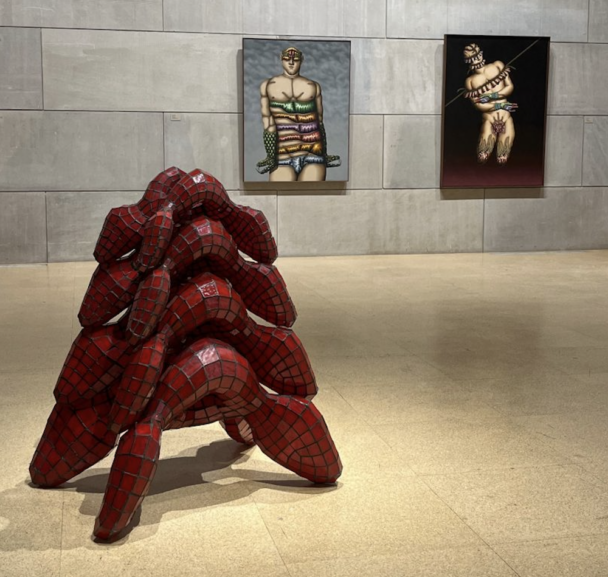
When walking into the Ezra and Cecile Zilkha Gallery in the Center for the Arts (CFA) to view the “Robert Lostutter and Kristi Cavataro” exhibit, I was struck by the juxtaposition between the figural paintings on the walls and the geometric freestanding sculptures that accompany them.
As I walked along the periphery of the gallery, I found the imaginative qualities of Lostutter’s paintings equally captivating. Each painting seemed to rethink the present world while combining the human form with animal features.
This duality frames the viewership experience, making the onlooker question the connection between Lostutter’s works and Cavataro’s geometric and systematic sculptures.
In an interview with The Argus, Visiting Professor of Art and Associate Director & Curator of Visual Art Ben Chaffee ’00 discussed the choice to pair these artists’ works together and his overall curatorial process.
The experience of seeing an exhibition in the Zilkha Gallery is far different than that seeing one in the University’s other primary gallery space, Goldrach Gallery in Pruzan Art Center. Zilkha’s large windows, which fill one of the gallery’s walls, let in a breath of natural light. When asked about the process for curating an exhibit with two artists placed side by side, Chaffee described his decision to design the exhibit in a more traditional model, one that is typical when creating a sculpture and painting show.
“I feel like there’s three things that kind of call out to me to be addressed in the space with every exhibition,” Chaffee said. “One is the verticality of the space, its monumental vertical volume. The other is the horizontal, like the horizontal line across the space. That’s often just addressed by putting pictures on the wall right there in the line. The other is the floor, because I think activating the floor is really important for the viewer to feel like they’re also in the same space as the artwork. And I think there’s still something a little radical about that.”
This idea translated within the exhibition space, especially when it came to Cavataro’s freestanding sculptures. Unlike the paintings on the wall, which often feel in an untouchable and remote place from the viewer, Cavataro’s sculptures are in the physical space of the viewer, on the exhibition’s floor. One’s view of each stained glass sculpture changes by walking around them and seeing them from different angles. The sculptures’ appearances also respond to the natural light outside.
Chaffee described how his process in designing this exhibit started with his interest in the work of Lostutter, an artist he had worked for and been a fan of for years. Lostutter’s work in this exhibition spans his early work from the 1960s and early 1970s to his more contemporary works from 2023. One is able to see the progression and changes in Lostutter’s techniques, color, palette, and materials, as his works on the white walls in the gallery are arranged chronologically, from the most recent works in his series “Songs of War” to his earlier works.
However, the space created some limitations as all the smaller watercolors and drawings were placed on the white chi rock walls, with the correct chronology only present on the rock walls. Keeping these limitations in mind, the exhibit still gives the viewer a chance to analyze the evolution of Lostutter’s work and to see how the passage of time has led his works to evolve both in formal properties and subject matter.
When asked how Lostutter’s work changed over the years, Chaffee described how Lostutter shifted from using watercolor as the basis for his oil paintings to using watercolor as the central medium for his finished works. Furthermore, in his more recent works, his color palette and scale have changed, as has the setting in which the figures are positioned.
“The adornments of the figures change over time, from a kind of like interest in contorting the body and contorting the female figures in the earlier work [to being] only male in the later work,” Chaffee said. “[The earlier works have an interest in] contorting the subject’s body into different restricted positions, whereas later, it’s more about adorning the figure with elements from the natural world to a non-human world.”
Therefore, the mixture of feelings I had about the juxtaposition between a world of reimagination and one of violence comes from the increasingly contorted bodies in his compositions. Whether or not one sees such bodily positions as aggressive or hopeful is up to the viewer, but Lostutter’s work forces one to confront this question for themself.
However, that was not the only question I was left asking. I still wondered what the reason was for putting Lostutter’s work, which pictures an anthropomorphic human form, even if distorted, in conversation with the work of Cavataro?
When Chaffee was asked this question, he responded by saying that he wanted to pair the work of Lostutter with a younger artist, and Cavataro fit this description.
A Connecticut native born in 1992 and a graduate from The Cooper Union for the Advancement of Science and Art with a Bachelor of Fine Arts in 2015, Cavataro’s work is grounded in a systematic language of her own. In her artist talk on Tuesday, Feb. 10, she talked about her sculpting process and how her artistic practice changed over time.
“The parameters for which I thought to define the sculpture was that it needed to be free standing and that it needed to be warm, have some warmth to it, and probably not be figurative because then the viewer would start comparing the sculpture to the figures in the paintings,” Chaffee said. “So actually [the choice was] led more, maybe, by contrast than similarity.”
Cavataro’s earlier works were focused on rearranging geometric forms, such as cylinders or cubes, into different configurations. In each of her works, there is a focus on multiples, where geometric forms are repeated in different orientations. Each part of her sculpture is made in fragmental chunks, which she then puts together in different ways, allowing the viewer to notice similarities in her works.
Even as her works transitioned and left the more systematic world of geometry, she remained interested in multiples. She described how the shapes became more ambiguous, which one can see in the sculptures in the exhibit. When examining the pieces, I was left pondering what exactly they represented.
The real heart of this exhibit comes from the questions it leaves unanswered for the viewer. When walking through the gallery space between the sculptures and the paintings, one attempts to draw connections between the two works and their themes. There is no clear or correct answer given to you, and that is what makes it so captivating.
Chaffee himself even expanded on this. “I think that something else is happening in the space,” he said. “I trusted that something else would happen in the space once their works were there together, and I think that’s true, and I’m not sure I can yet articulate what that is.”
Amelia Haas can be reached at ahaas01@wesleyan.edu.
Leave a Reply