
Player of the Week: Sam Pohlman ’26 Talks Betting on Himself, Torching Trinity, and Life Lessons Through Basketball
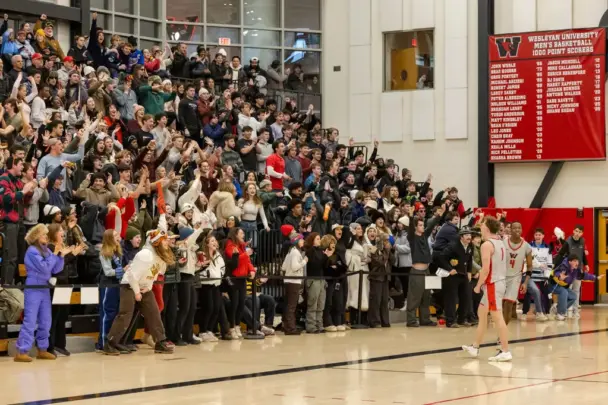
Sam Pohlman ’26 is a guard and captain for the Wesleyan men’s basketball team. Pohlman has led the team to a 17–5 record and 7–1 in-conference, good for the top spot in the NESCAC. The 6’2” guard has been a key contributor throughout his college career, but has made a massive leap in his production this year, playing 30 minutes a game and averaging 13 points, 6 rebounds, and 6 assists. His six dimes a game leads the NESCAC by a mile, with the next highest mark at 3.9.
On Saturday Jan. 24, Pohlman went off, putting up 20 first-half points against the No. 1–ranked Trinity Bantams, leading the team to a 64–62 win and silencing the familiar foe. With his performance, Pohlman earned the NESCAC Player of the Week award.
Pohlman is playing as well as anyone in the NESCAC, but it has not been a straight-line journey for him to get here. The Argus recently sat down with Pohlman to discuss his rollercoaster journey through basketball, the lessons and mentality he has learned as a result, and his recent success captaining the best team in the ’CAC.
The Argus: Is there a moment or memory that you think of as the time when you fell in love with the sport?
Sam Pohlman: I played in this league on the weekends in Teaneck, N.J. and the all-star team was me, these guys like Kyle Filipowski in the NBA now, Elliot Cadeau, starting point guard on Michigan, and Tahaad Pettiford, starting point guard on Auburn. And I would kill in that league. I was knocking down shots, and I was like, “I’m pretty good. I should stick with this.” Guys around the country started knowing who I was, and that gave me the confidence to keep doing it, even though I was not the biggest and not the most skilled at the time.
A: Who did you grow up trying to emulate on the court?
SP: Ty Jerome. He is the sixth man on the Grizzlies, and he was the backup point guard on the Cavs last year, finishing second in Sixth Man of the Year voting. His dad, Mark Jerome, was like an uncle to me. He was the director of the Riverside Hawks program and my high school coach. And I just wanted to play like Ty, who was really cerebral, an incredible passer, a gifted scorer, and really played at his own pace.
A: When did you decide to pursue basketball further than high school?
SP: My freshman year, we were one of the best teams in New York Class A. I wasn’t really getting recruited, but I was still playing some big Amateur Athletic Union tournaments. Then in my junior year, I was the captain of my team and led us to the Final Four of the New York playoffs. I was the best player on that team, and I knew that we were that good. I was like, “I think I’m one of the best players in New York City.” I was getting recruited by some of the high-academic Division III schools, but I knew that I was a little bit better than that, so I took a huge risk, and I re-classed and transferred to a boarding school in Pennsylvania called Perkiomen School.
A: What was the impetus for that risky decision?
SP: I was thinking about some New England Preparatory School Athletic Council schools, but no coach wanted to pull the trigger. And then this guy named Thomas Baudinet, out of some random school in Pennsylvania, texted me. They were choosing between me and this guy named Braden Smith, who is on Purdue right now. Braden Smith is a little bit better than me right now, but he wound up staying in Indiana, so they needed a point guard. I had no idea what the school was, and my parents did not want me to leave New York City. Perkiomen was not a very high-academic school, but Baudinet was one of the most persuasive people I had ever met. And I was like, “You know what? Fuck it. If there’s not going to be any school in New York City, I might as well go to Pennsylvania.” And when I went there, I lucked into joining one of the best programs in the country. He was probably the best high school coach in the entire country. My senior year roommate started 45 games in the NBA last year. As for my other roommates, one might win SEC Player of the Year this year, and the other won Ivy League Player of the Year last year. We had probably a top-10 High School roster ever, and I was the captain of the team and I played the most minutes.
A: What made Wesleyan the right place for you to continue your career?
SP: Head Coach Joe Reilly came all the way from Connecticut down to southern Pennsylvania just to watch me do a workout. We spoke for a little, he said, “Sam, I really want you to come.” He came to all my games that were in the Northeast. He came to watch us when we played against Montverde and Brewster Academy. They had all these guys in the NBA, like Matas Buzelis. I was playing really well in those games. And I didn’t necessarily think that I would wind up at Wesleyan, but thank God I did, because what we have at Wesleyan is probably one of the most first-class experiences a college basketball player can possibly have because of Coach Reilly.
A: Your first year, there was a large senior core. How did the upperclassmen welcome you into the program, and what did you learn from them?
SP: I had a very interesting first year. I was a little under-recruited by the D-I schools. So coming to Wesleyan, I thought, “This is going to be really good. I’m just gonna kill this and enjoy this.” That’s what happened in the beginning. I was starting as a first-year and had a stat line of, like, 16/7/5 against a top-three team in the country in my second college game ever. And I was like, “I’m that guy.” And then I got really, really sick. I was bummed out, not healthy, and my first year got derailed. That spring, I got really tight with Preston Maccoux ’23, Gabe Millstein ’23, Leo Clibanoff ’23, who is now the assistant coach at Vassar College. Steven Johnson ’23 MA ’24, Shackylle Dezonie ’23, and Gabe Ravetz ’23 were also great. We hung out with them almost every single day, and that really brought me into the Wesleyan ecosystem. That’s when I really fell in love with the school.
A: This year, you’ve taken on a role as a leader. How has that transition felt, and what can you attribute your success to?
SP: I think it’s all about care. The best thing that I bring to the table is how much I care about the people around me in whatever I’m doing, no matter how little or big the task is. And if you show the other people around you that’s how you feel about something, you’re going to get people to start feeling the same way. It was not really translating as much in the beginning of the year, but the way that all 17 guys have come together in the last few weeks has been insane. I am so proud of the product that we are putting together, the way that we are uplifting each other, the way that we root for each other’s success. And people sometimes will be like, “it’s just a practice,” or “it’s just a game,” or “it’s just basketball,” but at the end of the day, this is our life.
A: Going into this season, what were your personal goals and the team’s goals?
SP: In my opinion, we had the two best players in the country last year in Shane Regan ’25 and Nicky Johnson ’25 and elite senior class for leadership from also Jacob Pofsky ’25, Philip Park ’25, and Jared Langs ’25, with the level of consistency that they had every single day, and the care that they had for the team. This year, I knew that we had dogs and the potential to be just as good. We did get dinged a little bit early on, and I do think that that really helped us team-wise, because now we’re coming together at the right time. Individually, I’ve played a lot here, and I’ve always been a big part of the team, other than that part of my first year. But I always felt like I was one of, if not the best player of my class in the NESCAC, and I have had a pretty big chip on my shoulder this season. I think I’ve been playing as good as anyone in the league.
A: Your passing has exploded this year, and you’re leading the NESCAC in assists. How has your court vision developed over the years, and what does the chemistry of the team contribute to that cohesive playstyle?
SP: We have really dynamic guys off the ball, and we have great cutters. So that’s where the assist comes from. I can make the pass, but it’s about who’s scoring. And then the court vision I really attribute to Mark and Ty Jerome. I guess the third thing is, I’ve always played with great players. A lot of guys come into college, and they were the best player on their team by a mile, but not me. My senior year, I was starting point guard and captain, but the shooting guard was Xaivian Lee who’s now at Florida, the small forward was Ryan Dunn who plays on the Phoenix Suns, the power forward was Thomas Haugh who might win Southeastern Conference Player of the Year, and our center was Daouda Dembele who was the best player on a team that just made the Elite Eight last year in Division II. So I always had a pass-first mentality, because I was playing with dudes who were literally some of the best players in the entire country.
A: Against Trinity, you went off dropping 20 in the first half, and for your play, you earned NESCAC Player of the Week. How does it feel to get that kind of recognition for your play?
SP: I just wanted to set the tone, and I think I did a good job of that. I didn’t expect to explode like that, but it was very gratifying to come out and have that type of game. I looked up, and we had 20 points, and I think I had 18, and I was like, “Holy shit, this is crazy. I gotta keep going.” Jaalan Watson ’29 is as talented as any first-year I’ve seen at putting the ball in the basket, so thank God he came in. But then Trinity started denying me full court, and I was like, “This is like public high school back in the day. I have not gotten this treatment in a while.” But it felt really good, probably one of the best moments I’ve had in my basketball career.
A: What does this team have to do to close out the regular season well and continue having success into the playoffs?
SP: We just have to stick to why we’ve been so good, and that’s defense. Conn. College was the first game that we got away from that and made it more of a bucket-for-bucket scoring battle. That is not how we want to play. We want to get stops, we want to hold teams under 70, and then we know we’ll win. So it’s taking it one day at a time. We were way too focused on the end of the season in the beginning of the year, and that’s why we got dinged a couple of times. Now we have a really good next-game mentality going into this final portion of the year.
A: Finally, if you could give a piece of advice to your first-year self, what would it be?
SP: The best thing that I’ve learned this year is that experience and wisdom actually matter, and can’t be taught. No matter how much I thought I knew playing at the highest level of high school basketball coming into this school—and this is not just basketball, this is life—no matter how much you think you know, the knowledge that you will gain through experience that comes over time is irreplaceable. I feel a different level of control and calmness in the feel that I have for the game now than I could have ever had in the last four or five years of my career. And that just comes from the basketball that I’ve seen and the basketball that I’ve played over the years. The best things take time.
This interview has been edited for length and clarity.
Ethan Lee can be reached at ejlee@wesleyan.edu.
Leave a Reply