
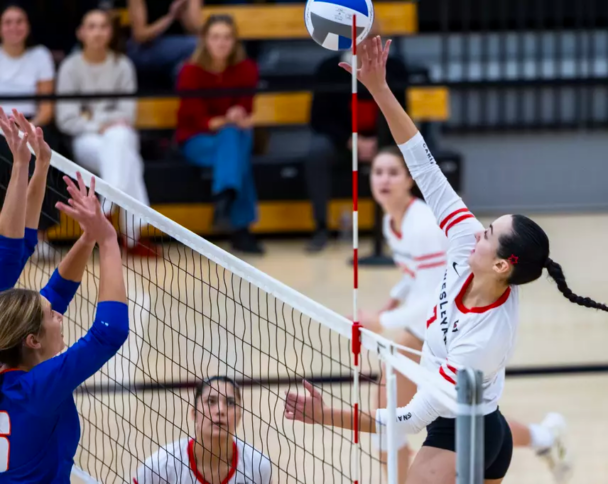
Volleyball Caps Off Successful 22–4 Season with Sweet Sixteen Run in NCAA Play
After a red-hot 12–1 start, the Wesleyan volleyball team was staring down the rest of its NESCAC regular season with championship goals in mind.
The quest continued with their final two road games of the regular season against Hamilton and Amherst. On Friday, Oct. 10, the Red and Black made quick work of the Continentals, with two of three sets won by seven or more points.
Amherst proved to be a harder challenge. The game started similarly to Hamilton, with the Cards taking the first set. However, the second set went past 25, with the Red and Black coming back down 20–24 to take it 31–29. The third was tight as well, but a late Wes push gave them the win and their second consecutive clean sheet weekend.
As the wins piled up, Sophia Lindus ’26 said the Cardinals began to feel the shift in how they were perceived.
“[Head Coach] Ben [Somera] always says you’re either the hunted or hunter,” Lindus said. “In the beginning of the season, we started as the hunter, coming off of this really weird season. And then as we started to stack wins, we became the hunted, and it’s fun because people really want to beat you, and when you then beat them, especially if it’s close like Amherst, it feels even better.”
The next weekend, Wes played host to Williams and Middlebury, with a chance to win the Little Three and extend their league-leading record over the ’CAC. The Red and Black made mincemeat of the Ephs, with their purple and yellow rivals only leading for one total point of the entire match. An easy 3–0 victory awarded the Cards their fourth straight Little Three title and their seventh in the last eight years.
While Middlebury was a closer opponent, the Cardinals still maintained the upper hand in all sets, capitalizing on strong runs throughout the match. In the first set, with the score at 13 apiece, Wes went on a 9–1 run to take advantage. The second match saw the Red and Black jump out to a 7–1 lead early and contain the Panthers’ late-game comeback attempt. In the third, they found themselves down 18–16, but they won 9 of the last 12 points—including 8 straight to start—and captured the victory. Sophia Lindus’ 31-kill performance over the course of the two matches earned her NESCAC Player of the Week for the third time in her career.
Siena Steines ’28 noted that playing alongside Lindus has shaped her development more than anything.
“Sophia has shaped me as a volleyball player so much,” Steines said. “She’s so fun to watch, and she just takes control of the court. There’s somebody there that can bail you out and will also be there to hold you accountable. Seeing how she takes charge, it’s something I want to embody going into next season.”
On the weekend of Oct. 24–25, the Red and Black played two non-conference home matches against Smith College and the United States Coast Guard Academy. Both matches unfolded similarly, with the Cards taking care of business in the first two sets and then winning close 25–23 sets to wrap up the sweep. With the two wins over the weekend, Wes completed their 8th-straight sweep, 10th-straight win, and 25th-straight set win.
The final weekend of the regular season featured a Halloween match against Tufts and a Saturday, Nov. 1 battle with Bates. The Cardinals and the Jumbos went to war in a five-match thriller, with every set being decided by no more than four points. Tufts seized the first one 25–22, never letting the Red and Black take the lead throughout the entire set. Wes fought back, taking back-to-back sets by an identical score of 25–21. On the verge of winning the high-stakes match, the Cardinals captured the lead at 19–17, but lost 8 of the last 11 points as Tufts forced a fifth set.
NESCAC rules indicate that a fifth set goes to 15 points, win by two. The two evenly-matched rivals went back and forth with the lead, with neither team taking more than a two-point lead until the final point of the match. While the Cards began the final set with the upper hand, a change of fate late put the Jumbos in front, and they came up with the shots down the stretch, earning a 15–12 set and 3–2 match victory. Tufts handed Wes its first NESCAC loss since last year’s NESCAC playoff semifinals 350 days ago.
Elliana Moreno ’27 spoke on the difficulty of playing their first five-setter after eight straight sweeps.
“Since we did have that eight [match] run, the five setter is hard because it’s unpredictable,” Moreno said. “Whoever starts off really strong ultimately wins. Unfortunately, we didn’t really get there. But I remember after that game, we were all just so exhausted. I think just the stamina and the mental state of finishing the game that really got us.”
The Red and Black had no time to recuperate from the loss, as the Bates Bobcats came to town fighting for a chance to make the NESCAC playoffs. This was a similarly close match to the night prior, with the first four sets all being decided by five points or less. The first two sets were all Wes, as they held off a late comeback in the first and maintained control of the second to take a 2–0 lead. In the third, though, the Bobcats punched back, going on multiple four-point runs to take it, 25–20. The fourth was the most animated of the sets, as each team went on runs early but found themselves on the see-saw late. As the match pushed past 25 points each, it was Bates who ran away with it, winning the set 29–27 and forcing a fifth set.
After seeing their lead evaporate, the Cardinals made sure to make their presence known in the fifth. They jumped out to a 7–1 lead and never looked back, winning the final set 15–8 and completing their closest win of the season. With the win, they clinched the #1 seed for the NESCAC playoffs, topping the conference with a 9–1 record (19–2 overall). However, the Bobcats were not going away either, as they finished the regular season with the #8 seed, meaning the two teams would square off once again at Silloway Gymnasium the next weekend.
“[Bates] are such a different team that we’ve seen,” Moreno said. “Making adjustments in the middle of the game when we played them the first time really helped us win. Our coach implemented a new defense, where we should be standing, and that strategically really helped us.”
The Cards pounced early, taking the first set 25–15. Wes hit .292 while holding Bates to a negative hitting percentage. The second set swung back and forth before the Bobcats edged it out 26–24. Wesleyan responded with a 25–20 third set behind five kills from Mila Chan ’28, who finished with a career-best .467 hitting percentage and just 1 error to 15 kills. Determined to avoid a third straight five-setter, the Cards ripped off 17 of the final 19 points in the 4th set to seal a 3–1 victory. Steines, Chan, and Lindus combined for 16 kills down the stretch, punching Wesleyan’s ticket to a home semifinal the following weekend.
Looking for revenge against the Jumbos, the Cards came out firing, dominating the first set. Bookend bursts of 8 of the first 10 points and 6 straight to close the frame set the tone early. The Jumbos’ offense woke up in the ensuing sets, recording 17 kills in each and pushing themselves within one set of the finals. The Cards didn’t go quietly, but the Tufts attack—featuring three players with double-digit kills—proved too much, with Tufts taking the fourth set 25–22 and ending Wesleyan’s NESCAC run in the semifinals for the second straight year.
A 20–3 season up to this point was certainly impressive, but the Jumbos’ loss looked like it would keep the Cardinals from hosting regional round action. On Sunday, the team received surprising news that they would host the regional round despite being ranked behind Colby and Ithaca College in their pod.
For the third postseason match in a row, the Cards were dealt a regular-season rematch—this time with New York University. While they couldn’t quite replicate October’s 25–4 opening-set rout, they still controlled the first set, winning 25–14. The Violets answered in the second by the same score, with their offense surging as five players recorded 2+ kills. Wesleyan responded with another 25–14 win in the third before closing the match with a 25–15 fourth set. It was a true team effort: Three Cards reached double-digit kills, three posted double-digit digs, and Ali Landa ’26 and Alexa Schnell ’29 each dished out 17 assists.
Less than 24 hours later, the Cards were back on Silloway to face the No. 12 Ithaca Bombers in what became one of the best matches of the season. The Bombers were led by Liberty League Player of the Year Wesley Slavin, who was averaging an absurd 10.5 assists per set. Despite a late push from the Cards, Slavin and company took the first set 25–23. Wesleyan answered with a wire-to-wire win in the second, with Chan delivering four of the team’s final six points. The Red and Black carried that momentum into the third, racing out to an 8–1 lead and never giving it back.
The fourth set turned into an instant classic. A string of Wesleyan errors handed Ithaca a 13–7 lead, but the Cards hung around and finally made their push at 22–18, tying the set behind back-to-back Moreno aces. The teams traded kills before a Schnell ace gave Wesleyan match point. Ithaca answered, winning the next rally, but a service error knotted the score at 25. With no timeouts left on either side, the final eight points were pure tension. The Bombers survived two more match points and ultimately escaped 30–28 to force yet another fifth set on Silloway.
In the fifth, Ithaca edged ahead 3–2, but what followed felt like a summary of Lindus’s entire tenure at Wesleyan. She simply took over, hammering four kills across the next six points, all of them going to the Cards. The Bombers pushed back to make it 11–9, yet Chan answered with two huge swings and Lindus closed the door with two more. The Cards claimed the set, the match, and a spot in the Sweet Sixteen.
It took the entire team to pull out this 225-point marathon, but Chan, Moreno, and Lindus were the standouts. Moreno, fresh off her NESCAC Defensive Player of the Year honor, finished with 24 digs, 5 assists, and 3 aces, throwing herself to the floor time after time. Chan, the biggest offseason pickup for the Cards, posted a season-high 24.5 points. And Lindus, in what may be the signature match of her career, exploded for 26 kills, a program tournament record, along with a personal-best 22 digs.
Lindus reflected on the physical toll the marathon against Ithaca took on her.
“The physicality of five sets when you’re jumping the entire time and making these quick movements and jerks, it really does hurt, and the next morning it was so bad, like, I could barely walk down the stairs,” she said. “But luckily, our trainers are always there for us, giving us a treatment when we need it.”
After the marathon against Ithaca, they could only rest for so long, as less than 20 hours later, they were back on the court competing against no. 7 Colby.
If the Cards were exhausted, they masked it well, storming out to take the first two sets and putting themselves one set from the Elite Eight. Colby gifted Wesleyan opportunities with 10 errors in each of the opening sets and 10 more in the third, but the Cards mustered only eight kills and couldn’t close the door. The fourth set turned into an offensive showcase: Wesleyan hammered 16 kills (11 from the Lindus-Chan duo) but the Mules matched the firepower, with five players recording at least three kills to win 25–22. That set up the Cards’ third fifth set in five matches, but the tank finally ran dry, and the Mules overwhelmed them 15–7 to end Wesleyan’s season.
The Cardinals ended the season 22–4, their sixth 20-win season in eight years. It was also the program’s third Sweet Sixteen appearance in five years. Even with the sting of the last loss, the Cards walked away knowing the foundation for next year is already in place.
“The upperclassmen next year, we’ve seen two very different versions of Wes volleyball, and luckily almost our entire team’s returning,” Steines said. “Only two seniors, two very important seniors, but we have a lot of firepower. We know what it takes to have a successful season.”
Max Forstein can be reached at mforstein@wesleyan.edu.
Sam Weitzman-Kurker can be reached at sweitzmankur@wesleyan.edu.



Leave a Reply