
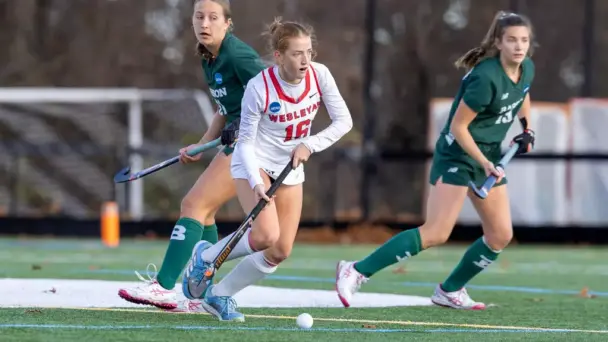
Field Hockey Finishes NESCAC Runners-Up, Makes Elite Eight in Historic Season
Playing in the most competitive Division III conference, Wesleyan field hockey has spent years trying to crack the NESCAC’s upper tier. Before the hiring of Head Coach Christine Kemp in 2019, they had only won two NESCAC playoff games and had never made the NCAA Tournament; the program was at a low point, having gone 5–35 in NESCAC play over the past five seasons. The first three years of Kemp’s tenure were up-and-down, but in 2023, they earned a program-defining 2–1 overtime win over No. 5 nationally ranked Tufts, and finished .500 in NESCAC play for the first time since 2010. 2024 saw more improvement with the squad going 12–6 overall: their most wins since 2000.
It looked like the 2025 campaign might be a lost year as the Red and Black lost their first three NESCAC games by a combined 9–2. But a few key tweaks—slotting Kiernan McColgan ’26 and Leila Feldman ’28 into the full-time starting lineup and shifting from man-marking to a zonal defensive scheme—completely changed their trajectory. Wesleyan ripped off eight straight wins to finish the regular season, allowing just five goals with a tightened defensive unit and standout keeper Audrey Pace ’26. Seven of those wins came against NESCAC opponents, including their first win at Amherst since 2005, second-ever win at Williams, first-ever road win against the seven-time defending champion Middlebury, and a four-goal onslaught versus No. 8 Bowdoin. The last two regular-season games featured the Cards outscoring Colby and Conn. College 10–2 with Feldman becoming just the third Cardinal in the last 13 years to record a hat trick. These wins ensured Wesleyan would host a NESCAC playoff game for only the second time in program history.
McColgan reflected on the arc of their four years.
“When we committed, we all bought into a program that was struggling,” McColgan said. “We went 4–11 our freshman year, but even then, we all knew things would turn around. In a way, this season was a microcosm of our entire four years, and made the commitment that much more validating for us.”
As the calendar turned to November, the Red and Black found themselves in an all too familiar position: facing off against Williams in the postseason. The Ephs had ended the Cardinals’ season each of the past two seasons. Wesleyan had also beaten Williams in October, which meant the pressure was now on them to do it again.
The Cardinals came out flying and broke through in the 11th minute off a beautifully designed play. On a penalty corner, Georgia Adams ’26 inserted it to Emily Smith ’29, who took two touches, then slipped one over to Brooke Miner ’28. Miner stepped into it and fired the ball towards the left post, where Meera Patel ’29 was waiting to redirect it into the goal and put the Cardinals up 1–0. This was the score at halftime as the defense turned in its best statistical half of the season, not surrendering a single shot or penalty corner.
The game stayed there through the third quarter, but the Cardinals found breathing room in the fourth on another penalty corner, off the stick of none other than Adams, who recently became the third member of Wesleyan’s 100-point club.
Adams spoke about the emphasis the team placed on penalty corners throughout the season.
“Coach Kemp always says, there’s not a lot of time for improvement as players once the season gets underway,” Adams said. “We are the team we are, but the one thing you can change is your penalty corner plays. So we worked really hard throughout the season on being very adaptable. We would learn new plays based on the team we were playing. Williams was a great example of us executing a play exactly how it’s supposed to go.”
While Williams added a late goal, the Cards were able to run the clock out in the last three minutes and earn their first NESCAC playoff win in 20 years.
Next up was the NESCAC no. 1 seed (and no. 3 seed nationally) Tufts Jumbos. Tufts thumped Wesleyan 4–1 on Saturday, Sept. 27, and six weeks later, neither team had lost since then.
Offense was scarce on both sides in the first quarter, but the Cards broke the game open six minutes into the second. Adams inserted the ball to the top of the arc, where Miner stopped it, and Sydney Cameron ’26 faked a pass, opening a lane for Feldman to step up and fire. Her shot deflected off a Jumbo stick, clanged off the crossbar, and dropped into the back of the net. It would have been a bad time to take a bathroom break, as the Cardinals extended their lead two minutes later. Patel weaved through a swarm of Tufts defenders and slipped a pass to Feldman, who redirected it into the net to make it 2–0.
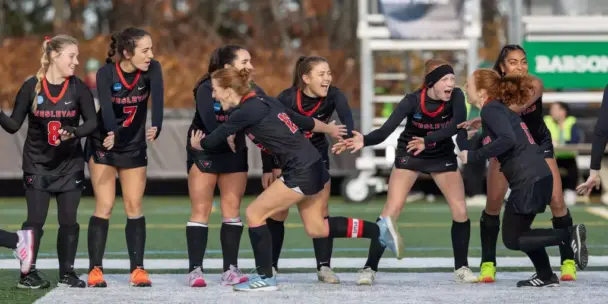
The third quarter was tightly contested, with neither team finding a goal. Tufts controlled much of the fourth, earning four penalty corners, but the Cardinals’ defense held strong, allowing only one shot on goal, which Pace turned away with ease. With 450 in attendance, the Cardinals earned their biggest win in program history. Along with their October defeat of Middlebury, it was their second top-five road victory of the season. Most importantly, it sent Wesleyan to their first-ever NESCAC championship game, where they would face Bates the following day.
Bates struck early, this time in the eighth minute off the stick of Brooke Moloney-Kolenberg. The Bobcats added another goal before halftime, putting the Red and Black in only their second two-goal hole of the year. Wesleyan’s offense responded with relentless pressure in the second half, dominating possession and outshooting the Bobcats 17–0. The Cardinals also generated eight penalty corners, but the Bates back line was unbreakable, turning away every chance and keeping the Cards off the board. Bates went on to win 2–0, capturing their first-ever NESCAC championship and becoming the first team in conference tournament history to record three shutouts in a single postseason.
Feldman spoke on the frustrations the offense faced.
“For two weeks, everything went right, and then against Bates, we couldn’t score,” Feldman said. “The Bates defense was unparalleled. They were such good tacklers and just so disciplined, and then their goalie was fantastic. But not being able to get good shots gets very frustrating, and we realize that in order to score, we can’t just do what we’ve been doing, and we have to get more creative than just trying our same old moves. So we learned a lot, and that was something that really helped us going into NCAAs.”
The Cards found solace in this loss in the following days as they earned the no. 7 seed for the NCAA D-III Tournament and cleaned up in the NESCAC awards. Smith became the first Cardinal ever to win a major award, taking home Rookie of the Year. She was joined on the first team by Pace and Adams, both of their second-career first-team appearances. The sophomore pair of Natalie Shaw ’28 and Miner made the second team, giving Wesleyan a program record five All-NESCAC members.
Hosting an NCAA Tournament game for the second straight year, the Cards’ first-round matchup was against the Marywood University Pacers. The Cardinals’ offense couldn’t find a goal in the first quarter, but a day after winning Rookie of the Year, Smith provided the team with a spark, scoring less than a minute into the second quarter. The offense exploded in the rest of the contest, outshooting Marywood 39–0 en route to a dominant 7–0 victory. Six different Cardinals scored, with Kate Francini ’29 and Shaw scoring their first career goals. This win marked the Cards’ 10th straight win on Hicks Field, another program record.
Next up was a trip to Babson College for a Sweet Sixteen showdown with the Hamilton Continentals on Saturday, Nov. 15. Earlier in the season, the Cards had suffered a pair of early three-goal defeats; after avenging one of them against Tufts in the NESCAC semifinals, they now had a chance to do the same against the Continentals.
Wesleyan seized control early, dominating possession from the opening whistle. Ten minutes into the action, Smith weaved her way into the circle and swung a cross-circle pass to Feldman, who was waiting at the back post to flick it into the net. The Red and Black carried this momentum into the second quarter, drawing seven penalty corners and recording six shots on goal, but they were unable to extend their lead.
Coming out of halftime, they faced an energized Hamilton side that pushed numbers forward, but the Cards’ formidable midfield and back line denied any shots from reaching Pace, allowing her to post her 10th clean sheet of the season. Feldman’s early goal proved the difference, sending Wesleyan to the D-III Quarterfinals.
Adams spoke about the defense and how they carried over the lessons they learned from the Bates loss.
“We went down early against Bates, and that’s hard to come back from,” Adams said. “So our primary focus against Hamilton was coming out strong. And then the defense did such a good job of holding down the fort. They’re so communicative. I would hate to have to play them; they truly are one of a kind. To hold a team like Hamilton to those few shots and no goals was something that we were really proud of.”
The next day, Wesleyan faced the hosts and no. 3 overall seed Babson Beavers, their seventh top-10 opponent of the season. The Beavers entered Sunday 21–1, riding a 17-game win streak. To make matters more difficult for the Cards, they were on Babson’s home turf, which was field turf, a drastic and difficult switch from the AstroTurf the Cards are used to playing in the NESCAC.
“It’s like going from driving NASCAR on a paved track to gravel,” McColgan said. “And Babson has been doing that all year, so they’re accustomed to it”.
The matchup quickly settled into a defensive battle. Babson controlled the early stages and broke through three minutes into the second quarter on a penalty corner. From there, the Cards pushed back and controlled much of the remaining play, outshooting the Beavers 9–3 and earning two more penalty corners. Two of them came in the final minute, when Wesleyan generated a pair of quality looks but was ultimately turned away, falling 1–0.
“As a team we played, quite literally, until the very last second,” Adams said. “We left that game with no regrets on how we played, our mindset, our mentality, and how we prepared. If we played Babson 10 times, we’d win five of them. It just wasn’t our day, and that’s just the nature of the tournament.”
While a Final Four berth would have been sweet, the Cards closed out the 2025 campaign with the most wins, most shutouts, longest win streak, and fewest goals allowed in program history. They also claimed the Little Three title for the first time since 2003, finished as NESCAC runner-up for the first time, and earned their first NCAA Elite Eight appearance. They finished the season 16–5 overall and 10–4 against NESCAC opponents, earning seven top-25 wins and didn’t lose to an opponent that ended the year ranked outside the top 12.
The individual statistics were also notable. Feldman led the team with 13 goals and 28 points, while leading the NESCAC with seven game-winning goals, three more than anyone else. Patel led the NESCAC in assists, with Miner and Adams also finishing inside the top five. Shaw was a model of durability, playing 1,253 of 1,288 minutes (97%) and going unsubbed in the final 15 games. As the final line of defense, Pace finished second in the NESCAC with a .806 save percentage.
The 2025 field hockey team authored one of the most drastic rises in Wesleyan Athletics’ history. A program that had won just three playoff games in its 53-year existence won four in three weeks. The transformation the seniors spearheaded won’t leave with them. Eight of the 12 players who started more than 16 games are returning, and five of the six top point-getters were underclassmen. The 2025 squad didn’t walk away with a championship, but they claimed just about every other program milestone. More importantly, they created a culture where competing for championships is expected.
Sam Weitzman-Kurker can be reached at sweitzmankur@wesleyan.edu.


Leave a Reply