
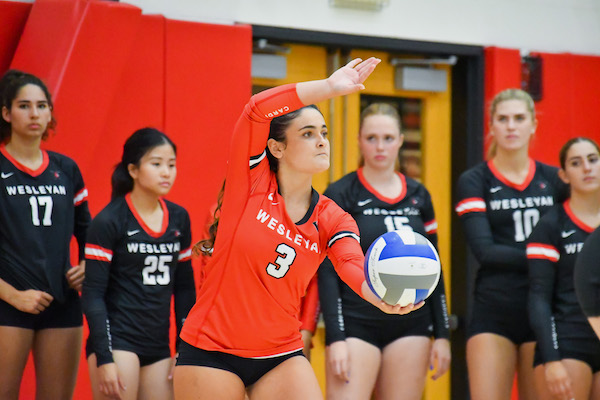
Player of the Week: Elliana Moreno ’27 Talks Catching Fire, Defensive Strength, and NESCAC Honor
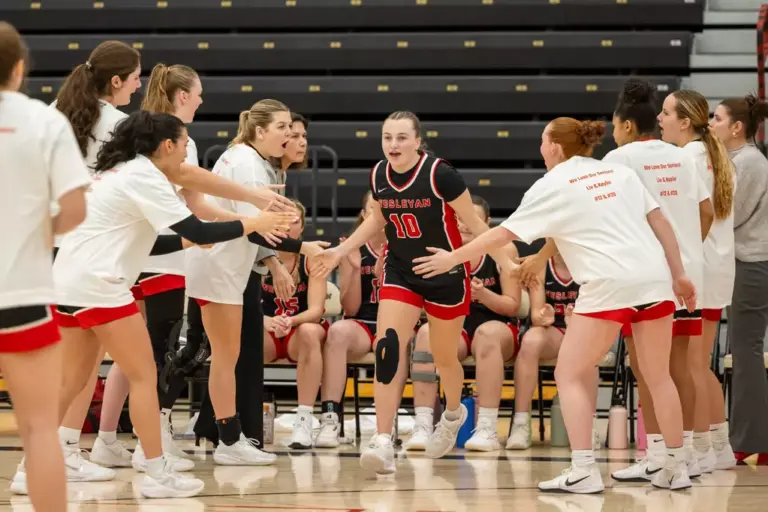
Elliana Moreno ’27 is an economics major and data analysis minor from Manhattan Beach, Calif. and a libero on the Wesleyan volleyball team. She and the Cardinals have caught fire to start the season, going 8–0 (2–0 in the NESCAC) while only dropping two sets across the matches.
Moreno has been a leader on the court for the Cards, being a defensive anchor in their close 3–1 win over Colby on Sept. 19 in front of a home crowd. The next day, she led the team in digs (21) and aces (4) on the Cards’ way to a 3–0 rout of Bowdoin. For her efforts, Moreno was named the NESCAC Player of the Week.
The Red and Black have their biggest test of the season today, when they take on No. 6 Johns Hopkins in Silloway Gymnasium at 7:00 p.m.
The Argus sat down with Moreno to discuss the Cards’ hot start, the recognition her play has garnered, and her winning mentality.
The Argus: When did you first start playing volleyball?
Elliana Moreno: I first started playing volleyball in fifth grade, around 11 or 12 years [ago] now. I just picked up a flyer at school that I saw and was like, “I want to try out for this.”
A: What was the recruiting process like, and how did you end up at Wesleyan?
EM: I played at a pretty competitive club: Sunshine Volleyball Club in [Los Angeles, Calif.]. Sophia Lindus [’26] actually committed here first at Wesleyan, and she played on club with me. I [learned] about D-III schools playing volleyball there. I knew I didn’t want to go D-I and I wanted to go high academic, and Wesleyan was actually the first school that reached out to me. I visited, I liked it, I knew Sophia, and I ended up here.
A: What is it like balancing the student-athlete experience at Wesleyan?
EM: I think just prioritizing any free time that I have, getting the busy work done early, and then if things get hard, I go to TA sessions or office hours with my teacher. [Knowing the weekends are busy], I also make a schedule…trying to get everything done by Thursday is usually what I’ll do.
A: Do you have any pre-match superstitions or traditions?
EM: Not really. I used to drink pre-workout and a lot of caffeine before my matches, but this year, I’ve really just been focusing on hydrating a lot. I like to go into the match focusing on what I’m gonna do in this game and being really relaxed and calm. Just play my heart out like I want to win every single point.
A: Last week you were named as NESCAC Player of the Week. What was your reaction when you heard you received the honor?
EM: It’s my first honor, so that was really exciting. I was on my couch when I saw it. One of my teammates sent it in our group chat, and I saw the picture. I was honestly just really excited, and the rest of the day I was just really ecstatic. I wasn’t expecting it, because a lot of times liberos don’t really get recognition. It’s usually hitters that make those big plays. So it was really exciting to just be a libero and get that recognition for my performance over the weekend.
A: I want to talk about the performances you had that led you to receive that honor. First, last Friday’s game against Colby. What made that match so close, especially the last set, which Wes won 30–28?
EM: Both teams didn’t make that many errors, which made it really difficult. Defense on both sides was really good. We struggled a lot in the beginning with our serve-receive, especially in the second set, which they demolished us in. Coming back from that, I remember taking my team aside, being like, “Okay, let’s just pick up the energy, pick up the focus, and serve, receive, and then bring that into the next set.” And that’s exactly what we did. And the execution was there.
A: Last Saturday, Wes cruised through Bowdoin, and you led the team in aces and digs. What was working for you in particular in that game, and how did that impact the team?
EM: It was hard, because obviously we were so excited having won the Colby game, but I was a little bit nervous before the [Bowdoin] game that we were just going to be super confident and not really work hard. But we had a really good talk in the beginning, being like, “Hey, we won. But that doesn’t mean anything. We still need to prove ourselves.” So we went into the match with that mentality, focusing on everything that we need to do. Our serve-receive was really good. Our execution was good. It felt like we were just playing at a way higher level than they were, and made it a lot easier.
A: Your team is 8–0 so far this year, with a very similar result pattern to when you won the NESCAC in your first year, 2023. How is this team similar to that year, and what has stood out on the court that has led to this much early success?
EM: [During my] freshman year, we had a lot of older girls. I was the only freshman who was on the court that year, and they all knew the system. Everyone knew how to play with each other. Last year, a lot of our freshmen played, but we got used to playing with each other. Having the returners come back and being able to play with each other is making us more of a collective. What’s really helped us this year is we have our outsides going six [rotations] for both. So our pipe attack is really nice to have, and we’re a lot more offensive this year than I would say, freshman year.
A: Do you have any volleyball inspirations or people you look up to?
EM: I like Laney Choboy at [the University of] Nebraska. I relate to [her] a lot because she’s a very defensive player, and she will go for anything. So I try to emulate that mentality when I play. But honestly, I have played with Sophia for around six years, and I always looked up to her because she’s a very consistent player. She was injured last season—the whole season—so having her back on the court has just felt very comfortable and relaxing, and I think that that has also just helped me perform.
A: What is an element of volleyball that the average fan wouldn’t expect to be difficult but is?
EM: I think the most difficult thing is serving and serve-receive. A lot of it comes down to that. What makes it so hard is with serve-receive, there’s so much time to think about the play: where the server is gonna serve, the communication with your teammates that are next to you. That’s what we’ve been doing really well this year, even when we don’t pass well. If we’re communicating with each other, we know which balls we’re taking, and we build that trust with each other in serving. This year, I’ve been really trying to be more aggressive with my serve, which is what I was kind of focusing on against Bowdoin. It’s hard, because you want to get the ball in, but you also want to make it aggressive. So I’ve been focusing on that.
A: As the year continues, what are your personal goals and what are the team’s goals?
EM: Obviously win the NESCAC championship. But I think to get there, right now, we obviously have a good record, 8–0, but we can’t be cocky or let our ego get to us. We need to just train like we’ve been training and keep that up going to every match. Not expecting the opponent to be bad, not expecting to win, just playing our game.
Max Forstein can be reached at mforstein@wesleyan.edu.
Leave a Reply