
Sam’s Early NFL Takeaways
Time for the first set of NFL takeaways. I am unfortunately without my partner Teddy for this edition, but he will be back next week. In the meantime, in the words of everyone’s favorite $60 million quarterback, “Here we go!”
Green Bay’s Game Changer
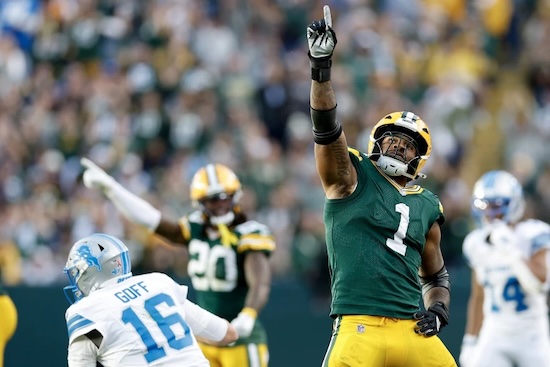
A month ago, the 2025 Packers felt predictable. Coach Matt LaFleur’s offense would dazzle in spurts, then disappear for stretches. Jordan Love would show flashes as high as anyone in the league, but the back-footed interceptions would linger. The defense would be well-rounded with an elite DC, but lack the pass rush and corner talent to have answers for elite offenses. They were going to be a really good football team, but it seemed inconceivable that they could make a Super Bowl run.
Graced by Jerry Jones, the Packers were able to pull off one of the biggest NFL trades in recent history, snagging Micah Parsons from the Dallas Cowboys. While his run defense leaves something to be desired, Parsons is the best pure pass rusher in the world—exactly what the Packers were missing. In a sport with so many moving pieces, you rarely see one move change the complexion of a franchise like this. But if you had asked me a month ago what single-player addition would make the biggest difference—excluding quarterbacks—it would have been Justin Jefferson to the Kansas City Chiefs and Parsons to the Packers.
The early returns have been everything Green Bay could have hoped for. Defensively, they have dominated two potent offenses from last year. They held the Detroit Lions without a touchdown until there were 55 seconds left, and the Washington Commanders only mustered 230 total yards. While the offense has looked great these past two weeks, they’ve had stretches like this before. The issue has always been consistency. Elite offenses find ways to keep their teams competitive even on off days, giving their defense a chance to win the game or allowing for the potential of some fourth-quarter randomness to lead them to victory. The Packers haven’t managed that these past few seasons, and I’m not sure Love will ever be super reliable, but this might be the year where their other strengths can overcome that inconsistency. They’re my pick to represent the NFC in the Super Bowl.
Bengals in Free Fall
The Cincinnati Bengals entered the year with more pressure than maybe any other team. They missed the playoffs in back-to-back seasons despite entering both years with better than +1300 Super Bowl odds. Last year felt cursed, but after much offseason drama, they returned with their core pieces. The defense still had questions, and the offensive line still hadn’t recorded a top-25 season in pass protection, but outside of the Chiefs, Baltimore Ravens, and Buffalo Bills, Cincinnati was viewed by many as the next best team.
Despite a 2–0 start—the first of the Joe Burrow era—it couldn’t have gone worse. They barely squeaked past the lowly Browns in week one, then yesterday Burrow went down with a toe injury and is expected to miss three months. It marks the third season in his career where Burrow will have missed 6+ consecutive weeks with an injury.
Jake Browning was able to survive and escape with a 31–27 victory over the Jacksonville Jaguars. Browning is as serviceable as they come for a backup, but this team is built around Burrow’s arm and mind. Expecting them to stay afloat without their star quarterback, especially with a tough schedule, feels like a stretch. Their run game has averaged an atrocious 2.35 yards per carry through two games, and that has to improve significantly if they want any chance.
Assuming Cincinnati misses the playoffs, the questions will only multiply this offseason. Trey Hendrickson’s weird one-year contract will expire, the Tee Higgins trade rumors will resurface, Taylor will likely be on the hot seat, and the defense will remain talent-deficient. It is becoming harder and harder to envision the Bengals returning to their early 2020s form, and with all these weaknesses, there’s no quick solution. More than ever, it seems possible we could see Burrow in a different uniform within a couple of years.
The Silver Surge
I’m writing this before their week two Monday night matchup against the Chargers, but I have to get my Las Vegas Raiders take out there. No team had me more bullish upon entering this season. Las Vegas made more significant upgrades at premium positions than anyone else in the league, starting with Pete Carroll, one of the best organizational leaders in football.
While Carroll has had one of the most stable and successful coaching careers in football, Chip Kelly is the exact opposite. Kelly was viewed as one of the brightest offensive minds during his Oregon days, famous for his up-tempo, no-huddle attack that frequently featured four wide receivers. It didn’t translate to the NFL, leading to disastrous tenures in Philadelphia and San Francisco. After spending time at UCLA, Kelly jumped to Ohio State as offensive coordinator, where he transformed that offense en route to a national championship. His creativity remained, but he showed a much more balanced approach. Kelly works better as a coordinator than a head coach, so the Raiders were ecstatic when they were able to bring him in.
The Raiders’ leading passers over the past two seasons have been Aidan O’Connell and Gardner Minshew II, so it was clear they needed an upgrade at the helm. Much like the Carroll and Kelly hires, they got one of the best possible available options in Geno Smith. What Smith accomplished in Seattle was remarkable and underappreciated. He led three straight winning seasons, averaging over 4,000 yards despite a disastrous offensive line and coordinators who didn’t help him. While his aggressiveness sometimes plagues him, especially in the red zone, he is one of the best pure passers in the league.
Week 1 proved this as Smith broke the franchise record for most passing yards in a debut with 362 en route to a 20–13 win. Kelly showed that while he wants balance—run/pass, motion, under center/shotgun—when airing it out, he’ll play to Smith’s strengths, giving him plenty of intermediate and deep opportunities. The offensive line remains the biggest question after a poor week 1 showing, and the personnel doesn’t look particularly exciting on paper, which could keep them from the elite tier of offenses.
The defense is a wild card. Their starting back seven features a rookie and five newcomers, many with up-and-down track records: Germaine Pratt, Devin White, Eric Stokes, Jeremy Chinn, and Elandon Roberts. The margin for error is slim in a lot of areas, but my trust in the coaching staff and Smith leads me to expect a wild-card berth.
Kickers Growing Impact
In 2015, eight players made a field goal over 56 yards. In 2024, that number had tripled to 24. I chose 2015 because it was the last year a touchback led to the offense starting at the 20-yard line. A touchback brought the ball out to the 25-yard line for the next eight years until it became the 30-yard line for last season, as the kickoff rules were re-invented. Now, a touchback gives the team the ball at the 35-yard line, but because of the new pre-snap structure and rule, the return rate is 76.8%, which has thus far resulted in an average starting field position of 32.3 yards.
Yesterday, the Cowboys got the ball back with 25 seconds left, needing a field goal. KaVontae Turpin returned the kickoff to the 33-yard line. After an incompletion, it took just two plays—an 18-yard seam to Jake Ferguson, then a three-yard run from Javonte Williams—to set up Brandon Aubrey’s 64-yard game-tying kick. Granted, Aubrey is the best long-range kicker ever, but the fact that Dallas only needed 20 yards to attempt a field goal is insane. In 2015, with touchbacks at the 20, teams needed 40 yards to even attempt a 58-yarder, a make which would have ranked as the second-longest kick made that season.
The new touchback rule will make game endings much more compelling. Down 3 with more than 15 seconds left, any trailing team has a realistic shot to tie. The Giants played soft coverage on Dallas’s final drive, which is standard practice, but that defensive approach might start to disappear. Coaches may also become more aggressive about clock management, placing greater emphasis on milking time if they are in a position to score a touchdown to take a three-point lead late.
Long-term, it will be interesting to see what the genetic ceiling is for kickers. Genetic ceiling refers to the theoretical upper limit of human performance in a specific trait. Usain Bolt’s 9.58-second 100-meter dash is the perfect example. Scientists have determined that sprinters have nearly maxed out fast-twitch muscle use, stride length, and reaction time, so while another Bolt-like freak of nature will probably come along eventually, the margins are so slim that progress isn’t inevitable like it once was.
There are virtually no studies on kickers’ caps, but my understanding is we’re approaching that ceiling now. We’ve already seen a 70-yarder hit in preseason, and while perfect conditions plus marginal improvements will likely produce a 75-yarder at some point, I don’t think we’ll ever see 70+ yard attempts unless it’s at the end of a half or in desperation situations. Still, the consistency of 60+ yarders will be a game-changer.
Here are some other season-long predictions I have.
- The Texans win 12+ games
- The Commanders miss the playoffs
- The Falcons win 10+ games
- The Ravens win the Super Bowl
Sam Weitzman-Kurker can be reached at sweitzmankur@wesleyan.edu.

Leave a Reply