
Skriker Evokes Fantastical World of Puppets and Garbage
Well, watchers of the Argus (there’s a deep seated irony in that, I think), I went to see The Skriker tonight, and I think you should too. Not see it tonight (Thursday), unless you have some form of time travel, but see The Skriker sometime this weekend.
If you must find out the plot, there’s a world of media for you to locate it. That’s not a good thing either, as while the play carries a plot, it is almost ancillary to the series of tableaux set out before the audience. They all seem to connect with each other, with recurring themes, but seem slightly distant, like in a dream. They muddle together, the reality of the scenarios ebb and flow like a tide, concurrently casting the audience further adrift. I have to extend a tip of the proverbial hat to the lighting crew, as the atmosphere was built on the lights–sometimes the lack thereof–and they provided an excellent foundation.
It seemed like a trip to Wonderland through a cracked looking glass. The Skriker feasts on other tales, cobbled together from them like a roiling junkyard heap, shuffling across the stage like its many imps, tricksters, and assorted magical things. “Roiling junkyard heap” is far from criticism; rather it’s got the “scrap and offal” charm of a Tom Waits album. In fact, the closing scene struck me in a similar manner, though with a slightly more post apocalyptic vibe.
The play starts with a haphazard monologue delivered by the proverbial master of ceremonies herself, The Skriker (Cecilia Lynn-Jacobs ’11) as spurts of wordplay choppily burst out, like a poorly spliced film. As she sputters, the audience is given a chance to adjust to the tone of the evening. Ms. Lynn-Jacobs gets well-earned accolades for memorizing what could seem to be one of the longest word salads I’ve seen since tackling Finnegans Wake, as she encroached upon the audience, destroying whatever barrier there is supposed to be between audience and performer. The figures in the play get quite close to the audience, and the front row is desirable for those wishing for a more immersive experience.
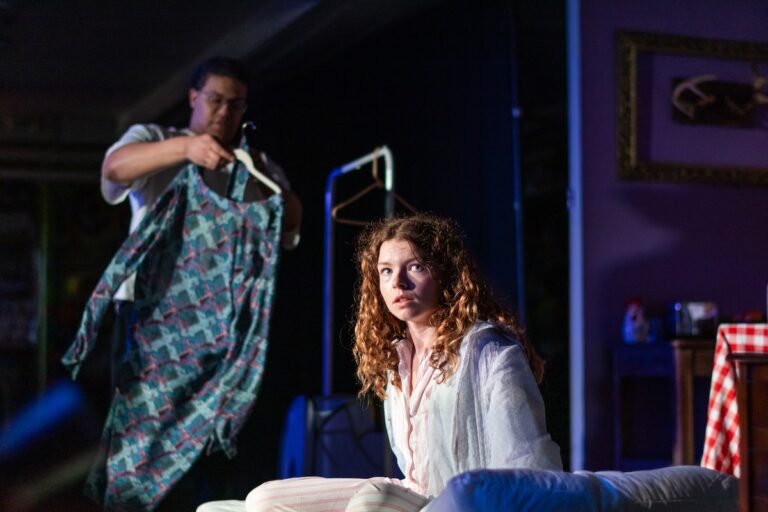
Things then turn to Lily (Emily Caffery ’10) and Josie (Emily Steck ’12), the other two speaking parts. Lily’s found trying to help her friend from what is supposed to be the verge of madness. Unfortunately for the performance, the actresses seem to have trouble acting stark-raving mad (though this may be a good thing for them personally): they always seemed a tad forced whenever they had to be full-on nutters. Luckily, they were backed up by a cast of surreal and somber images, starting with the Kelpie (Nick Orvis ’13) who watched over Josie’s bed. Director Robert Bresnick staged the show beautifully, and this was shown as the Kelpie, looming with towering head and elevated shoes, kept a “safe” distance from the girls. This cunning move allowed Bresnick to remove this safe distance as the play progressed.
The play is painted in the color scheme of Leslie Weinberg’s vision, though the puppets designed by Christian Milik and Kate Ten Eyck provided the visual highlight of the night. Cherry-picked out of fairy tales (like the grim, horrible ones where things get raped and killed instead of “happily-ever-afters”) and put together with the skill of Jim Henson’s Creature Workshop, they cut the earthly tethers of the play, whether they towered over the audience on stilts, or whether they were rodent looking things controlled by figures garbed in black that busily cleaned up with a simple broom. These horrors got more familiar, as puppets would make additional appearances, almost appearing habitual by the end. Though they occupied more of a background role, the actors, such as the Green Lady (Christine Treuhold ’13) and her interactions with the infamous “Man with Bucket” (Noah Heau ’12), put on a fantastic performance. Seeing their little sub-plot develop entertained the audience while the location changed.
I’ll take another time out to mention one of the breakouts of the performance: Elena Georgieva ’12, as the Passerby. Possibly the only one to challenge Ms. Lynn-Jacobs for total stage time, Ms. Georgieva danced like her life depended on it, swishing and dashing about in ways that seemed physically impossible. When she was the focus, while the stage crew set up for the next scene, she enraptured the audience.
While the play was not strictly a musical, there was some singing, such as in the memorable ballroom number, and some solo singing by Cheryl Tan ’11, who filled the room with a haunting melody. While the music itself wasn’t optimally prepared (some recordings sounded pretty underwhelming), the performers themselves managed to piece the music together quite nicely.
The best scene came fairly early on, with Lily meeting The Skriker, in disguise as a shapeshifter generally is, sitting down for a drink. As the scene progressed, my focus slid away from the two, and to the background: there they were, the life size puppets with actors inside, having drinks behind them. One looked wistfully into a cup, the other enjoyed the company of a lady in black. It took me a bit to realize what it reminded me of, or why I liked it so much, until it hit me: it reminded me strongly of a Miyazaki film (Spirited Away is probably the first one I thought of, if you like specifics). Just the way the surreal wonders blended in with the supposed center of attention in the foreground was stunning, almost magical. The fantastic thing about this production of The Skriker was that it loved having multiple things going on at once, making compound eyes a necessity for proper viewing.





Leave a Reply