
“Fefu” Experiments with Space
“Laugh at me if you think I’m ridiculous,” Fefu exclaims to a critical friend in the first scene of “Fefu and Her Friends.” “I know I’m ridiculous!”
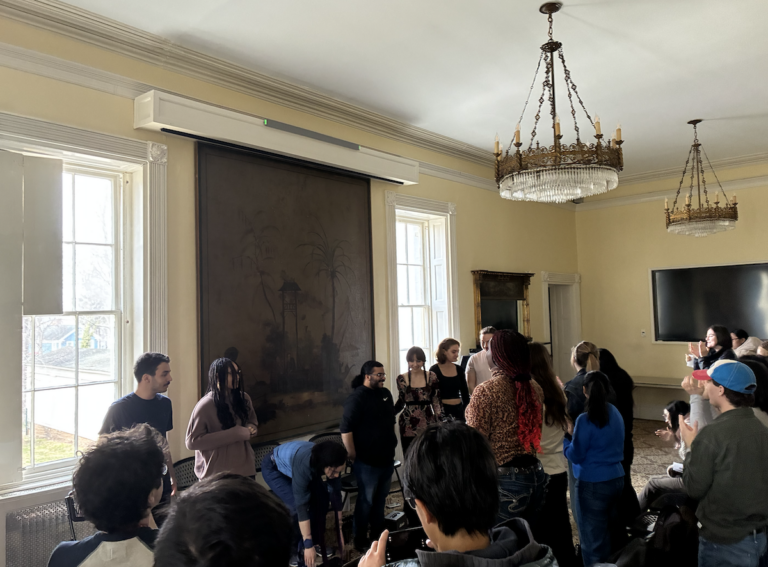
Such is the spirit of Gedney Barclay’s senior thesis play, which went up last weekend. The play, originally written by Maria Irene Fornes in 1977, tells the seemingly simple story of eight women gathering at a friend’s home to discuss a “theater education project.” Despite the conventional plot, however, the play is an exercise in eccentricity and ingenuity. Like its female characters that gender-bend and turn out to be “too smart for their own good,” the play willingly and self-consciously defies conventions. Instead of watching the whole play from auditorium chairs, the audience observes the action from four different spots throughout the house. The director splits the audience into four groups, which see the various scenes in the play at different times. Despite minor confusions in the script, the whimsical originality of this concept showed through and made the play an enjoyable and thought-provoking production.
Set in the thirties, the play opens with Fefu welcoming friends into her home for the day. Fefu, played by Ali San Roman, is an eccentric and smart woman who rebels against her role as a woman by wearing men’s clothing, firing guns at her husband, and fixing the toilets in their house. Cindy, a longtime friend of Fefu’s played by Emily Levine, brings her friend Christina (Emily Caffery) to meet Fefu. Punctilious and old-fashioned, Christina is frightened by Fefu’s free-spiritedness. Other friends arrive at the house, including Julia (Kiara Williams-Jones), a woman in a wheelchair haunted by painful hallucinations, and Cecilia (Alli Rock), who bickers with her former lover Paula (Sarah Wolfe).
Set designer Greg Soros did a fantastic job of creating four unique and intimate interior spaces. One room, for example, had been completely converted into a green house, with the floor covered in autumn leaves and tree stumps for the audience to sit on. Because of the small size of the room and the small number of audience members, the scene in the greenhouse seemed less like watching a play than it was like sitting in on a friend’s conversation. In another scene, set in a tiny kitchen, audience members were cramped and literally bumping into each other while two lovers attempted reconciliation. The set up was awkward—perhaps purposefully so. The physical discomfort of being squished into such a small space increased and highlighted the emotional discomfort of two former lovers failing to connect. As an audience member in these scenes, I was included in the action as an invisible eavesdropper; thus, I felt like a participant in women’s eccentric and wild social event.
The acting in “Fefu” was generally strong, though the characters portrayed were a lot older than the students cast to play them.
Normally this wouldn’t matter—obviously, college productions are limited to actors who are younger than their characters– but because of their age, certain actresses at times failed to do justice to the emotional intensity of the play’s subject matter.
That said, there were many strong performances. Particularly impressive was Kiara Williams-Jones, who played wheelchair-bound Julia, a girl who suffers from frequent hallucinations of being beaten and judged by men for being “too smart.” In one of her soliloquies, Julia has a particularly violent hallucination where imaginary assailants beat and insult her. Williams-Jones conveyed the woman’s pain with such startling accuracy, emotional clarity and intensity that at times I found myself flinching. The scene was truly disturbing.
The play’s ending is mysterious and many dialogues are strange, but “Fefu and Her Friends” doesn’t want to be traditional. Instead, Barclay’s expert directing and Fornes’ brilliant script portrayed a world where personality, self-expression, and creativity abound. Having to physically walk around the building in order to see a play created an experience of art that was not passive, but interactive and personalized. I left the play rethinking the rigid distinctions between theater, performance art, and social interaction.
“Life is theater,” one character claims jubilantly at one point to her friends. “Theater is life!” This could very well be Barclay and
Fornes speaking to the audience, imploring them to think–really think–instead of just watch.


Leave a Reply