
‘Somewhere’considers internal difference
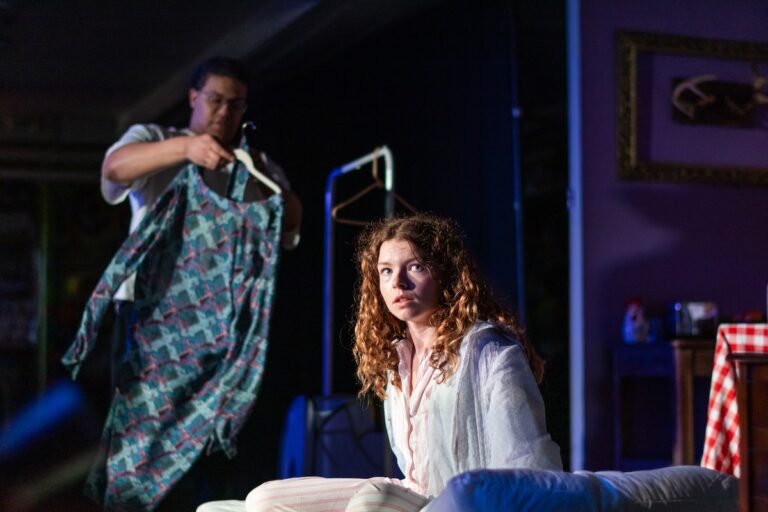
Something about “Somewhere in the Middle,” a new play written and directed by Joelle Minott ’09, worked for me—and it wasn’t just Mytheos Holt ’10’s (unsurprisingly) convincing portrayal of Governor Edward John Eyre. Perhaps it was the extremely cute little children who sat in front of me during the show, gasping and guffawing along with the trials of the hero, George William Gordon (Andrew Zingg ’11). But nonetheless, “Somewhere in the Middle” had me smiling throughout the show. This is the most important test of theatre—the ability to entertain—and Minott’s play passed admirably.
“Somewhere in the Middle” chronicled the story of George William Gordon (1820-1865), a genuine hero, less from a historical standpoint—though the play contained few references to the history of the time (most notably, Gordon referenced the absent character of Paul Bogle various times)—than a psychological one. Born in colonial Jamaica, the son of a slave mother who had been raped by a white plantation owner, Gordon educated himself by reading the Bible—he was taught to read by his uncle—and eventually became a successful small business owner and preacher. He was an open critic of the British colonial government, personified by Governor Eyre, and was eventually executed—falsely and without trial—for his supposed role in the Morant Bay Rebellion of 1865.
But rather than focusing on these events, Minott used them as a backdrop for a discussion of poverty, race, and religion. She presents a Gordon built upon binary oppositions: his wife Jane (Amanda Faraone ’11) wants him to give up politics, while the Jamaican people demand that he not. His two heritages—white and black—were constantly pulling him different ways, and were symbolized by the different accents Zingg moved between seamlessly.
While this novel concept worked well overall, there were moments during the play that seemed to dra—or example, the first extended interaction between George and Jane bordered on cliché, and seemed lacking in enthusiasm. While I was greatly impressed by both Zingg and Faraone overall, their chemistry was lacking at some critical moments—their fight, for example, didn’t really seem believable. This was not so much because of either of them, but rather because of the way they interacted on stage: they seemed slightly clunky and awkward, especially in their physical interactions.
This, however, was a minor detail and should not obscure the achievement of this play: Zingg—and the whole crew—changed seamlessly between times and setting, a feat that required both extremely quick costume changes on the part of the crew, and flawless changes in character and accent on the part of Zingg. Minott benefited from an extremely talented cast, marked by the wonderful performance of Rudi Motshubi ’1—ho played, in his best role, a slave who, having been beaten within an inch of his life, dragged himself to George’s house. Mr. Holt also did a superb job of conveying the genuinely evil, sleazy nature of Governor Eyre, while bringing some frightening intensity to the role.
The play also benefited from an exceptional crew of musicians (most notably Marie-Eve Augier ’11), directed by Claude Moise ’0—ho, while conveying a Jamaican atmosphere, imbued the play with energy and life.
The central theme in the play was George William Gordon’s role as intermediary—a role that put him in a center point between the binary oppositions that made up his life. But from this place, “somewhere in the middle,” Minott suggests, Gordon forged a relationship not only between different races and classes, but also between his own internal divisions. Minott presented these divisions in a manner that was not only intellectually interesting, but also entertaining—a staple of a talented writer, and a mark of good theatre.




Leave a Reply