
“Wait Until Dark” lacks strong acting, directing
On Feb. 2, 1966, the first production of Frederick Knott’s “Wait Until Dark” opened at the Ethel Barrymore Theatre on Broadway. The cast included Robert Duvall, Mitchell Ryan and Lee Remick, who was nominated for a Tony award for Best Actress. In 1967, Terence Young directed the terrifying film adaptation starring Audrey Hepburn (who was nominated for an Academy Award for Best Actress) and Alan Arkin. Unfortunately, last weekend’s performance of “Wait Until Dark,” directed by Chris Ceccolini ’11 and Phil Singleton ’10, completely failed to capture any remnants of the horrifying originals. Instead, the production was uninspiring and amateurish, and resorted to cheap tricks designed primarily to startle, rather than frighten, the audience.
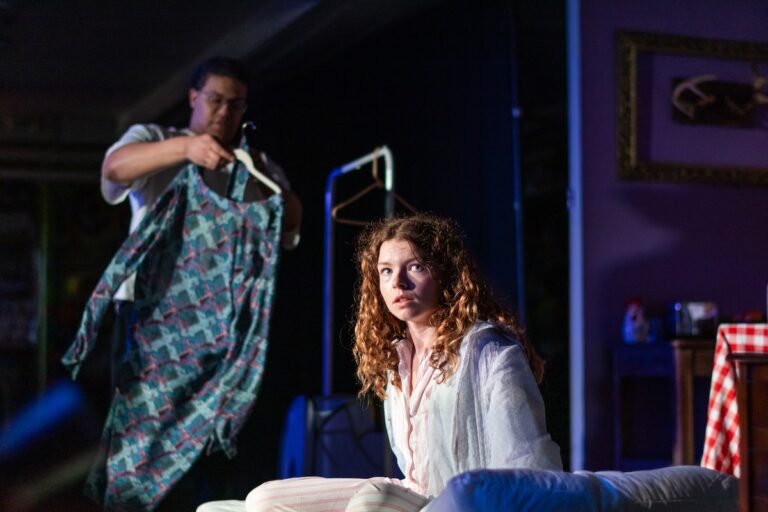
Set in a Greenwich Village basement apartment in 1967, “Wait Until Dark” centers on the blind Susy Hendrix (Sara Schineller ’12), who unintentionally becomes the target of three con artists—Mike Talman (Julian Silver ’12), Sergeant Carlino (Justin Wayne ’12) and Harry Roat (Howe Pearson ’12)— trying to find a doll stuffed with heroine that Susy’s husband Sam Hendrix (Michael Inkles ’12) unwittingly smuggled back from Canada after a woman (subsequently murdered by Roat) gave it to him. The second half of the play takes place in total darkness since Susy, in a desperate attempt to escape her captors, blows all the apartment’s fuses. In a final twist—the staple of this production—Roat, who was thought dead, barrels out of a closed door towards Susy, who fends him off with a scream.
This is a complex, interesting plot, filled with twists and turns (and one gaping hole: why doesn’t Susy just lock her door?!) and it deserved a much better production than it received. The best part of the performance was probably the venue: the Malcolm X House basement worked perfectly to convey the mood and scene of the play, both when lit and especially in pitch darkness.
Unfortunately, this was the first and last impressive aspect of the performance, except, perhaps, for Schineller, who is clearly a talented actress and seemed genuinely believable. The same cannot be said for the rest of the cast, who turned in amateurish performances, though it is not clear whether this was despite or because of Ceccolini and Singleton’s direction. The dialogue, especially Wayne’s and Silver’s, was in a very 1940s film-noir style, and sounded alternately forced and clichéd. It was unclear whether these traits were a result of poor direction or poor acting.
What is clear, however, is that both directors resorted to bottom-of-the-pale physical thrills in order to “spook” the audience. First, they announced that the audience should be prepared to be “scared.” Secondly, at the end of the first act they announced that the doors would be “shut and locked” after intermission so that nobody could “leave;” rather than simply asking politely that nobody leave because it would ruin the darkness, they instead tried to frighten the audience like a cheap ride at an amusement park. Finally, they centered the entire production, which lacked enthusiasm other than at this moment, on Roat’s loud charge at Susy. While this moment was genuinely startling—my friends screamed and gasped, as did most of the audience—it is hardly a good basis for an entire production.
I guess I went into the production expecting more than I should have: at midnight on Halloween, who would want to see “Oedipus,” much less perform in it? Unlike the deep psychological thriller that was the original, this “Wait Until Dark” provided amusement-park-style thrills more reminiscent of Paris Hilton’s opus, “House of Wax.” But hey, what’s Halloween without someone (or something) jumping out at you from the darkness?


Leave a Reply