
Ladies swim into 2nd place
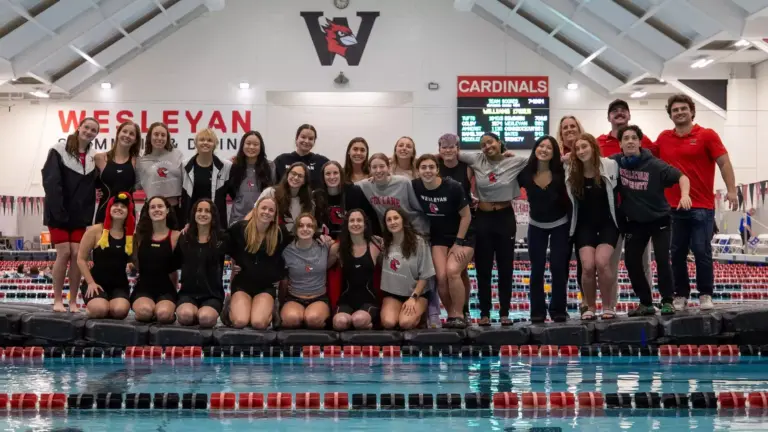
Racing both Saturday and Sunday, in three separate sessions, the women’s swim team fought through fatigue to come in second at the Cardinal Invitational, finishing with 1142.5 points against strong, non-conference teams from Brandeis University and the Massachusetts Institute of Technology. Brandeis won the meet with a final score of 1185.5, and MIT came in behind Wesleyan with 1041 points.
“One of the biggest things for us at this time of year is being able to have these guys fight through being tired from training and race,” said Head Coach Mary Bolich, after a week of practice that was admittedly tough.
“We weren’t expecting our best times, just because we were so tired; considering everything, we did really well,” said co-captain Kate Krems ’08.
The Cards earned ten individual titles, along with two relay wins and 55 other point-earning finishes.
The weekend had a lackluster start, according to both coaches and swimmers, but that lack of energy luckily didn’t linger throughout the following sessions.
“We didn’t come in as strong Saturday morning as I would have liked to, but it allowed them to learn and we made adjustments,” Bolich said. “As we look toward the end of the season, that’s what we want to be doing: making those adjustments from session to session.”
“Saturday morning was the hardest session; we weren’t really as into the meet as we could have ideally been,” Krems added. “Mary mentioned it, and we really picked up the energy and excitement for Saturday night and Sunday morning.”
Impressive performances were forthcoming, including some record breaking ones. Co-captain Amanda Shapiro ’08 broke the school record for the 100-yard individual medley (IM) with a time of 1.03.11, and Niki Holtzman ’10 recorded a season best in the 100-yard butterfly in 1.03.48. Shapiro also won the 50 and 200-yard breaststroke and Holtzman the 100-yard freestyle.
Krems won all three butterfly events, Caitlin Bethlahmy ’09 took first in the 200-yard backstroke, and Kate Haring ’10 captured the title in the 1650-yard freestyle, her first time racing that event.
“To do the mile Sunday after two sessions when we were already tired to begin with took a lot of mental strength,” Krems said of Haring. “She did really well.”
Carly Bollinger ’08 had an exciting race en route to victory in the 200-yard IM: though consistently in the lead, Bollinger had slower splits than the second place finisher in the last two laps and pushed through, eventually winning by .08.
The Cards’ relay teams again performed well, racking up 288 points overall. Of note was the fact that all five relay teams raced this weekend, instead of the usual two. The diving team also brought in points for Wes in the one and three meter events.
“I would say that overall everyone is just racing smarter by really thinking about turns and starts and mechanics,” Krems said. “Mechanics are the most important to focus on in season because you may not see your fastest times, but if you’re as close to perfect as you can be technically, the fast times will come when you’re rested.”
“What has improved the most so far this season is their ability to evaluate races and make positive changes each time they race,” Bolich said of the team. “Ultimately, while racing, they should be able to make adjustments to complete that race in a better manner.”
What kept Wesleyan from earning the title this weekend was a problem they can’t exactly solve: size. Like Amherst earlier in the season, the teams the Cards faced at the invitational had more than twice the swimmers than the hosts did.
“It was tough to lose to Brandeis: we were the better team, and we had the best times. It’s disappointing, but we know it’s just a matter of size,” Krems said. “We’re all doing really well; it’s a great group of girls, we just could use a few more.”
The fact that the top 16 finishes were scored, instead of the top heat as at regular dual meets, hurt the Cards because it made a point of the size difference between teams.
“Brandeis mainly finished first based on depth,” Bolich said. “For us, keeping everybody healthy and in shape and knowing how valuable each person’s performance is to the team is very important.”
Racing well despite fatigue was the focus of this weekend’s events, as it is for the conference championships in February.
“In the end, if you can race really well tired, when you’re rested you’ll race that much better,” Bolich said of her coaching philosophy.
The sheer number of events raced this weekend (22 as opposed to the usual 14) prepped the women for February; the format, which closely matches that of the NESCAC championships, also gave the freshmen a chance to find out what to expect at the end of the season.
The women resume conference racing this Saturday against Trinity College at home.

Leave a Reply