
Swim coach Bolich moves from Big Ten to Little Three
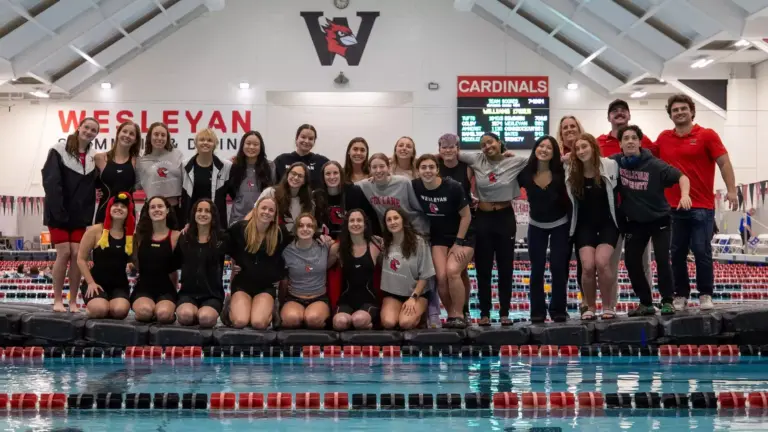
In the world of coaching, it is common for a successful coach to move up to more prestigious teams over time. Wesleyan’s head swimming coach Mary Bolich took the opposite route, moving here from the University of Iowa, and the Cardinals have benefited greatly from her decision.
Bolich received both her bachelor’s and master’s degrees from Temple University, where she swam sprints in the freestyle and butterfly events.
“I very much enjoyed my time at Temple,” Bolich said. “It’s great to be a student-athlete.”
Bolich went on to assistant positions at the University of Pittsburgh, Penn State and California-Berkeley before becoming head coach at Iowa. Bolich also coached athletes at the Olympic trials in 1992, 1996, and 2000, including a Romanian who reached the consolation finals in the 200m butterfly. She spoke of all of the competitors as “the elite of the elite,” as it is a great accomplishment just to make the trials, and said that her time there was “a pretty phenomenal experience for both the athlete and the coach.”
Iowa, one of eleven teams in the Big Ten Conference, was a top-100 school in Division I before Bolich arrived. When she left for Wesleyan, the Hawkeyes were in the top 30. She said her main focus was on recruiting quality student-athletes. In other words, she sought people who would work as hard in the classroom as they would in the pool.
“It creates a nice balance for the student-athlete to be one-dimensional and solely focused in one area,” Bolich said. “If you’ve got a lot of interests that you try to excel at, you tend to do a much better job that way.”
Many wonder why a coach like Bolich would come to Wesleyan, a Division III university, rather than coach a Division I swimming program, but she wanted to try coaching a different level, at a school with a greater emphasis on academics.
“I really don’t see it as a demotion or a less important or less challenging or less gratifying job,” Bolich said of her move to Wesleyan. “Are the experiences different? Without question, but that’s partly why I wanted to make the move.”
Before Bolich’s arrival, both Cardinal swim teams were very average, hovering around .500. The bottom fell out for the men in 2001-2002, her second year, but since then they have always had a winning record in dual meets. The women were in a similar state, but this season they have broken innumerable team records, so many that Bolich said she stopped counting them midseason.
Even though Wesleyan cannot offer scholarships based solely on athletic merit, the recruiting process was revamped to bring in new talent before this season. One new talent, Amanda Shapiro ’08, called Bolich “the most knowledgeable coach I have ever swum under.”
The past two years have seen Cardinal swimming make huge gains in the NESCAC standings with the help of record-setting underclassmen like Ben Byers ’07, Joanna Tice ’07, and Shapiro. However, one must ask, even with the abundant natural talent, whether the Cardinals would have showed so much improvement without Bolich’s energy and knowledge of the sport. During the women’s NESCAC finals, a couple of swimmers said she seemed more tired than them in her efforts to make the finals run smoothly, yet she still had the energy to coach the team in a meet in which several of the women set personal bests.
It was just another day at the office for Mary Bolich, architect of the rising Cardinal swimming and diving squads.
The women’s finals are this weekend at Middlebury, and the men host the NESCACs the following week.



Leave a Reply