
‘Quills’ artfully brings sado-masochism to ’92 Theater
Last weekend, audience members crowded into the Petricelli ’92 Theater with tickets in hand to see a performance full of nudity, fake blood, and even fake excrement. These theatergoers came to see “Quills,” a Second Stage Production directed by Liz Thaler ’05.
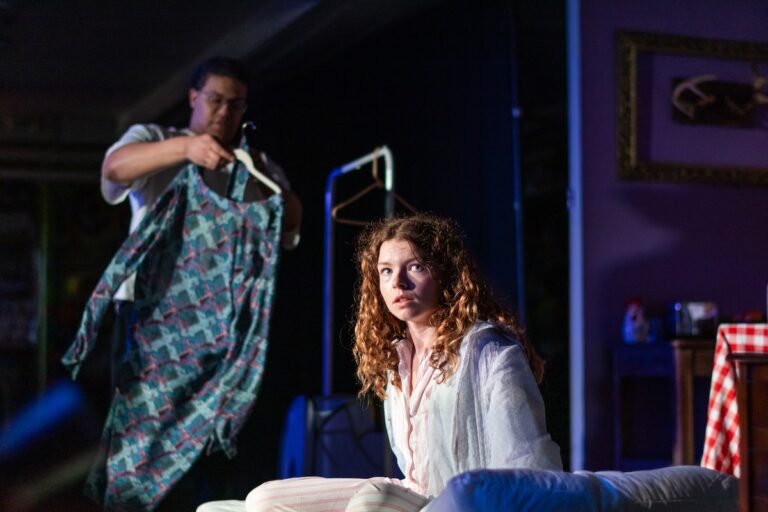
Set in France in 1807, “Quills” is the story of the Marquis de Sade during his time as an inmate of the Charenton Asylum. Played by Chris Krovatin ’07, sadism’s namesake was sentenced to Charenton, rather than a jail, to be cured of the horrific acts he committed. While in Charenton, the Marquis writes equally terrifying yet racy stories of acts of both love and violence. As a puppet of Charenton’s director Doctor Royer-Collard (played by Michael Gottwald ’06) and resident priest Abbe de Coulmier (played by Seth Cohen ’07), must take increasingly drastic measures to ‘cure’ the Marquis of his writing.
Encouraged by Madeleine Leclerc, the virginal seamstress and avid reader played by Molly Gaebe ’07, and his apparent love for her, the Marquis continues writing his stories at all costs. When Coulmier takes away his quill, ink, and paper, the Marquis writes with wine on his linens. When Coulmier strips his room bare and takes away his wine, the Marquis writes on his clothing with his own blood. When Coulmier strips him naked, the Marquis and Leclerc devise an elaborate plan to continue his stories.
The Marquis whispers his story to his neighbor Cleante, a lunatic who thinks he’s a bird, played by Logan Starr ’06. Cleante then passes the story through a chain of lunatics until it reaches the cell next to laundry room where Leclerc can record it. The set designed by Nick Weiss-Richmond ’07 and lighting designed by Greg Malen ’07 conveyed this information relay through the four inmates’ silhouettes, cast with colored lights on white screens. The Marquis’s provocative story riles the inmates into frenzy and revolt. The audience hears a scream as the spotlight shines on the bloodied, half-naked corpse of Leclerc hanging from the beams of the ’92 at the end the first act.
Many audible gasps and even a few shrieks could be heard from the audience upon seeing this first major shock.
“I was enthralled to have a play that was really bloody and violent,” said Adam Bernier ’06. “I’ve never really seen a play like that.”
The gruesomeness only increased throughout the second act. To keep the Marquis from telling his stories, Coulmier cuts off his tongue and presents it to Royer-Collard in a box. However, the Marquis will not be stopped and begins mixing his own spit and excrements to write a story on the wall. Although this story is not as explicit as the Marquis’s earlier works, the innuendo and hints of an affair hit a special nerve with Royer-Collard as he has just learned that his wife, played by Rebecca Josue ’06, has been having an affair with his architect, also played by Starr.
Hoping yet again to quell the Marquis’s stories, Coulmier presents Royer-Collard with five more boxes containing every body part that the Marquis could use to write- both hands, both feet, and even his penis. After committing these horrific acts, Coulmier is ready to leave and never return, but with Royer-Collard’s prodding he fills one final box- with the Marquis’s head.
Though the audience didn’t see the actual dismemberment- of the head or anything else- vivid sound effects in the pitch dark didn’t leave too much to the imagination. Overcome by guilt and fully understanding the implications of his actions, Coulmier himself begins to go crazy. The lights fade from him and on to Royer-Collard’s office where the boxes with the Marquis remain. Three open, revealing his reanimated head and two hands, which begin to write the story of the Marquis’s tenure in Charenton.
“I think it went incredibly well,” said “Quills” stage manager Jessica Chayes ’07. “I’ve never worked with a group of people who were so absolutely in love with the play they were doing. The actors and designers were both so invested in the outcome that I can’t imagine it turning out any other way.”


Leave a Reply