
Goldrach Gallery Greets “Looking Inward” Exhibit Drawing on Works Depicting Lone Subjects
The weather is getting warmer, but not warm enough to stay outside: arguably the perfect weather to visit your local art gallery.
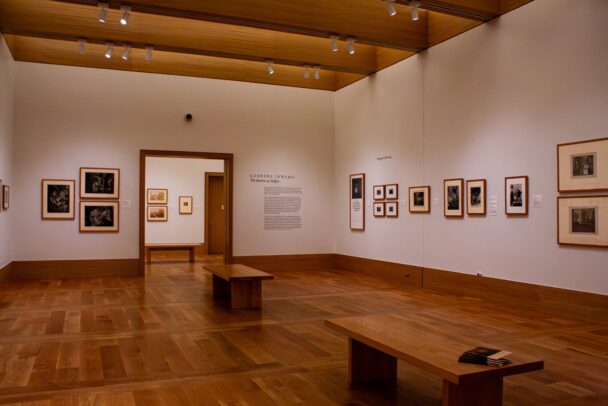
Appropriately placed in the cozy Goldrach Gallery is the University’s new exhibit, entitled “Looking Inward: The Interior as Subject.”
Curated by Miya Tokumitsu, the Donald T. Fallati and Ruth E. Pachman Curator of the Davison Art Collection, the exhibit will be open Tuesday through Saturday until May 23, from 12:30 p.m. to 4:30 p.m. I visited it last week, and I’d like to explore the exhibit’s investigation of the dimensions of solitude.
The main room of the exhibit contains a customary introduction to the gallery.
“Tending to one’s personal thoughts often parallels tending to those intimate enclosures where one can both indulge individual preferences and disinhibit the self after time out in public,” the introduction reads. ”But private spaces are not always liberating; they can also be zones of terror, particularly when access to the outside is barred, or if one is subject to another’s control within them.”
Immediately to the right is a photolithograph of a woman’s bare back in a bedroom, resting her hands on the frame of an unmade bed with her hair in a strict updo.
“IT WAS CLEAR I WAS NOT MANET’S TYPE. PICASSO – WHO HAD A WAY WITH WOMEN – ONLY USED ME & DUCHAMP NEVER EVEN CONSIDERED ME,” the caption below the photolithograph read.
Created by Carrie Mae Weems, this is one photograph in a series of five which critique the exclusion of Black women from the artistic canon. In this way, solitude is neither desirable nor intimate, yet in the piece, without context, it could be both.
Superficially, a viewer sees a young woman ruminating on an event of sexual intimacy that could be considered positively, made more private without the attention of prolific artists, an effect furthered by the use of a light-skinned model in a black and white grade, which obscures the image’s racial quality. This piece, positioned in the gallery as its introduction, immediately challenges assumptions of an image of sensual solitude, suggesting that they are inaccessible and blithe to those historically rendered undeserving.
The main room has been divided into sections, with “Sleeping and Dressing” first: the sensual, the momentary, a room left exactly as it was. Weems is accompanied by a Picasso etching and aquatint from “The Vollard Suite” set entitled “Boy and Sleeping Girl in Candlelight”, a rough, tangled rendering of the cozy, insular bedroom. Then, “Apertures and Walls:” hallways of homes often rushed through, snapshots of life lived in the tranquil, uninhibited private, a picture of floorboards by Sylvia Plimack Mangold.
Next comes “Surfaces and Patterns.” Maurice Denis, a member of a group of artists called the ‘intimists,’ depicts a woman sitting on a couch with a man looking over the back of it at her. Her dress is red, and the couch is stylistically upholstered, a mustard yellow wall contrasting the figures’ listless, ghostlike features.
To the right is “Prisons and Cells:” Have you ever been as lonely as Francisco de Goya’s subjects were? Does prolonged, forced solitude actually obliterate privacy, ripping through its veil of separation until to be alone is to know, instinctively and inescapably, that you are surrounded?
The rear room of the exhibit holds the “Not/Finished”, a collection of cancellation prints that are not part of the discrete edition of a series and are marked to be discarded or invalid by artists, including James McNeill Whistler, who denoted his cancellation prints with numerous sharp, hatched scratches. On one wall lie two copies of Glenn Ligon’s untitled prints, which repeatedly read in bold, capitalized letters reminiscent of Weems’ that “I FEEL MOST COLORED WHEN I AM THROWN AGAINST A SHARP WHITE BACKGROUND.” This section of the exhibit is for the unspoken aspect of solitude, that is, the involuntary discarding of matter deemed to be outside of the predetermined limits: What, and who does and does not make the final edition? Displaying unfinished or scrapped art is a rebellion against publicly effacing conventions, evoking the undesirable, banished aspect of solitude.
“Interior as Subject” will be open until May 23, except for March 7–23, from 12:30 p.m. to 4:30 p.m. Tuesday through Saturday. Come visit!
Isabella Canizares-Bidwa can be reached at icanizaresbi@wesleyan.edu.



Leave a Reply