
“The Modern Chick’s Guide to Giving No Fucks” Ruminates on Solitude
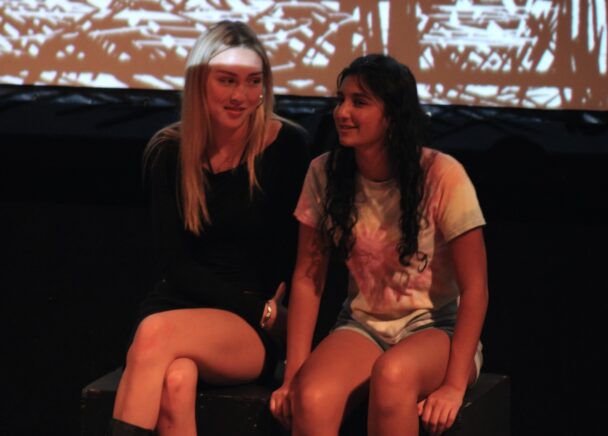
Last Friday, Nov. 7, I had the pleasure of seeing Spike Tape’s “The Modern Chick’s Guide to Giving No Fucks,” written by Phoebe Levitsky ’26 and directed by Levitsky and Daniel Anton ’27. Following two young women as they embark upon a “Euro summer,” “Modern Chick’s Guide” documents the convergence of youth, femininity, and independence. The story is written as a play against projections (see picture), combining what the camera captured with what actresses Shreya Savur ’28 and Pia Gissing ’28 brought to the stage.
Characters Norah (Savur) and Poppy (Gissing) first meet in the hostel of a European country, Norah on the first leg of her (impromptu) journey after being broken up with by her largely useless ex-boyfriend Tom. Poppy, on the other hand, is a seasoned traveler, immediately presented to the audience as the Euro Summer Queen, standoffish and cold on instinct in response to Norah’s bubbly, curious disposition. The stark contrast between Norah and Poppy establishes two distinct images of feminine independence: defensive versus curious, chosen solitude versus forced solitude. The focus on the different ways in which independence can be reached and maintained emerges as a prominent through-line and is decidedly my favorite part of the story.
I asked both the directors of the show and principal actress Savur the question: Especially in the case of young women, does true independence exist? I received a general consensus that true independence is rarely the actual goal of anybody professing their desire for it. Both Norah and Poppy begin their story staunchly pursuing choice and autonomy over their lives, right down to the country in which they will stay, but Levitsky’s writing bluntly demonstrates that this independence is not complete; rather, it is inescapably a trade-off of enormous proportions. Revealed in the first act of “Modern Chick’s Guide” is that in order to maintain her travel, Poppy has developed a survival tactic of sleeping with older, wealthy men and stealing their money on her way out; this tactic, although repeatedly criticized by Norah, is a symptom of the contingent nature of independence that Norah cannot understand.
“I don’t actually think Norah and Poppy are looking for total independence – in fact, they both gain a great deal from depending on each other,” Levitsky wrote. “They both seek to break out of status quos and power systems that dictate their lives, but they still crave community and connection from each other.”
Anton and Savur delivered similar sentiments.
“Depending on others, in my opinion, is part of our fundamental desire to belong,” Anton wrote. “Poppy originally felt like she couldn’t depend on anyone, and we see that cause her and Norah to clash throughout the show.”
Savur’s opinion references Poppy’s motivations for traveling in the first place; Poppy confesses to Norah that, having come from a very wealthy family, she relies on prostitution as a way to remain self-sufficient and estranged from both her family’s money and their control.
“Even though Norah is trying to learn how to be independent now that she isn’t dating someone and Poppy is trying to separate herself from her family’s wealth, I don’t think you can ever be truly independent from everyone,” Savur wrote. “People will always rely on others, even if it is just a little bit, because emotional connections with others are needed.”
Levitsky’s piece admits that independence is precious and the reliance upon others is often a prerequisite for obtaining it at all. Poppy and Norah’s individual journeys, and their eventual confessions of having fallen in love with each other, define their solitude as a liminal period between reliances of varying necessities.
“I worked on the writing of The Modern Chick’s Guide all through last year and last summer with the help of the incredible [Associate Professor of Theater Edwin Sanchez],” Levitsky wrote. “I locked the script the week before auditions…but the script isn’t done. I took script notes throughout the rehearsal process, and after a break from working on it it’ll undergo another substantial revision. I’m not great at finishing things, so the process just ends when the piece isn’t fun to work on anymore.”
This attention to detail, compounded with Anton’s insight, made for a deeply collaborative artistic process that reflects, and perhaps contributed to, the themes of community within the show itself.
“The process between Phoebe and I was very collaborative,” Anton wrote. “For example, I suggested using film transitions to highlight key themes in each scene before they began. At the end, I wanted to record real Super 8 film of our actors, Pia and Shreya, in various “Europe-looking” places around Connecticut…What’s great about working with Phoebe is that there’s never a moment where you feel that your input is being rejected. Our ideas for the show were always being developed together.”
Isabella Canizares-Bidwa can be reached at icanizaresbi@wesleyan.edu.



Leave a Reply