
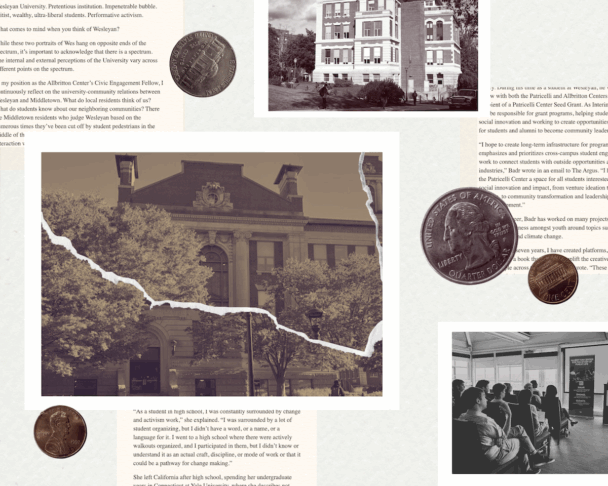
Will the JCCP Invest in the Right Side of History?
When I decided to apply to Wesleyan, my college counselor warned me, “I hope you don’t mind lots of shouting and sign-holding on street corners.” I laughed about this later with my friends, because we all knew if anyone would be shouting on street corners, it would be me.
Throughout high school, I was a climate and reproductive rights activist, privileged enough to experience the power held in collective, grassroots organizing. I chose Wesleyan because of its activist reputation. Although I was part of many wonderful social justice-focused communities outside of school, I often felt isolated, even weird, for my activist passions during high school. I dreamed of Wesleyan as a place where I’d find, as college brochures kept promising, my people. The ones who stand on street corners, sure, but also those who create art for social change and run sex-ed workshops, who marshal rallies, build community, and take every opportunity to expand the range of the politically possible in service of equity, justice, and Earth’s regeneration.
Before I arrived on campus, I had about 10 Jewett Center for Community Partnerships (JCCP) jobs saved on Handshake. I read these job descriptions wide-eyed, hardly believing that I could potentially have a job as an activist, working for organizations like Sunrise Wesleyan and Adolescent Sexual Health Awareness. Every time I saw a new JCCP job pop up, it seemed like an affirmation of what I’d been hearing about Wes: It was the place for me.
When I arrived on campus, I found that students here were (for the most part) everything I had hoped for: engaged, opinionated, passionate, and involved. But at every activist meeting I showed up for, there seemed to be an undercurrent of doom. The Jewett Center for Community Partnerships at Wesleyan had just unexpectedly restricted funding for student activist and community engagement groups, leading to mass lay-offs of student workers. The JCCP’s actions are particularly affecting Wesleyan students who cannot afford to devote many hours a week to unpaid activist work, such as international students relying on campus employment and students with work-study as part of their University aid. Just last week, The Argus reported that groups including the Sunrise Movement have lost leadership due to the cuts, and Middletown partnerships such as the Foster Connection tutoring program may not be able to continue at all.
By cutting this funding, the JCCP is essentially turning activist and community service work into a privilege, not a right, during a time when our coalitions must stretch as wide as possible—and our communities’ roots just as deep—as we marshal our collective power to fight, dream, build, and weave the world we all deserve.
Over the summer, I watched as university after university caved to the Trump administration’s pressures. I was confident that my school, with our president’s defiant op-eds and its reputation for student activism, would never do the same. However, it is hard to see these JCCP cuts as anything but one piece of a larger institutional wavering on its commitment to the Middletown community and student organizations.
Wesleyan now needs to decide what it prioritizes as an institution. As President Michael Roth ’78 publicly speaks out against the fascist precipice the United States is teetering upon, as our immigrant neighbors and friends are under attack from legions of militant forces and people’s bodily autonomy is stripped from them, what are Wesleyan’s financial priorities? Will it embrace the unique badge of honor that drew so many of us here? That of being a school filled with students who are weird, passionate, engaged, shouting on street corners, and looking to change the world? Will it decide that at this critical point in history it wants to uplift its students who are committed to building a different future than the one our political leaders are charting us towards?
The reason I became an activist, way back in middle school, was that activism gave me hope. There is nothing we need now more than hope.
It is a tool of fascism to break spirits, a task the Trump administration is embracing, flooding our inboxes, newsfeeds, and neighborhoods with proof of its encircling fascist domination. This tirade is contributing to massive overwhelm and activist burnout that ultimately undermines our capacity to resist. The way to combat this hopelessness is through collective action and local networks of mutual aid and support.
Now is the time when we must build our activist and community coalitions stronger than ever. I have no doubt that Wesleyan students are up to this task. The question now is to Wesleyan as an institution and to the JCCP: Which side of history will you choose to invest in?
Josephine Almond is a member of the class of 2029 and can be reached at jalmond@wesleyan.edu

That’s what they get