
Zilkha Gallery Exhibition Explores What It Means to Preserve Culture
“Excavations,” an exhibit in the University’s Ezra and Cecile Zilkha Gallery, features ceramics by Gary Red Oak O’Neil, an outspoken member of the Wangunk tribe of Connecticut. The exhibit, on display until Nov. 16, is a testament to the indispensability of cultural preservation; it asks, “what does it mean to tell the story of a culture long forgot?”
American artistic elites have long attempted to erase Native American culture. Inflating the white man’s identity as an originator and trailblazer has historically been a priority of U.S. policy, at odds with the acknowledgment and protection of the people who originally lived in our nation. The work of activists such as O’Neil, however, has forced our collective narrative to expand, finding an audience at institutions such as the University.
“My pottery’s nice, but I’m just the messenger, and this exhibit is a vessel that opens the door to information, to knowledge,” O’Neil said. “My thrust is to open the door for knowledge and for people to know more about this tribe that was here for 10,000 years.”
“Excavations” follows exhibitions of Wangunk art in and outside of Middletown, from pieces housed at the University to O’Neil’s own artwork in the Wadsworth Atheneum Museum of Art.
But beyond merely setting milestones, I believe there’s a broader significance behind these works. Cultural preservation is a practice of curation, something that requires an eye for what will be strong enough to wedge its way back into common memory.
“I have always been the one [who] was in charge of the Wangunks in the family,” O’Neil said. “My great-grandmother talked to my father and my mother about Gary being the old soul. [She said], ‘He will carry us,’ and this is the way I carry.”
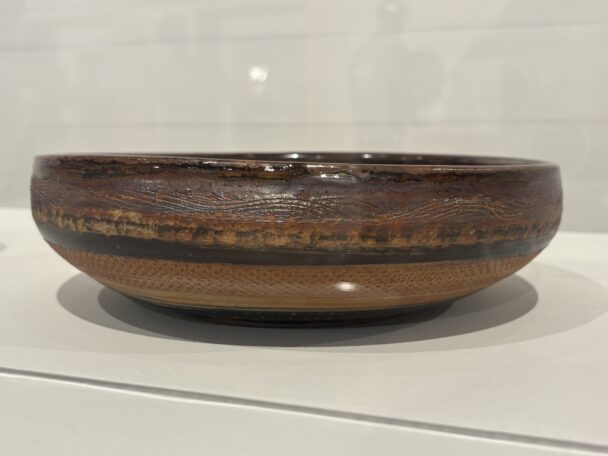
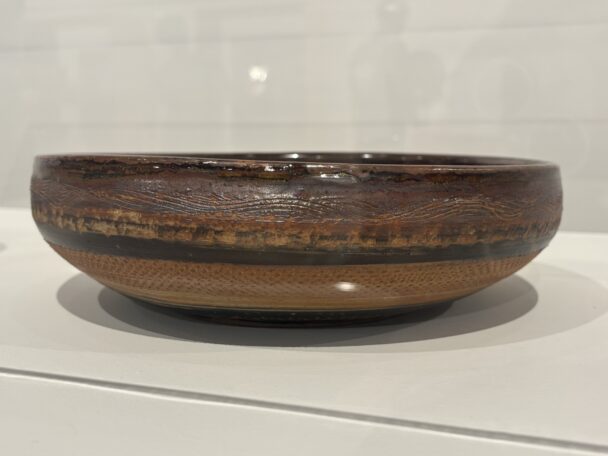
Upon my arrival to “Excavations,” I began to survey the scene. Organized to mimic a museum, O’Neil’s assorted ceramics are encased in glass and lined up in neat rows. I searched for something not immediately visible in the clinical overhead lighting. It took a moment to find this something: the bowl pictured above, untitled. Made of stoneware clay and glaze, it measures 10.75 inches by 3 inches.
There I was, crouching on the floor of that very formal exhibit with posh white ladies looking down at me, combing for the piece’s punctuation: its purpose, its touch. Where to look? To find this point, you must excavate the art you’re attempting to uncover. On a phone call, O’Neil told me about his own efforts of cultural preservation.
“I started labelling my great grandmother’s photographs in 1967 and she died in 1968,” O’Neil said. “[The cemetery] caused a history lesson every time [my grandmother and I] went, so that’s how I gathered all my information in the beginning.”
Bowls like these were handled, crafted, and displayed; a detached experience with the artworks will often produce a detached audience reaction. This conflict is why the audience must excavate. So as I was on my knees, I was looking for the reality of the piece at the level it was accessible to me: its craftsmanship. That viewing was the closest I will get, and with an artist such as O’Neil, it was enough. His patterned hues—harmonious yet fierce and carefully intentional—are the essence of what his art intends to preserve: the brilliant, fortified nature of his people etched in time, products of past and present.
“Going to town halls, going through church records, going through burial records, there was a strategic way of doing this that I learned, and then I was able to tell a story,” O’Neil said.
I asked O’Neil why he chose to display his work here at the University, where he completed his graduate studies and will appear in an artist talk on Oct. 24.
“Wesleyan is on Wangunk territory,” he said. “In 1961, my great-grandmother told my father that he needed to get a babysitter because she wanted to go to Wesleyan, and so they [went] off for a couple hours. She [came] back and talked to us as her great-grandchildren and said, ‘Something happened today that’s really important…I went to hear Martin Luther King speak. I went to a place that allowed him to speak.’ She said to us, ‘I can die now, because this guy is going to make the world a better place.’”
Regarding his own time at the University, O’Neil described it as a fantastic experience and a dream for his family.
Where to go next? To learn more, O’Neil says viewers should check out “Disrupted,” a National Public Radio (NPR) podcast hosted by Executive Director of the Allbritton Center for the Study of Public Life Khalilah Brown-Dean, where he appeared as a guest, as well as the documentary “Piece by Piece,” showing at Wesleyan on Oct. 24, concerning O’Neil and Wangunk history.
In the project to rebuild the larger American mural, “Excavations” is important paint on the canvas. Through art, O’Neil creates for the sustained protection of his people.
Isabella Canizares-Bidwa can be reached at icanizaresbi@wesleyan.edu.

Leave a Reply