
Awkward Love Abounds at “24″
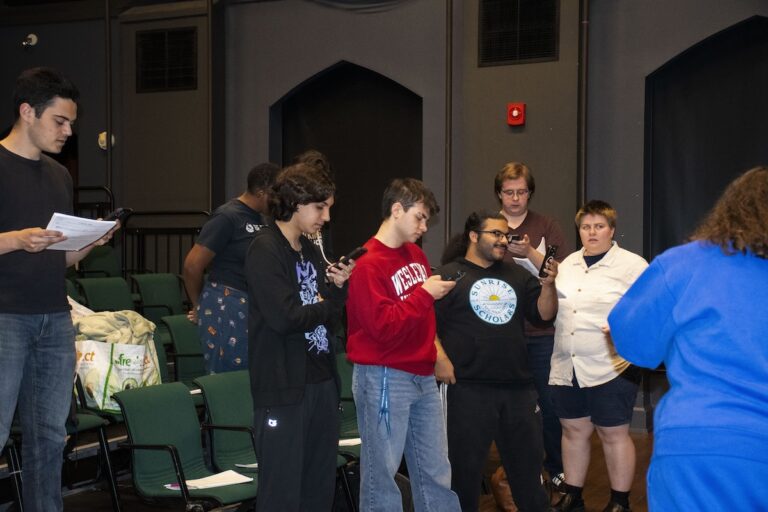
Awkward love was in the air and on the stage last weekend at Second Stage’s “Blitz-Plays: The 24 Hour Play Festival,” a showcase of six plays written, directed and staged in only 24 hours. Of the six plays, five involved female and male characters attempting to verbalize mutual attraction, but getting lost in insecurity or unavoidable circumstances that made romantic feelings impossible to act on. If I walked away from “Blitz-Plays” with anything salient, it was the knowledge that Wesleyan students are a sexually charged bunch that has difficulty forming healthy relationships. Overall, I wish “Blitz-Plays” had employed other creative tropes besides stilted love, but I was nonetheless impressed by the writers’ ability to create entertaining scripts in such a short amount of time, not to mention the actors’ success at the formidable task of memorizing 10 pages of text in under 10 hours.
The festival opened with “She Came in Through the Bathroom Window,” written by Rachel Carpman ’10 and directed by Gabriel Fries ’09. The play opens with Peter, played by Anthony Bryan Lexington Smith ’11, delivering a monologue that probably would have been hilarious if he had been given more time to rehearse. Minutes into the play, Mo, played by Marlene Sim ’11, crawls into his bathroom window and chaos (and a play about awkward love) ensues. This was the play that could have used the most time to rehearse; and probably because of time constraints, much of the script’s potential humor and intelligence could not be conveyed by the actors.
“Everybody’s Got Something to Hide Except for Me and My Monkey,” written by Jake Hunt ’12 and directed by Dan O’Sullivan ’11, was an often laugh-out-loud tale of the unlikely pairing of a failed criminal and runaway cavewoman/monkey from a museum exhibition. Emily Levine ’11 was hilarious as the secretive but loveable monkey; her physical comedy was spot-on, and whenever she loped around the stage there was audible chuckling from the audience. John Gallagher ’12 was also effective as an
angsty and attention-deprived career criminal. There were, however, too many—or simply awkward—scene changes in this play, that could have been remedied by different directorial choices or editing of the script.
“Glad All Over,” written by Chris Mixon ’09, was a story of two college students, Estelle and Keith, played by Sabina Friedman-Seitz ’11 and Robert Kipp ’12, respectively, attempting to mend a broken friendship. Eleanor Blakeslee ’11 did a fine job as director, skillfully highlighting Keith’s many, many monologues with quick lighting changes that allowed the humor of the script to fully shine through. Infused with an enjoyably dark and ironic tone, “Glad All Over” engaged in pointed critique of the often-shallow character of college friendships. Friedman-Seitz did an excellent job embodying the stereotype of the cute but self-involved college female.
After a slew of sometimes-uneven plays, “Where Have You Been All My Life” went down as easy as water. Benjamin Firke’s ’12 script was wonderfully staged by Justin Wayne ’12. From the beginning, the audience was drawn in by the complex and three-dimensional characters. Dakota James Gardener ’11 played Nathaniel, a beekeeper obsessed with his livelihood, who meets Helen, played by Daniela Reimann ’12, while waiting in the airport. Eventually the two realize they are made for each other, but not before the intrusion of Dave, Helen’s self-centered, cock-fighting boyfriend who is also (coincidentally) an airport security worker bent on detaining Dave and his bees. Gardener was great as a neurotic beekeeper, and Wayne’s direction made the humor in the script shine.
“Three Cool Cats,” written by Robby Hardesty ’11 and directed by Hannah Weiss ’12, was the only play not to attempt comedy, which was appreciated. However, vocal projection problems on behalf of the actors made understanding the script nearly impossible, to the extent that I can barely tell you what this play is about. After reading the script in the comfort of my own room, I can tell there was a lot of emotional material that I simply missed. The biggest—and perhaps most unforgivable— problem with “Three Cool Cats” is that it is a play that should have been a poem. Written in metaphorical and often elliptical language, “Three Cool Cats” circles around love, longing and loss, but never gives the audience a plot to hold on to. This poetic language, combined with the actresses’ demure, almost sedate delivery, produced a cryptic play that was too esoteric for the majority of viewers to appreciate.
“Blitz-Plays” ended with “Fixing A Hole,” a brilliant musical with book and lyrics by Jo Firestone ’09 and Zach Rebich ’11, and music by Abaye Steinmetz-Silber ’12. The story revolves around two idealistic environmentalists who fall in love, and the scheming of their explicitly and deliciously evil friend who tries to ruin everything. Highlights from the play included a life-sized doll being used as a machine to fix a hole in the ozone layer, Meghan Twible’s ’12 heavenly singing voice and Samantha Joy Pearlman’s ’11 rendition of a song with the lyrics: “Do you want to see my panties? If you do, just say hello.” (Awkward love, anyone? Anyone?)
Leaving the festival, I was struck with two conflicting emotions: relief that I didn’t have to bear further witness to the awkwardness of a play created in 24 hours, and amazement at the talent of the writers, directors and actors involved in these productions. That the crew of “Blitz-Plays” managed to create what they did in such a short time period is truly impressive, and prompted viewers to ponder the role and possibilities of theater at large. Ross Shenker ’11, the festival’s coordinator, said it best when I spoke to him about his goals for the festival.
“I want people to rethink theatrical conventions,” he said. “We could stand up on these tables right now, start some improv, and it could be theater. Theater can be anything.”



Leave a Reply