“Some of us came in here really heavy tonight. Before we leave here, we’re going to shake all that off.”
Ebony Singers director Dr. Marichal Monts opened the gospel choir’s winter concert on Monday, Dec. 1 with the intent to entertain, inspire, and interact with the audience. Throughout the performance, Monts encouraged the crowd in Crowell Concert Hall to participate in whatever ways they were comfortable, as the choir worked to create an open dialogue between performer and viewer.
“This is Crowell Pentecostal Church tonight, so you’ve got to talk back to me,” Monts said. “We need noise, we need clapping, dancing, screaming, whatever you want to do. Your emotions are connected to motion.”
Founded in 1969, the Ebony Singers aim to facilitate communication and unity among people of different ethnicities. Beginning just as a student group, the Ebony Singers is now composed of about 75 students who go through a rigorous audition process to participate in a half-credit class. It was originally exclusively African-American students, but since Monts became director in 1986, the choir has been open to everyone.
Monts embraces expression through movement in his conducting, and his passionate directing and brief interludes in between and during songs were highlights of the show. Accompanied by a guitarist, bass player, drummer, and two pianists, Monts and the Ebony Singers performed eight songs, each of which was chosen specifically to evoke emotion in the singers.
“I’m generally looking for something first that will inspire the students,” Monts said in an interview with The Argus. “If I can ever get a song that inspires them, their delivery is going to be so passionate that the people who are listening will be inspired as well. Ultimately, that’s what I want to do, but I have to find the right songs.”
Monts was indeed successful in inspiring the singers; throughout the concert, those most passionate about the music stood out visually, dancing and drawing the eyes of the audience. It was clear from their enthusiasm that students had favorites among the numbers, and as a result, those were the ones that came out as the strongest in their repertoire.
“All In His Hands” was one such stand-out, and the singers delivered it with zeal. The number did have rough patches, however, when it called for the sopranos, altos, and tenors to perform separately. The smaller groups struggled to fill the concert hall with enough sound and the lyrics consequently were difficult to distinguish. Once they merged back into a full ensemble, though, the singers’ passion echoed throughout the space.
The following song, “Hand Of The Lord,” featured a dramatic opening that brought applause from the audience. This number was faster and higher pitched, but the singers were able to carry it as a group. During an instrumental break, Monts told the story of his own history with Ebony Singers and introduced the audience to his 73-year-old mother, heartwarmingly citing her as his greatest inspiration.
While the choir excelled at the more energetic numbers, the pinnacle of its performance came with the penultimate song, “Be Weak.” Monts deemed it as his personal favorite.
“This song speaks about people who go through difficult times in their life and everybody is generally saying, ‘Be strong. Get over it. You can make it,’” Monts said. “But this song talks about how, when you really trust God, it’s okay for you to be weak. He gets your weakness. Your tears are going to turn into a smile eventually, so let everybody else tell you what you shouldn’t be. Embrace the weakness, and let God be strong in your weakness.”
Beginning slowly, the song’s message clearly resonated with the singers. They carried it powerfully, even—perhaps especially so—when the instruments dropped out of the mix. Halfway through, Monts turned to direct an audience sing-a-long, and later signaled for a standout solo from Associate Director of Career Development and Campus Outreach Persephone Hall. Stepping out of the audience to perform, Hall gave an impassioned, deeply personal take on the chorus that brought the audience to its feet.
The concert finished strong with the high-octane “Trouble Don’t Last Always,” featuring a beautifully sung solo from special guest Ernie Cloman and ended with the audience standing and, of course, singing along. In a stressful time of the semester, the choir succeeded at the feat of harmonious inspiration. The Ebony Singers’ bursting, infectious passion was just what strong gospel does best.
“Well the kids/ I think we’re alright/ now we’re losing control.”
all-caps LADD is a group focused on transition, whether it’s the evolution from childhood to adulthood or from college student to post-graduate. As I watched LADD, composed of vocalist Jack Ladd ’15, guitarist Sam Wheeler ’15, bassist Bennett Gelly ’15, and drummer Piers Gelly ’13, open for Avi Buffalo at Eclectic on Friday, Nov. 7, I couldn’t help but feel this performance was a victory lap for a band already considering its next step. Regardless, just because this is a band at the start of its final bow doesn’t change the fact that LADD knows how to own a crowd and bring a seriously addicting blend of rock, pop, and indie rock to the table. This band plays the kind of music that makes you want to get up on a table and dance to your heart’s content until that table splits in half.
Mad in the Coatroom is all-caps LADD’s initial studio release and, though only three songs long, it provides a fleeting glimpse into the depth of Ladd’s addictive one-liners and the smoothness of Wheeler’s guitar licks. The EP serves as an intriguing statement for a group that has taken Grand Cousin’s—whose members graduated last year—mantle as Wesleyan’s premiere student band.
Mad’s first song, “The Kids,” starts off with an up-tempo old-school guitar riff, each eight-bar progression building upon the next until Ladd’s voice nonchalantly saunters onto the track. Wheeler’s guitar sets an upbeat and youthful tone that the band distorts as the trio of songs progresses. The song is steeped in a blithely repetitive guitar sequence but is rife with pop influences.
“The Kids” taps into the moment when parents realize their children are out of the house, out of their control, and essentially equipped to confront adulthood, if anyone ever really is. At the same time, for a generation of young adults in transition, the song represents one final grasp at the innocence of childhood and Ladd’s suggestion in the lines, “I’d like to take you to New York/ maybe we can start a band,” becomes increasingly urgent as Ladd’s vocals become muddled together until it’s clear he’s saying, “Don’t go.” Youth is certainly fleeting and perhaps LADD implies the dreams of our childhood are as well.
“Summer Nights” opens almost hauntingly and crystallizes the sense of loss of “The Kids.” Its woozy keyboard line meshes well with a baseline that parallels the weary sound of The National’s Scott Devendorf. On “Summer Nights,” LADD continues to wrestle with youth and a vanishing childhood, beginning to distort these ideas into more vivid feelings. The song is driven by a creeping baseline and a wistful cry: “Summer nights are over/ I miss the nights when you used to fuck me sober.” While the song begins to feel repetitive in both the progression of LADD’s instrumental layering of guitar and bass and its lyrical content—a malady that threatens “The Kids” as well—it is able to capture perfectly the nostalgia of the dog days of summer. Ladd looks back once again with almost bereavement, but in “Nights,” his perspective is tinged with regret and even guilt.
“Summer Nights” is not a shallow or preening attempt to capture the passion of summer love. Rather, it is an honest look at the aftermath of a summer romance and the way we reflect on it and allow it to characterize our behavior once the year begins. When Ladd admits, “I feel like shit for all the ways I fucked you over,” his voice descending into a dizzy and syncopated plea for forgiveness, it’s clear why the “summer days grow colder.” Ladd examines a relationship gone awry, and questions all the ways he could have salvaged it, rather than letting it dissolve into just another summer fling that ends in regret.
“Mad in the Coatroom,” the project’s eponymous track, concludes the record on decidedly different terms than the regret of “Summer Nights” or the thinly veiled melancholy of “The Kids.” It’s also far more expansive instrumentally than either of its predecessors, as Ladd and Wheeler are able to weave intricate guitar patterns that immediately declare a different experience. While “Mad” is still driven by its baseline, it’s more Gaslight Anthem than The National. In an EP driven so fully by each track’s instrumentals, Wheeler’s ability to improvise and play off drummer Piers Gelly ’13 and fellow guitarist Ladd sets a perfect tone here. “Mad In The Coatroom” sees LADD firing on all cylinders, as their percussion, guitar, and keyboard converge perfectly in a dazzling burst of sound. “Mad in The Coatroom” is my favorite song from the EP and represents LADD’s most fully realized piece on all levels.
On “Mad,” Ladd strives to expand his vocal range, and his lyrics are his most dynamic and daring. Throughout the EP, he is able to lace each track with ambiguous lines that serve as driving questions as the song expands. Of course, he is still “thinking about you” and trying to “get somebody to notice.” However, on “Mad in The Coatroom,” Ladd’s imagery is far more pointed: “She found a pack of bruised Camel Turkish cigarettes in my pocket.” His voice seems more focused, perhaps because “Mad” offers some allusion to a resolution of the questions Ladd poses in both “The Kids” and “Summer Nights.” When he sings, not without some hope, “She said I could finally get to rest my head soon,” the closure Ladd seeks so adamantly throughout the EP seems miraculously in reach.
Mad In The Coatroom is an EP about the lens through which we evaluate our childhood, filled with both pleasurable and regretful memories. Instead of judging or indicting ourselves for our past mistakes, it seeks to find the resolution that will make our next chapter more fulfilling.
Craig Shepard and Beth O’Brien’s performance of “On Foot: Brooklyn” at Wesleyan’s CFA Hall on Saturday night felt disconnected, and whether or not that was entirely the point was unclear.
Shepard is a composer and trombonist who directs On Foot Productions, and he is described on his website as making “music related to stillness.” He studied trombone and composition at Northwestern University. In 2005, Shepard embarked on a 31-day, 250-mile walk in Zurich, Switzerland, during which he composed a new piece every day and performed it every evening. Beth O’Brien, on the other hand, is a photographer, filmmaker, and visual artist.
Together, they created “On Foot: Brooklyn,” a project undertaken over 13 weeks in 2012, when Shepard—similar to his 2001 project—would only walk to travel, abstaining from public or private transportation, and compose a new piece every week.
“I had a better sense of where I was, in terms of my own internal map,” Shepard said in a PBS documentary on the project, adding that he composed better when he walked.
Each Sunday during this process, he would lead a cell-phone free, silent walk, followed by any observers, friends, or collaborators, to a different public space in Brooklyn to perform that week’s piece.
“By committing to each other to keep silence, a group creates a bubble of stillness which moves through the urban landscape,” the On Foot Productions website reads.
O’Brien would follow behind on bicycle, photographing them and their surroundings, taking thousands of shots, right after one another.
On Saturday night, Shepard, dressed in concert attire with his trombone, sat in a chair on far stage right while O’Brien took her place at a desk with a computer and speakers on far stage left. The auditorium could hold 120 people, but only about 10 students, myself included, made up the audience; two left before the performance was even half-finished, which might be indicative of the performers’ failure to explain any components of their project or of the evening.
Shepard and O’Brien both sat, silent, for a few minutes, with the “On Foot: Brooklyn” logo projected behind them, which then changed to a black screen. Eventually, the screen changed to a projection of O’Brien’s photographs, stitched together to make essentially a very sparse stop-action film showing Shepard performing in one location in Brooklyn.
Shepard eventually began playing his trumpet in the photos, long held notes—each “piece” only used two or three notes—with large gaps in between, seemingly without meter.
“It sounds a little like wind chimes on a slow day, so there will be some tones and some silence in between,” Shepard said in the documentary. “And they might find they start hearing some things in the space outside that they’ve never heard before.”
At some point, the speakers would begin to fade in noises taken from the streets they walked and played, with children laughing or car sirens blaring, attempting to stitch together a sonic landscape from disparate parts.
This happened twice, but not in any apparent coordinated matter. The friend with whom I attended the performance (who lives in Queens, NY and is a fellow soundscape aficionado) pointed out the three locations listed in the provided setlist did not match up with the two locations shown on the screen, which she identified as Canarsie (his March 4 location) and Downtown Brooklyn at the intersection of Flatbush, Atlantic, and 4th Avenues (his April 22 location).
Knowing that, and giving Shepard the benefit of the doubt that it was not a mistake but a purposeful alteration, we questioned how each element of the performance connected. There were five elements we could identify: Our visuals of the performers on the stage; the images projected on the screen; the sound from Shepard’s trombone; the sound from the speakers; and the ambient noise of the room (taking into consideration what Shepard said above about hearing things in the space outside).
If we could not be certain the location listed in the program was what was shown on screen, we could also not be certain that what Shepard was playing matched up with what he was playing on the screen, and we could not be certain the ambient sounds we heard matched up with where he was shown on screen or in the program.
We were, absolutely, as Shepard seems to have intended, made more aware of the sounds around us—people moving or leaving the room, my own breathing, the whirring of the hall’s fans—but most of all, we became doubtful of all we saw and heard. After the second piece of the performance ended, both Shepard and O’Brien stood up, bowed, and left the room, without comment. I doubt this was the takeaway they intended, but without their intervention, it was the one we got.
Corrections: An earlier version of this article stated Craig Shepard’s Zurich performance took place in 2001 with Manfred Werder and Jürg Frey. The project was in fact a solo performance and took place in 2005. In the final sentence, the article used “he” and “his” in reference only to Shepard, and has been corrected to “they” and “theirs” to refer to both Shepard and Beth O’Brien.
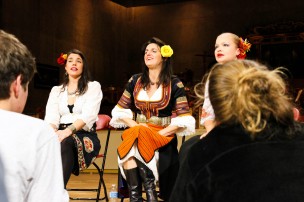
From the far corner of the World Music Hall stage, three women emerged with flowers in their hair. Vlada Tomova, Valentina Kvasova, and Shelley Thomas wore woolen outfits with embroidered and scalloped shirts. Each outfit was a variation on the same theme.
Seeing the three women together recalled images of the three Graces, or perhaps a trio of backup singers. But this show was entirely theirs. Unaccompanied, they opened with a song that they described as “in gibberish,” all about the moon. The second was about a gathering in which girls fall asleep and wake up missing clothing. Their voices formed rich, golden dissonances. The audience sat enraptured by the bright, clashing harmonies.
After they finished, Tomova remarked that the resonance of sound in the hall was “very, very, marvelous.”
“The way you all are seated, it’s kind of like a village,” she added, scanning the cross-legged members of the audience.
The group onstage, Bulgarian Voices, formed because Tomova ran a Bulgarian choir in Brooklyn, NY. Kvasova, who is Russian, called Tomova because she was interested in singing together, and even teaching each other.
“For a couple of years, we just strolled about with our tiny babies and I taught her Bulgarian songs and she traded me Russian songs,” Tomova said. “The joggers would stop.”
Later, when Thomas, an American, joined, they became a trio. The three women use music to explore their individual backgrounds. The concert was composed of traditional Bulgarian village folk songs and Russian songs coming from villages as well as polyphonic and Western songs with traditional influences.
As Tomova made eye contact with the other women, they synced up their breaths before beginning again. The third and fourth songs—about a girl who sees her reflection in a river and three others going to bed—continued their dissonant, sonorous pattern. Kvasova’s alto voice kept steady as the other women’s voices wove in and out. Particularly striking were the effortless slides from note to note; Thomas’s voice soared up and down the octaves. As they closed the set, Tomova remarked that the end of one of the songs was open to interpretation.
“It leaves you wondering, making up your own story in the end,” Tomova said.
Before starting the next songs, Kvasova hurried offstage and emerged with a tambourine for the more traditionally Russian pieces. She explained that the songs came from Rostov-on-Don, a city about a thousand miles from Moscow. Many Cossaucks, who had run away from the Czar, lived in this place; Kvasova described them as strong people.
“You can hear it in the song,” she said.
The Russian melodies offered a contrast to more traditional harmonies. People in the audience sat motionless, save for the smiles creeping across the lips of a few patrons. The women also sang a Russian tongue-twister about a man in love with a girl named Natalia. When Tomova burst into laughter at fudging the last syllables, she jokingly asked the audience if they wanted to try the lyrics themselves.
For the final songs, Tomova invited all the members of the audience to sit closer and hear the harmonies differently. Cross-legged in concentric semi-circles onstage, the audience gathered as if ready to listen to stories. The trio invited members of Slavei to sing one of their signature songs, “Dilmano, Dilbero,” a Bulgarian tune about picking peppers. Grinning, audience members lent their voices to help craft the beautiful harmonies of the Bulgarian tune. One could almost imagine all those seated together as a kind of village.
From light, cheery melodies to deep and dark tones, John Spencer Camp Professor of Music Neely Bruce drew in his audience in what has become a semi-annual piano recital in Crowell Concert Hall on Sunday, Oct. 12. The afternoon recital was the fourth out of 12 CD-length concerts in Bruce’s “This Is It!” series, an ongoing effort to record his entire selection of solo piano works as he plays them in front of a live audience.
Bruce’s free, chromatic improvisation, with pieces that lasted no longer than one minute and 45 seconds, mixed sweet melodies with unconventional chord patterns.
The concert began with Bruce’s “prelude à l’improvisto,” a nine-part introduction. Staccato rhythms transitioned abruptly into softer melodies, and Bruce’s utilization of dissonant chords and hurried playing gave his opening piece an air of musical abstractionism. Despite the seemingly erratic features of the composition, the natural ebb and flow of the piece, with its constant crescendos and decrescendos, felt cohesive. Similar patterns were later implemented in “Modal Study No. 4,” “Serial Invention No. 2,” and “Two-Part Invention and Chorale.”
However, as his “prelude à l’improvisto” progressed, the overall tone of Bruce’s compositions shifted. Once he began performing his “Pandiatonic Study No. 2,” the slightly cacophonous, often-clipped chords that were prevalent at the beginning of the movement gradually diminished in frequency. More slurred notes replaced them, flowing into each other to create increasingly mellifluous melodies. When Bruce had reached his “Algorithmic Gymnopédie No. 1” and his “Andante variée,” a total conversion had occurred: Polished melodies had overtaken the somewhat jagged quality of his opening pieces.
The metamorphosis became even more apparent in “The Two-Twin Tango” and “Three Lullabies.” Bruce had allocated each portion of the latter three-part composition to a specific individual: one lullaby to baby Alex Broening, one to baby Max Broening, and yet another lullaby for their parents. Delicate tones persisted throughout, eventually building into Bruce’s “Variations on a Polonaise.”
Before the second portion of his concert, following a five-minute intermission, Bruce explained to the audience how his “Variations on a Polonaise” are actually “anti-variations,” since they exhibit traits that Frédéric Chopin’s original works do not. The first piece, “Tema,” was a jumpy, upbeat selection with little difference throughout the volume. In the fifth fragment of the Variations, “Arioso,” the cheeriness evident in “Tema” made its return. Despite a hint of the dissonance that was characteristic of the first half of the concert, the progression of the Variations remained holistically melodic. From “Presto non troppo” to the final fragment, “Tema, da capo,” a dramatic crescendo heightened the grandeur of the Variations’ finale.
The performance concluded with a jolly rendition of “Rondo Fanfare” by Anthony Heinrich, as well as an equally uplifting encore that was another original composition of Bruce’s. His talent on the piano underscored a high degree of fluidity and proficiency in this particular genre of classical
music.
Bruce’s genuine desire to share his passion with an audience was clear throughout the concert, and his devotion to becoming the first pianist/composer to record his complete roster of piano music is a testament to his deep emotional connection with a skill he has truly mastered.
When Vijay Iyer took the stage at Crowell Concert Hall on Saturday night, he joked that it was no coincidence he was playing on Columbus Day weekend.
“I’ve never been here before, but it’s a beautiful venue,” he told the almost sold-out audience. “I think I’ll just rename it after myself.”
He was kidding, of course, but these are the sorts of themes he’s thinking about, maybe not in the heat of playing, but certainly in his research and creative process: the merging of musical worlds and the correcting of certain biases and inaccurate narratives. The son of Indian immigrants, Iyer created his own Ph.D. program in the cognitive science of music at the University of California, Berkley. In 2013 he won a MacArthur “Genius” Fellowship, and last January took the position of Franklin D. and Florence Rosenblatt Professor of the Arts at Harvard University. That’s all in addition to recording dozens of albums—solo, with the Vijay Iyer Trio he brought to Wesleyan, and with any number of collaborators, jazz or otherwise.
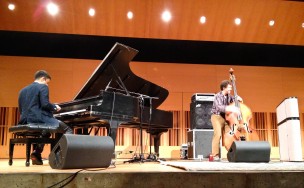
Iyer’s compositions may fall under the broad umbrella of “jazz,” but their boundaries are more porous: elements of minimalism and other avant-garde and classical styles can be heard throughout. Rhythms, for one, are paramount. On Saturday night, he played a terse repeated pattern on the bass notes with his left hand while waiting to strike with his right, emphasizing the important beats in coordination with the drummer, Tyshawn Sorey MA ’11, who studied in the graduate composition program under both Anthony Braxton and Alvin Lucier and who displayed not only remarkable rhythmic control but also a deftness for creating experimental textures. Iyer also used dynamics both in coordination with and opposition to the bass, played by longtime collaborator Stephan Crump, and drums, where a sudden strike would ring out surprisingly.
At times, Crump, Sorey, and Iyer would appear as if they were off in their own worlds, playing melodic and rhythmic patterns that seemed to have nothing to do with each other until they slowly merged into a cohesive whole. Sorey would, for a moment, lead with an outspoken funk groove before the emphasis shifted to Crump, soloing while Sorey and Iyer dropped out except for the occasional roll to keep the tempo and chord changes.
“It seems like you’re in a different universe every night,” Iyer told Sorey in an intimate pre-performance workshop. “I am, too.”
Between the workshop and a quick interview, The Argus had the chance to talk with Iyer about his music, life so far in the academic world, embodied cognition, and the importance of listening.
The Argus: What have you been teaching over at Harvard?
Vijay Iyer: I started there in January in the music department, and there’s no performance program. There are a lot of people who come to Harvard who are really good musicians but they don’t necessarily come there to study music. There’s a joint program with Harvard and the New England Conservatory, and the best musicians, are in that program, and they do all their music at NEC, and they do something practical at Harvard like econ or pre-med. What I did last term was “Creative Music Critical Practice Studio.” I wanted to see who would show up, see what we could do together, and see what were the needs of the people in that community because I was new there, and there’s no one on faculty who does what I do. It’s a pretty standard music program: scholars of music, ethnomusicologists, some composition faculty there coming out of a postwar European modernism palette, so their points of reference are different.
I had this critical mass of pretty exceptional players, but there were also people who were good in high school who make do with the activities on campus like being in the jazz ensemble. What I found with these students is most of them don’t know the history of the music, don’t know their place in it, and haven’t listened to much besides Miles and Coltrane. I’ve given a lot of stuff to listen to from the last 100 years, and then they played, and we did some critiques in class. Their final project was to collaborate. This to me was what I felt was necessary for that particular gang. And it seems to have stuck, because what I’m doing this term is a graduate seminar, which is now notorious; you may have heard about it. That’s called “Theorizing Improvisation,” and that’s for music scholars, so I have Ph.D. students in ethnomusicology and music theory and historical musicology, and a couple of people from outside the department. A lot of the alums from last semester wanted to continue, pick up where they left off, so I piled them into a seminar called “Creative Music Seminar.” They’re all undergrads, because there aren’t any grad students at Harvard who are ready to deal seriously with music, with creative music, with improvising, who self-identify with that jazz background.
A: There was a recent controversy on social media involving a course syllabus you wrote. Can you explain what happened there?
VI: It’s not even really a controversy; it’s just a lot of online sniping. “Theorizing Improvisation” is a huge reading list, way too much reading, but also on the syllabus I wrote a sort of mini-essay introducing the course, because there hasn’t been anything like it in the department, so I felt like I needed to not exactly sell it but explain it. I thought it was reasonably clear. I had enough visitors to the class who kept asking me to post the syllabus, so I posted it on Facebook as a note. I said, “Here it is,” and linked to it on Twitter. A lot of people were like, “Wow, this is great,” or, “I’m gonna research the sources you’re citing!” But several people sort of had this, “Well this is what happens when jazz goes to the academy! So much talk and so little substance.” I answered back to some of these snarkers; there was this inaccurate portrayal of me as not worthy of being in the field, basically that I’m not authentic. Somebody said, “Well, actually, this is racism, and you should push back.”
It reminded me, a year ago when I got the MacArthur, there was something similar going on online. What I found about all of these people was they hadn’t listened to my music, none of them, not any of it. They were actually speaking about me without listening, and that to me is why it is racism, because you can’t form assumptions about people without finding out some facts, but these folks weren’t interested in the facts.
A: In terms of your research, you have a Ph.D. in music cognition.
VI: Subject-wise, yes. [The program is] an interdisciplinary program at UC Berkeley, where there’s an option that’s rarely used to create your own interdisciplinary doctorate, so that’s what I did. It was named “Technology and the Arts,” and the focus was cognitive science and music.
A: Can you tell me what that is and what your interests there are? As a jazz musician you’ve talked about a more distributive model of thinking about collaboration.
VI: Music perception and cognition is an existing research field. I was stepping into something that was already in motion. I felt that it needed to be supplemented by some other perspectives on music, on what music is. What I found was happening was that scientists were trying to extrapolate from attributes of Western (and in specific 19th century tonal music of Western Europe) and kind of make these rather extravagant claims about the cognitive universals of music. Like, “This is how the brain works,” or, “This is what the musical mind perceives; [it] favors this and not that.” It seems to me they couldn’t disambiguate culture from what they were examining. But they weren’t aware that was the case.
Coming from—I don’t know where I come from, I come from a lot of places—my own aesthetic and artistic priorities are connected to African American music, that whole history, which is quite vast and stands in great distinction to European classical music in a lot of ways. One of the ways is the role of rhythm and also the role of improvisation. Meanwhile I learned about this new perspective on cognition called “embodied cognition,” which was an understanding that the mind is in the body, which seems kind of obvious, but the history of Western thought is influenced by people like Descartes. It’s called “dualism,” this idea of the mind sort of being on some abstract realm that isn’t the body. And this kind of thinking influences views on cognition and views on music and treats, for example, music as an abstraction, as just the abstract play of forms in this intangible space that is not this earthly plane. And I don’t want to rule that out, that is true, but it’s also the case that music is something we do, and something that we do together. It’s found in every human culture on earth, along with dance; that tells you something about its foundational role in human life and particularly its role in what we can call “culture” in the way that humans interact.
This perspective on embodied cognition was coming into being in the late ’80s/early ’90s, and I started thinking along these lines in the mid-’90s, rethinking cognition as something that is contextualized by the body and its environment, so that actually what we call “thought” it some sort of mediating process between sensory input and what you call “motor output,” or the actions of the body. That grounds it. It’s this activity that we do that is full of sensation; it’s very much alive; [it] stimulates our sensory organs. It also involves some coordination of activity, literally bringing the body in sync with others. Thinking of music in those very basic terms, as the sound of human bodies in action, and then understanding how we perceive the sound of bodies, there is a way of prioritizing sounds of bodies when we are listening. We can hear each other in even the midst of a noisy place; we decode it instantly, like, “Oh, that’s a person.” That’s something we’ve evolved to do because it’s useful for us to be able to hear each other, even to hear without seeing. That, to me, makes more sense for a foundation for music perception. You could then call it a kind of empathy; it’s the sense of hearing another person and being able to identify that person as a fellow person, a fellow human being.
That process is still mediated by culture. In particular, we’re able to render ourselves deaf to each other, and that’s a way of kind of revoking personhood or denying personhood. We see it in the literature of the slave era, when whites in or traveling in the South would observe slave music, but they wouldn’t call it music; they’d call it noise. It’s bound up with the idea that they weren’t seen as fellow human beings, and we still see this today in the way people talk about hip-hop for example as not music…. Even the history of jazz has this rejection in the academy until pretty recently.
A: The subaltern can’t play music.
VI: Yes, exactly. [Laughs] I guess I’m interested in that process and how this becomes an overlapping area between science and the humanities because we’re talking about, on the one hand, what seems like a direct and transparent process of perceiving another body through senses, but then we also see how that process is subject to all these cultural forces. That’s basically what the research topic was.
A: When you perform with your trio, in a collaboration with Indian musicians, or even with poets, how does this idea of embodied cognition come into play, in practice?
VI: What I hope is apparent in the music is a process of listening to each other in a way that the listener who is not onstage can then empathize with that process to the point of even imagining themselves to be a part of it. That’s what it boils down to.
It was funny; yesterday I worked with a string quartet that I’ve been collaborating with. They’re sort of classical music stalwarts; they’re the best in the world at what they do. I’ve heard [Franz Schubert’s string quartet] “Death and the Maiden” many times, but I feel like I heard it from scratch yesterday; they really brought it to life. We were warming up at some point, and the second violinist and I just started playing together; she doesn’t think of herself as an improviser or anything like that, and she was just warming up, but I heard her taking her time in a way that was in relation to things I was doing, and it came to a close, and I said, “That was music.” And she said, “Yeah. I felt it, too. So why do you think that is?” I said, “I don’t know, but I think it was because we were listening to each other. As simple as that.”
As a cry of “threes in the air” echoed through the cozy confines of New Haven’s Toad’s Place, Ab-Soul emerged amidst a hazy cloud of weed smoke and neon green lights, rocking his customary black tinted sunglasses with his typically unruly fro tucked neatly beneath a Duke Blue Devils snapback.
An eclectic mix of hip-hop heads and gangly teenagers, many of whom had formed a line outside hours before doors opened, roared after waiting through three opening acts for Ab-Soul to take the stage at 11:15 p.m. While Dreamville Records signee and J. Cole-affiliate Bas, along with local rapper Kid Dop3, did an admirable job of holding down the crowd, it was clear by about 10:30 p.m., after several deafening “Soulo” chants, that it was about time for the so-dubbed “Black Lip Pastor” to take the stage. Ab-Soul’s hype man and DJ, T1, hopped onstage to rile the audience up, and the rapper himself nonchalantly slinked up to the slightly elevated platform as if it were not even his own show, carrying a red solo cup. As he surveyed the crowd, he smiled. “New Haven, what the fuck is up?”
Ab-Soul sits at a crossroads in the hip-hop landscape. On the one hand, he is a part of Top Dawg Entertainment (TDE for short), the record label chiefly comprised of Kendrick Lamar, Schoolboy Q, Soul, and Jay Rock, which has taken the industry by storm the past two years. The self-dubbed “Black Hippy” crew cut their teeth on the underground rap circuit in Los Angeles until, after years of accumulating critical acclaim and a loyal following, they were pushed into the consciousness of mainstream rap with the release of Kendrick’s classic Good Kid, M.A.A.D City in 2012. In 2014, after Schoolboy Q released Oxymoron, buoyed by hits such as “Collard Greens” and “Man of The Year,” TDE President Punch promised the label would drop six projects this year, priming Ab-Soul to be the next Black Hippy to ascend to rap’s throne. In June, Ab-Soul released his major label debut, These Days, and while the project was met with general approval, it failed to resonate as deeply with its audience as Good Kid and Oxymoron, or to cross over into rap’s mainstream.
It is primarily because Ab-Soul refuses to conform to major label pressure and to drop radio-ready singles that he has been unable to catch up to luminaries such as Kendrick and Schoolboy, whom he once surpassed in appeal. This leaves Ab-Soul with the delicate choice of continuing to cater to a loyal following that can barely pack the intimate Toad’s Place, or push to join his TDE counterparts. But following the path of Kendrick or Schoolboy does not necessarily mean sacrificing artistic integrity for record sales. Both artists have been able to create music that satisfies at both a creative and commercial level. Rather, it is Ab-Soul’s apparent unease in adapting his style so drastically as to appear chameleon-like and lose his most important asset (a reputation as a technically superior rapper) that causes him to refrain from a drive towards mass recognition.
All of this bubbled just beneath the surface during the opening of Ab-Soul’s set as he furiously ripped through a series of hits from his fan-favorite first project, Control System. During “Terrorist Threats,” Ab-Soul led the entire crowd in a chant of “kick your game, spit your flow, can’t fuck with this Top Dawg shit though.” “Pineal Gland” and “Track Two” established a trippy and almost chilling atmosphere at times. T1’s manipulation of machine-gun-esque 808s into a harsh cacophony of sound prompted Ab-Soul to ask, “We scaring any of you guys yet?”
Ab-Soul has an impressive catalogue of guest appearances on the hits of slightly more established artists—something that he integrated effectively into his live performance. The audience, which regularly rapped along word-for-word verses, became most animated during performances of Chance The Rapper’s “Smoke Again” and Schoolboy Q’s “Druggy Wit Hoes Again.” Ab-Soul’s ability to mesh the work of his colleagues with his own set provided the crowd with a shot of energy at key points in in the concert. House of Pain’s “Jump Around” swirled into Kendrick’s “Backseat Freestyle” in a dizzying display that helped form a context for the space Ab-Soul’s own music occupies in the minds of rap fans.
Introducing the second half of his set, Ab-Soul did his prerequisite investigation of who had listened to These Days, presiding of his performance of “Days” with a workman-like attitude. “Dub Sac,” “Tree of Life,” and “Stigmata” allowed Ab-Soul to flex his loquacious wordplay, and his recital of “Hunnid Stax” literally caused the floor to shake. Audience members who were unable to keep up with the rapper’s dexterous flow had an easier time digesting Mac Miller’s monotonous but catchy hook.
When it was clear that Ab-Soul’s act was winding down, he brought one lucky audience member on stage to freestyle; after rocking the mic for several minutes, the newly recognized rapper began to hand out CDs from his back pocket and shout for a Twitter follow. Ab-Soul closed with “The Book of Soul,” an introspective number that united fans of both his projects. While it is unclear whether Soul will strive to be in the same conversation as his label mates, he was obviously very comfortable at Toad’s Place, spitting for an audience that reminded him that, as he says in “Tree of Life,” “I’m the solution, salute me, absolutely the best.”
Early in the afternoon on Sunday, Oct. 5, students, professors, musicians, and Middletown residents gathered to hear the warm acoustics of Russell House to hear members of the West End String Quartet—comprised of Jessica Meyer and Sarah Washburn on violin, John Biatowas on viola, and Anne Berry on cello—perform classical and modern chamber music works. The West End String Quartet members, playing together since 2005, are not only strong advocates of classical, modern, and contemporary music, but they also direct and coach the chamber music program at Wesleyan. Individually, members also teach at the Hartt School Community Division, Bay Path College, Three Rivers Community College, Greater Hartford Academy of the Arts, The David Einfeldt Chamber Music Seminar at Hartt, and Strings by the Sea in San Diego.
Bringing us back to the days of Mozart, the concert began with the short (by classical standards) and sweet: Wolfgang Amadeus Mozart’s “String Quartet No. 21 in D Major, K. 575,” which immediately captured the audience’s attention. Members of the audience sat onstage surrounding the musicians, which pleasantly gave this event a traditional, intimate feel.
Mozart’s recurring melodies, repeated in different dynamics, tones, and keys, moved audience members to feel as if they were involved in the ongoing conversation happening between the musicians of the quartet. These cantabile, carefree moments captured the blithe and lighthearted persona of Mozart’s music, and the individual technique of each musician allowed them to play cohesively with agile clarity.
Sometime during the first movement, Allegretto, I could not remember where I had recently heard some of those melodies. As a violinist, I naturally began to think about other classical music works and compositions where I might have come across them. When I got home, however, I realized they were actually used in the middle section of the song “Mozart’s House” by UK indie-electronic band Clean Bandit.
Midway through the second movement, I noticed my neighbor’s eyes begin to shut. Rather than being a negative observation, it felt to me to be an indication of the pleasant, lulling quality of the slow Andante section. In the dancing third movement, Menuetto: Allegretto, however, the room’s atmosphere instantly became jubilant and festive. Eyes opened, heads nodded, and I wanted to jump out of my seat and join in with my own violin. The musicians breathed in sync and slightly tapped their feet as they played.
Right before intermission, the group performed Erberk Eryilmaz’s “Miniatures Set No. 4 for String Quartet.” I’d never heard of either the composer or the composition before this concert. This contemporary work was quite interesting, providing a deep insight into the composer’s Turkish background, juxtaposing traditional melodic belly-dancing themes with more contemporary techniques. Each of the five movements was quite short, keeping the audience on its toes as different quartet members began to sporadically yell and randomly tap their instruments and their bows. It understandably shocked the audience at first, but they began to acquiesce and enjoy the piece as it progressed.
We eventually arrived at my favorite portion of the performance: Dmitri Shostakovich’s “String Quartet No. 3 in F Major.” Historically, this string quartet is well known as the one composed by Shostakovich after his “Symphony No. 9,” which was censored by Stalin’s Soviet authorities; as a result, each movement delicately revealed the angst and the pain that Shostakovich felt.
Even if you missed this performance, Russell House hosts a series of concerts throughout the year. They are all great opportunities to experience firsthand a variety of music, played by only the best of the best.
The first thing you observe when you watch Sun Speak play is the chemistry the Chicago duo has cultivated. Matt Gold (guitar) and Nate Friedman (drums) have a Black Keys-esque ability to anticipate one another’s decisions and react accordingly.
Indeed, the two have a long, developed musical relationship that stems back to their time at Oberlin College, from which they graduated just last year. Both majored in music and said they believe the opportunity to interact in and out of Oberlin’s conservatory helped create the partnership they now have today.
Sun Speak’s synchronicity mirrors its style of playing. Gold and Friedman are humble and understated, yet committed to their goals and confident that they can achieve success in music. After graduating, the duo decided to relocate to Chicago and focus on making music full time. They emerged from the studio with Light Blue Light, their debut album, which was released last April. Light Blue Light sounds like the slow awakening from a midday nap. When you wake up, see the sun shining through the blinds, and slowly get ready to resume your day, this is the soundtrack you play.
What makes both Light Blue Light and Sun Speak’s live show so compelling is their ability to play an eclectic mix of rock, jazz, and classical music with subtle hip-hop and African influences. Light Blue Light sounds at times almost ethereal, with simple percussion and guitar parts woven together expertly to create incredibly involved instrumentals.
Their album translated remarkably well to their live performance, and the cozy space of Earth House allowed them to explore the album’s subtleties when they took the stage around 11 p.m. on Friday night. Sun Speak performed for a crowd that clearly wanted an alternative to the raucous scene at DKE or Fountain. Immediately, Speak set a cool tone for their set and the crowd was more than happy to oblige. Soon, nodding and cautious movement quickly turned into more expressive dancing as any inhibitions were lost. Speak’s performance style is decidedly workman-like, another quality the duo shares with The Black Keys. They acknowledged the crowd politely but mostly focused on craftsmanship rather than crowd interaction.
“Thomas in the Whale” sounds even better live than it does on the album, benefiting from drum patterns that swell and emerge fully realized as the song climaxes. “Brain Lake” was one of the more relaxed tracks in a set full of tranquil moments while “Medium Friends” offered a more upbeat vibe. “Friends,” a hip-hop influenced track and one of the highlights of Sun Speak’s set, allowed for some impressive improvisation, a definitive element of Speak’s style and live set.
Though Light Blue Light clearly sounds like a focused effort that never wanders too far from its core, Sun Speak’s live performance allowed the duo to test the boundaries of its material. Indeed, it was Gold’s tremendous skills on the guitar that set up many of the most impressive moments of Speak’s concert, especially on Light Blue Light opener “Harvest.” Gold’s ability to segue from electric to acoustic guitar added a great deal of depth to Light, but was somewhat harder to pull off live without multi-tracking. Nevertheless, his ability to blend his classical jazz roots, which feature heavily in Light Blue Light’s sound, with experimental electric guitar licks makes Sun Speak’s live set a truly appealing listen.
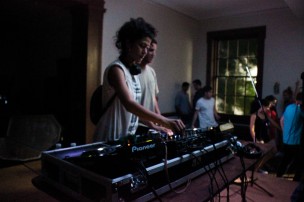
Saturday night’s show at Eclectic was an interesting spectacle: the performance of headliner Nguzunguzu (pronounced en-GOO-zoo-en-GOO-zoo) was beset with problems, although they were met by the organizers with an admirable tenacity. But it helped that the immense crowd present was already in such a good mood from the party atmosphere established by the opening acts.
The concert kicked off at 10 p.m. with a set by student DJ Calhoun Hickox ’15 under the name DOXA. His music was an interesting start to the show; it was much darker and techno-heavy than the rest of the night’s sounds. His music started out slow, building in tempo as time passed yet still retaining a haunting, almost discordant feel.
A performance by Jaime de Venecia ’15, also known as JDV+, followed DOXA. His work was far more energetic and fast-paced, lending itself well to the growing crowd that filled Eclectic. Unbeknownst to most of the audience members, however, a series of crises was unfolding behind the scenes.
The first major issue had occurred about a week earlier, causing a last minute rescheduling.
“Basically, they were trying to make a show in New York at 3 a.m.,” said Jacob Rosenbloom ’15, the show’s organizer. “Originally, I had them set to play from 12:30 to 2 a.m. I never said this was an early show; I had said this was something that would go until 2 a.m. and I expected to have them booked until 2 a.m.”
Rosenbloom navigated around the issue by having Nguzunguzu stay on until 1:15 a.m., with Saarim Zaman ’16 playing a set for the remainder of the show. Just hours before the start time, however, another crisis emerged.
“I was supposed to pick up the artists of Nguzunguzu at 6 p.m., but by the time I got to the airport, their manager texted me saying that they had missed the plane,” Rosenbloom said.
After leaving the airport without the group he was supposed to meet, Rosenbloom then received another text from Nguzunguzu’s manager, telling him that duo’s luggage was on the plane and waiting at Hartford Airport. By this time, however, Rosenbloom was already back on campus. Ultimately, the group managed to catch a train to New Haven and make it to campus around 10:40 p.m. They started playing just 10 minutes later than originally intended, at 10:50 p.m.
Nguzunguzu played a diverse mix. Almost every song had a strange double layer to it. At the forefront were the songs they were mixing, mostly consisting of fast-paced hip-hop and R&B samples, even incorporating a little Rihanna at one point. However, these were all accompanied by some of Nguzunguzu’s own produced work: synth-heavy, slow-paced beats that gave the songs a dreamlike feel. It was this blending of a fast-paced overlay with a much moodier background that made the music so unique.
At 11:50 p.m., the ballroom suddenly lost all power, much to the confusion of both the audience and the two musicians on stage. As it turned out, the electricity to the ballroom had been deliberately cut; somebody most likely flipped the fuse in the building’s basement. Rosenbloom suggested that competing parties, jealous of the show’s large audience, might have been to blame. At any rate, the power was switched back on after just a few minutes, but it was too late to save the evening. Rather than play for another half hour, Nguzunguzu decided to call it quits.
“I was like, ‘Well you signed up for a 90-minute set,’ but they were a little pushy,” Rosenbloom said. “I didn’t want to aggravate them too much because I really did like what they had done. I realized that it was pretty out of their comfort zone; they’d had a pretty stressful day, losing their baggage and missing their flight. So I cut them some slack. I was like, ‘Fine, you ended up playing an hour long set. Zaman could play an hour and fifteen at the end.’”
Zaman DJed a loud and frantic set of remixes, managing to regain some of the momentum lost in the chaos. By this point, however, the ballroom had unfortunately cleared out.
Yet looking back, it would definitely be unfair to say that this series of obstacles stopped it from being an enjoyable night. Throughout the concert, audience members were letting themselves go, even jumping on the stage and dancing with the performers. DOXA and JDV+ deserve a lot of credit for playing excellent sets in the face of the looming issues.
And, despite the crises, Rosenbloom still felt positively about how the show went.
“Last year I planned a show in the WestCo basement, and I thought it was a great show, everyone who came thought it was a great show, but the problem was there were only 10 people who came,” Rosenbloom said. “This time it was the complete opposite, and I had a good time. Seeing 400 people excited for something I organized really means a lot to me.”