
Guest Lecturer Sam Rosenfeld Discusses Hollow Parties, Political Polarization, and Democratic Crisis
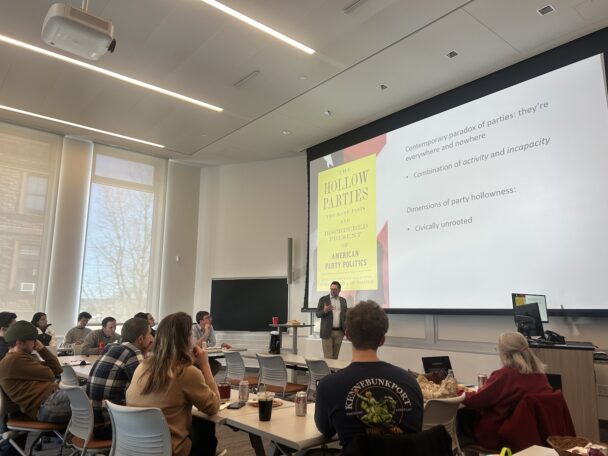
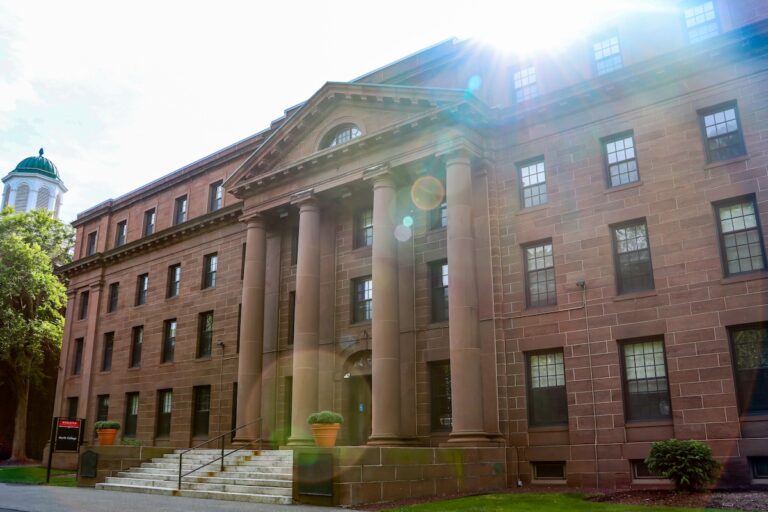
Associate Professor of Political Science at Colgate University Sam Rosenfeld delivered a lecture titled “Hollow Parties and Democratic Crisis” at the Frank Center for Public Affairs (PAC) on Friday, Feb. 13.
Moderated by Logan Dancey, Associate Professor of Government and Faculty Fellow at the Allbritton Center for the Study of Public Life, the event was sponsored by the Government Department, the Allbritton Center for the Study of Public Life, and the PAC. 30 students and faculty members were in attendance.
Rosenfeld’s work explores the development of American political parties, the relationship between social movements and institutions, and the politics of social and economic policymaking in the United States. Additionally, he is co-author of “The Hollow Parties: The Many Pasts and Disordered Present of American Party Politics,” which traces the evolution of American parties from the Jacksonian Era to the present.
Rosenfeld was a Visiting Professor of Government at the University in 2015–16, and his return to campus was not without demand. Dancey arranged the lecture after a student read “The Hollow Parties” and suggested that the University host Rosenfeld for a talk, unaware of his past affiliation.
In the talk, Rosenfeld expounded on the book’s thesis, contending that the polarized and ineffective state of today’s parties is the byproduct of competing traditions that stretch back to the nation’s founding. He began by describing the paradox of strong party polarization and weak party organizations in contemporary American politics, an indicator of “party hollowness.”
“By party hollowness, we mean an incapacity to organize collective action both internally, in terms of making parties’ own decisions in their own name, and externally, in terms of shaping the conflict around them in the broader political arena,” Rosenfeld said in the lecture.
Rosenfeld traced the origins of such hollowness back to the 1970s, highlighting the political and economic transformations of that era. These included the breakup of the New Deal coalition, the rise of economic inequality, the transformation of financial regulations, and the rise of ideological advocacy groups that competed with formal party organizations. Though this affected both the right and the left, it most substantially resulted in the consolidation of a historic conservative movement.
“An array of new advocacy organizations that come loosely to be referred to as the New Right consolidate control over the Republican Party,” Rosenfeld said. “This leads to, out of the kind of world that the transformations of the 1970s make, the dissipation of the process of civic rootedness of parties over time.”
Rosenfeld then elaborated on how this manifests in today’s political landscape, contrasting the experiences of the Democratic and Republican parties in dealing with party hollowness. Specifically, he discussed the former’s struggle to maintain organizational and civic connections with working-class constituencies, and the latter’s failure to police boundaries against extremism, as well as its vulnerability to capture by anti-democratic forces. All this has induced a broader crisis of legitimacy and trust in the United States, which affects both engaged partisans and the mass public.
“I think we’re obviously at a critical moment nationally, and I think it’s important for us to think about some of the themes from this talk,” Dancey said. “Figuring out ways to be involved at the local level and help politics be more community-based can help address national problems.”
Students also appreciated the historical traces mentioned by Rosenfield.
“I wasn’t really anticipating the historical lens through which he talked about things,” Government Majors Committee member Katherine LoCascio ’26 said. “National politics is obviously a big part of everybody’s life, especially here at Wesleyan, and so it was really nice for him to lay out what has changed throughout history and what brought us to this present moment.”
Daniel Chehimi can be reached at dchehimi@wesleyan.edu.
Leave a Reply