Tag: Theater

  • “Showtunes Sideways” Gender-Bends Classic Musicals

    Sofi Goode, Editor-in-Chief

    Fighting the patriarchy, heteronormativity, and all that jazz is a normal part of life at Wesleyan. But last Friday, March 27, a group of performers gathered in the WestCo Café to battle against oppressive forces exclusively through the power of musical theater.

    A one-night only, gender-bent cabaret, “Showtunes Sideways” was organized by Maia Nelles-Sager ’17, Philip Heilbron ’18, Aileen Lambert ’16, and Nola Werlinich ’17 in partnership with the Queer Resource Center to raise money for Broadway Cares/Equity Fights AIDS. Sign-ups were held in December and January, but besides encouraging group performances, the coordinators let the acts develop on their own.

    “Anyone who would want to be involved could be involved in any way,” Nelles-Sager said. “My basic premise for all of this was that I wasn’t going to say no to anything.”

    Nelles-Sager’s plan blossomed into a fantastic show, notable for both its diversity and its straight-up entertainment value. The casual backdrop of the WestCo Café, including the live band and cluster of lamps lighting the stage from the front, created an informal atmosphere that blurred the line between audience and performer. Since acts were planned and practiced individually, the final product was a range of song, dance, and dress that left the audience members—including members of the cast—perpetually unsure of what to expect next.

    The lineup played on this uncertainty, placing numbers from musicals as diverse as “Fiddler on the Roof” and “Legally Blonde” one after another.

    Several performances stood out for their energy and finesse. “The Bitch of Living” from Spring Awakening (Nelles-Sager, Lambert, Werlinich, Jess Cummings ’17, Mio Magee ’18, and Alina Whatley ’18) incorporated an active dance number rich with the feeling of teenage rebellion while “Poor Unfortunate Souls” from The Little Mermaid (Max Luton ’17) featured Luton playing piano instead of the band. Dan Storfer ’15 sang a powerful rendition of “Back to Before” from Ragtime in a pair of stiletto boots that were jokingly rumored to be available for purchase. Throughout the night, the band (led by Heilbron) was consistently excellent, adapting to a wide variety of musical numbers and matching the energy of the performers.

    But the two performances that stole the show were Adam Jacobs’s “If I Were a Rich Man, or An Ode to Patriarchy in Bb Minor, in Honor of Leslie Feinberg,” a revision of the song from “Fiddler on the Roof,” and the closing act “The Cell Block Tango,” from Chicago (Dan Bachman ’17, Griffin Deary ’17, Nic de Soto-Foley ’17, Russell Goldman ’17, Ryan Dobrin ’18, and Will McGhee ’17).

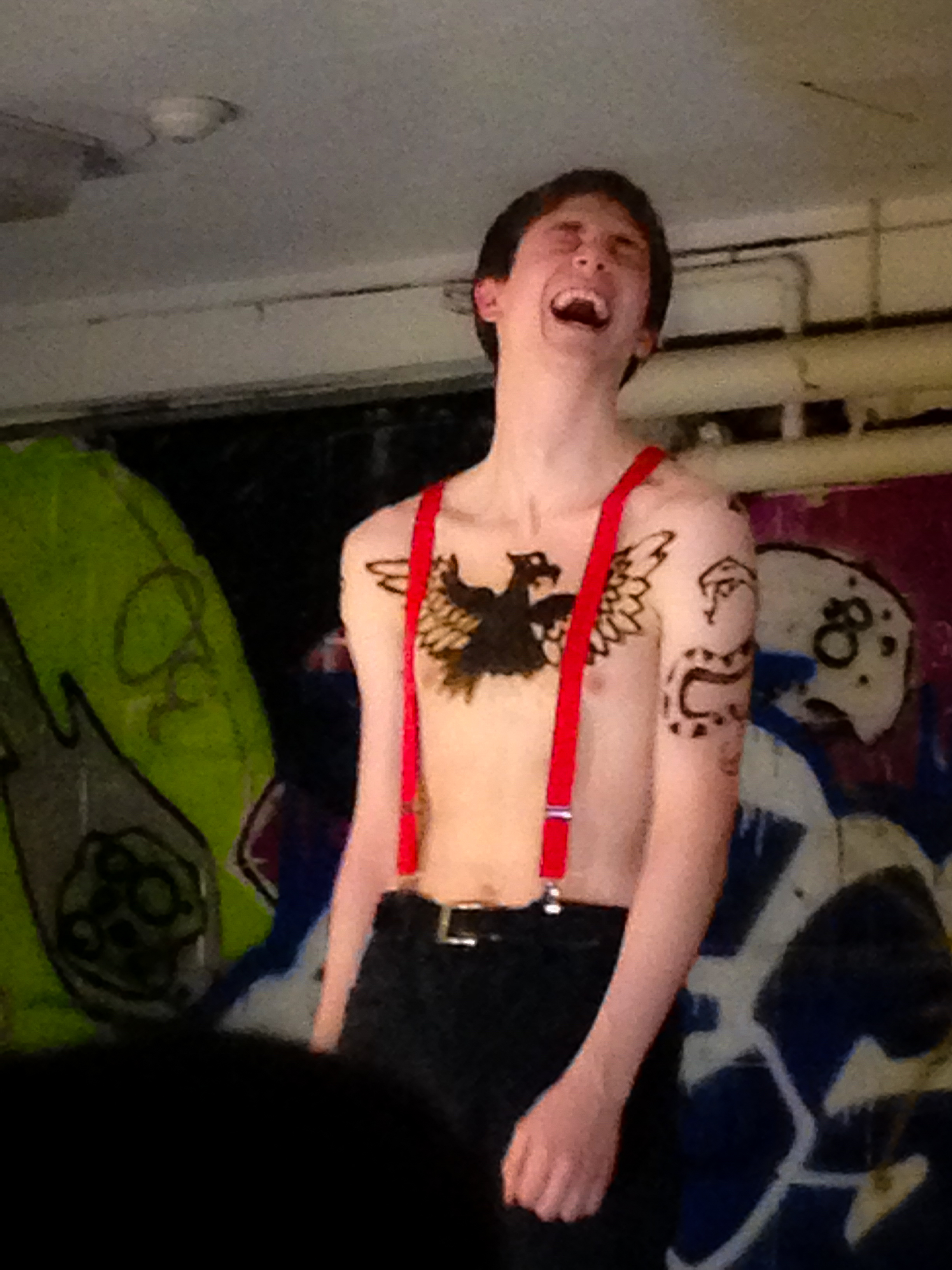
    Jacobs began “If I Were a Rich Man” in drag, smoking, and waving his hands in the air above his head as he turned in a circle. The number, which started out as hilariously entertaining, turned political in the middle as Jacobs altered the song to include class struggles personal to Wesleyan. In addition to including references to Sun Services in the lyrics, Jacobs handed out copies of Wesleyan Student Assembly Resolution 5.36, a resolution targeting first-generation needs, to the audience members. The audience visibly reacted to Jacob’s take on the song, applauding his changes and calling out to him as he continued to sing.

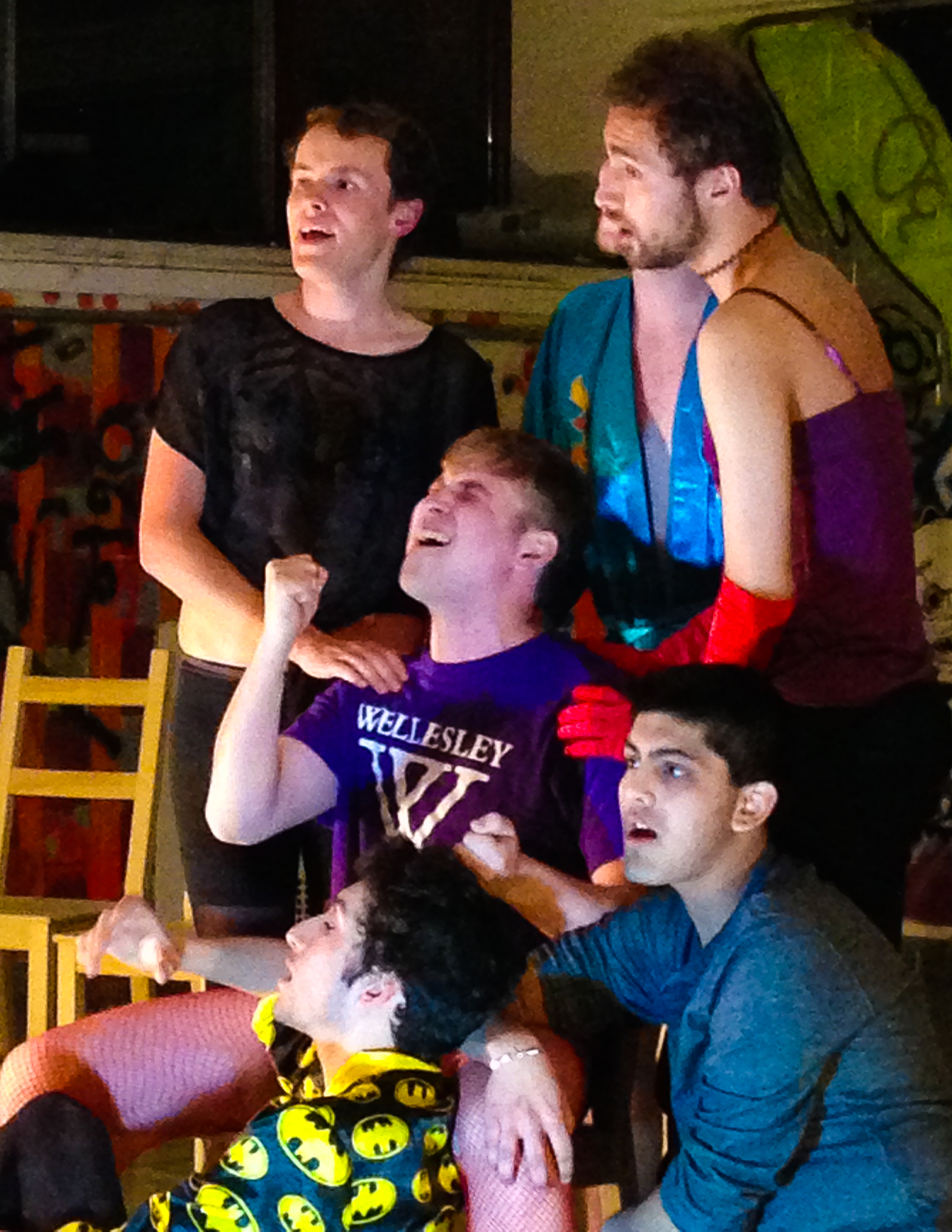
    “The Cell Block Tango” was sheer hilarity. The six merry murderesses of the Cook County Jail sported a selection of ripped fish-net tights, blood-red elbow length gloves, and one bright blue bathrobe as they performed choreography by Emily Butcher ’17. The monologues within the song gave each a chance to solo, and their number gave the show a loud and powerful conclusion.

    “Showtunes Sideways” was an active and enjoyable change of pace in the Wesleyan theater community, and its success has encouraged the organizers to consider putting it together annually.

    “It was very queer and I think there’s not enough queer events on this campus,” Nelles-Sager said. “It’s also sometimes really hard to do theater on this campus that’s not involved with Second Stage…. Everyone did a lot of work for it on their own. We asked for a show without giving any schedule or rehearsals or anything, and they did it, which is awesome.”

    Correction: A previous version of this article listed the event name as “Broadway Backwards.” The title of the event was changed after it was hosted.

  • “Sontag: Reborn” Explores The Duality of Private Life

    On Oct. 2, The Center for the Arts welcomed The Builders Association for a two night performance of “Sontag: Reborn,” directed by Marianne Weems. Founded in 1994, The Builders Association is a New York-based performance and media company, using innovative ways to implement digital media on stage and create unique performances.

    “Sontag: Reborn” is an adaptation by Moe Angelos, the show’s sole performer, of Susan Sontag’s journals. It follows the life of the world-renowned figure from her teens to the beginning of fame. Using multiple layers of digital media “Sontag: Reborn” transforms her words into an eccentric piece that contrasts with the methods of classic theater.

    Angelos, however, is the shining star of this performance. While a projection of Angelos as the old Sontag is always present on the stage to observe and interact with Angelos herself as the young Sontag, “Sontag: Reborn” is one of few pieces that fully manages to expose the deepest and the most private sides of an icon to its audience. Angelos owns the stage with her confidence, voice and subtle physical movements; it’s a reminder that there’s more to theater than what’s on Broadway.

    The Argus had the opportunity to sit down and talk to Angelos about her journey through the adaptation, her performance, and the rebirth of an icon.

    The Argus: Why Sontag? What inspired you to adapt this?

    Moe Angelos: It’s a very good question. I think theatrically we don’t often see a portrait of a woman just thinking with a very vivid mind and a really strong drive toward intellect.  So for that I was very drawn to it. Also, Susan Sontag was on the board of directors of The Builders Association many years ago, at the beginning of the company, and she was a friend of Marianne [Weem, artistic director of The Builders Association and director of “Sontag: Reborn”] and a colleague. They worked on a piece together that ultimately was never performed for complicated reasons. But they were friends and Susan Sontag was a mentor to Marianne. So I think there was a bit of that too. And the diaries themselves, the journals, are a goldmine. There is just so much going on there. Because of course any person has many thoughts in their lifetime, in a day even, and to try to capture that life of a mind was very challenging and tantalizing for all of us, to try to make that visible in some small way, because of course you cannot do it entirely.


    A: Since you used a lot of digital media and projections on the screens, when you were adapting this, did you imagine what it would look like or was the final setting different than what you initially imagined?

    MA: I guess a little of both because when I began the project, Marianne and I talked about it a lot and I knew that I was going to do the script. The Builders were going to make this production, so I had in my mind that media is a character in the show. So that character needs something to do. I thought a lot about it and I made little suggestions in the script but Austin [Switser], the video designer, and Dan [Dobson], the sound designer, in conjunction with Laura [Mroczkowski], the lighting designer and of course Marianne, made choices and took it in other directions. Of course I have never seen the show live, I have looked at video representations of it and it is so much more beautiful than anything that was in my mind. I mean I would say things like, ‘We see a cigarette burning in video.’ But I didn’t know where that was going to be or what it would look like; in my mind it was on a screen somewhere. It wasn’t this beautiful sort of gossamer image that’s in front of me, the live performer. That was not in my mind!


    A: How was the process of recording the old Sontag? Was it difficult or challenging? Because she should be constantly talking or making contact…

    MA: Or listening! Oh yeah, that was tricky! What we did was I recorded young Sontag lines in roughly as close as I could get it, the timing. I recorded the lines that I actually say on stage, then we put them in a little digital recorder and I had an earbud. So I sat there for very long takes in old Sontag drag and this thing was playing in my ear and I was just listening, because there are many times in the show where she, the old lady version, interjects. So you have to kind of know the timing on that. I used this digital recording, I was sitting for a very long time smoking or looking at a journal or a magazine or something, and then I would say a line. And then I would listen some more and then say the next line. We had very long takes sometimes because the whole digital track is an hour and twenty minutes long or something. It’s as long as the show. So that’s a long time. We tried to do it in one take but we couldn’t, like I flubbed it or something went wrong or whatever.


    A: Were there any scenes that you really liked or are really special to you?

    MA:  The scenes where I’m talking to the recording of myself are more fun, because there is much more very direct dynamic and we are playing with each other. She, the old version of Sontag, is very consistent in her performance as I like to say, but Emma [the production assistant] is riding how she interjects with me, ’cause she can slow her down and speed her up and fire the queue. So those are really fun, especially; there are a few moments when I, as the performer, acknowledge that she is there and that’s particularly fun to me, because it’s also sort of saying to audience I’m not really Susan Sontag, I’m not really here, I know what’s going on like when I give the finger to myself [the old Sontag projected on screen]. This could never happen of course because this is an older self, looking back on the younger self. Can the younger self see the older self? I guess the younger can in this theatrical context.


    A: I assume you only used two of the three journals in the performance. So how did you decide where to end?

    MA: Yes! Very good question! Well, I decided to end at the point that she steps into her public persona as Susan Sontag. The part of her life before she became a public figure is much more interesting to me that after. We look at all her writing and see, here’s how her career went, although she was a very private person. So we didn’t know too much about her personal life. So there’s still some interest there, but I was really interested in what makes a young person decide? What makes us all decide this is what I’m going to do; I’m going to make myself that. And she was so willful in that activity of constructing herself. That was the interesting part to me so I quit right about when “Notes on Camp” came out, which is only one year or so into the second volume of journals. And then her life really changes because she has access and people recognize her. She has access to incredible people. Actually I didn’t include this, sadly, because the theater-loving part of myself really wished to but it didn’t work, when she takes that trip to London at the very end, even then she has more recognition and therefore people want to talk to her or let her into their worlds and she goes to [English theater director] Peter Brook. Peter Brook’s company in rehearsing in London with [Polish theater director Jerzy] Grotowski. So Grotowski is there, some of his actors, which are Cieślak and some his troops are working with Peter Brook’s actors and Peter Brook is making “Marat/Sade” at that point, and so there is a very interesting dynamic, she is in the room watching their rehearsal and kind of reporting how the rehearsal room goes and it’s totally fascinating to a theater nerd like me. But it didn’t have a place in the show, but because of who she was and her determination, she could get herself into these places where other artists were working and they would allow her to see their process, which is amazing.


    A: This is a solo performance completely, to some extent. How do you feel going on stage knowing that you are going to be the only person there? Is it empowering? Is it frightening? Or how does it feel different than when there are other people on stage?

    MA: Oh my God! It’s terrifying. I have to sort of put it out of my mind and not think about it because last night I was joking about this after the show that at some point, every night in the show or every time I’m performing the show, I’m talking away and I think, “Oh my God! I’m still talking.” I can’t believe it. Isn’t anyone else going to say anything? So there is a certain marathon aspect to it that is daunting and I just say a little prayer, even though I’m not given to prayer, I’m not a religious person. But I just say, “Oh my gosh! Please! Whatever strength I have in me, get me through this.”


    My mental focus has to be very sharp. I really have to work and concentrate on what is the next thing I’m going to say. It’s a lot of words and a lot of big words and a lot of embedded complicated ideas. It’s not dramatic speech. It’s not like, “Hey! How are you doing? I’m good, how are you? What did you do today?” It’s not casual speech. It’s not conversational. It’s theory. There’s a quite a lot of theory in there too. So to make that, so that the audience has a hope of understanding, it’s a lot of work. I have to be very careful in my speech and that takes more work that my daily normal speech.


    A: Did you ever think that you would have another person as the old Sontag? Or was this initially thought of as a solo performance?

    MA: No. Well, we did talk about that. We talked about getting someone else to do it and even the idea of having that person be live on stage, and then that seemed wrong. That would be very tricky. You’d have to do that very carefully, because that sort of is her, in a certain way. Because the image of her as an older woman with the classic white streak of hair, which is in my mind when I’m thinking about Susan Sontag, that’s what I think of. So to embody that, I think, as a live person is very difficult, hard to pull off, but as a film, you know she was such a cinephile too; it sort of elevates it, lifts it up and gives you a lot of room for interpretation.


    A: What is your next step? Would you like to work on more journals or you want to go to some other areas?

    MA: Well, The Builders are working on a new show, which is in completely other direction. It’s another one of our sort of bigger shows that is an adaptation of “The Wizard of Oz.” We have just sort of candy store of fantasy to go into. I’m very much looking forward to that. We’ve done some little workshops and we’ve been playing around with ideas and Dan is assembling a heavy metal band for “The Wizard of Oz,” which I’m super stoked about. We’re going to have a band on stage playing heavy metal because we’re looking at the movie version, not the books, and it’s a musical.

    So that’s many more different directions than Sontag, and it is an adaption too, because we’re taking the book somewhat, histories of Oz and the movie, and we’re trying to adapt that, or translating it into a fantastical, amazing piece of theater. We often start with an existing work, literary work, or something to use as a jumping off point. So adaptation I guess at this point is part of the work but I don’t think I’m too interested in doing solo work. It’s very lonesome. It’s lonesome up there and also the beauty of theater is dynamic, is seeing two people talk to each other or many people talk to each other. That is the living thing that is so wonderful about the theater.


    A: If you could ask Susan Sontag a question now, what would it be?

    MA: Wow! If I could ask her a question, I guess it would be, “Do you forgive me?” I said that as a joke but I sort of mean it too. I think I would ask her was there anything left to do in her life? If she could have more time to live what would she do? Because she loved living even though she was quite a tortured person at times but oh my God, she loved being alive even in that tortured state. I guess I would ask her, “If you had one more day, what would you do?”


    This interview was edited for length.

  • Avenue Q Preview

    Chong Gu/Staff Photographer

    As finals approach, we all need a reason to laugh. What better way to jumpstart that merriment than by watching puppets discuss sex, porn, and racism? This Thursday through Saturday at 7:30 p.m. in Beckham Hall, catch a performance of Robert Lopez and Jeff Marx’s “Avenue Q,” directed by Lily Martin ’14.

    “Avenue Q” marks the third collaboration between Martin and Kayla Stoler ’14, the show’s artistic director. In the past two years, the pair has put on “The 25th Annual Putnam County Spelling Bee” and “Spring Awakening” with overwhelmingly positive reception. “Avenue Q” combines the hilarity of “Spelling Bee” with the musicality of “Spring Awakening,” creating a funny, music-oriented experience.

    “Avenue Q” explores the interconnected lives of various puppets, monsters, and humans who are neighbors. The plot centers on a heartwarming love story, while quite a bit of adult humor spices things up.

    This show is perhaps Martin and Stoler’s most ambitious venture yet due to the incorporation of puppetry. First, they needed to find puppets that were within their price range.

    “Over the summer, I did a lot of research Googling different places that rented out Avenue Q puppets. We were balancing the quality of the puppets with the cost, and I ended up going with RoosterSocks, [a company based in Georgia],” Martin said.

    To raise the nearly two thousand dollars necessary for the puppets, the pair, along with stage manager Hannah Rimm ’15, created a Wesleyan club called the Puppet Collective, whose main mission was to bring Avenue Q puppets to campus.

    The trio also created an Indiegogo campaign where people could openly or anonymously donate to a fund directed toward the puppets. In four days, they raised over $1,500.

    The trio had various rewards for those who donated the most.

    “You could kiss a puppet or get a photo with a puppet,” Stoler said. “The biggest reward, which was our ‘Avenue Q Award,’ was [adopting] a puppet, so your name is in the program.”

    Martin’s grandmother sponsored the puppet Lucy the Slut upon special request.

    Once the puppets were in the directors’ possession, they needed to teach the actors how to use them.

    “It’s definitely a huge other thing to think about when doing musical theater,” Martin said. “Usually you’re a triple threat: you can act, sing, and dance. But now you also have to think about using a puppet.”

    Josef Mehling ’14 stepped in as Puppet Consultant. He led a puppet workshop and worked for over three hours with the actors and the puppets in a mirror exploring how they move. Before the real puppets came, they had rehearsal puppets that the actors took home to practice with. The actors have been working with the performance puppets for the past two weeks.

    The music is also an extremely important aspect of “Avenue Q.” Led by Pit Director Simon Riker ’14, who has been with Martin and Stoler since “Spelling Bee,” the pit band plays difficult scores for the length of the show. Some musicians noted that this music is even more difficult to learn than that featured in “Spring Awakening.”

    Even though the puppets and music are major facets of the show’s appeal, it is the cast that brings them to life.

    Cast members went through a typical musical theater audition process, but in callbacks, they were asked to use sock puppets during scenes. In addition to acting chops, the cast needed to have vocal talent and physical coordination. It was also crucial that the members worked well together.

    Freshmen Max Luton and Julia Morrison, who play Princeton and Kate Monster, respectively, lead the show with gusto and strength. They are onstage for nearly the entire show and sing for just as long, which is undoubtedly a difficult feat. They have magnificent chemistry and stage presence as well.

    Some memorable numbers include “The Internet is for Porn,” an upbeat song that includes the whole cast, “Everyone’s a Little Bit Racist,” which delivers a social critique while invoking laughter, and “The Money Song,” which involves audience participation.

    Simone Hyman ’15 and Solomon Billinkoff ’14 are memorable as the Bad Idea Bears, which function as the angel and devil within one’s conscience. Naturally, there is an inappropriate twist.

    Billinkoff also plays Nicky, whose relationship with his roommate Rod, played by Johnny LaZebnik ’16, resembles that of an old married couple and is the grounding subplot of the show.

    Dan Storfer ’15 plays Trekkie Monster with a voice so deep and grumbling one questions how he can produce it. Katie Solomon ’15 performs a rendition of “Special” as Lucy the Slut that is soulful and attention-grabbing.

    Dominique Moore ’14 keeps all of the cast members in order as Gary Coleman, and Will Stewart ’17 and Zoe Lo ’15 are a hysterical, if unlikely, couple determining what to do with their lives.

    Stoler’s set is magnificent; it is the façade of the buildings on Avenue Q with windows and doors that serve as the perfect backdrop for the action. She also choreographed many of the dance moves, which were clearly difficult to manage with puppets and actors. Some actors noted that moving the puppet one way while moving their own different body part another way was at first nearly impossible. Through her own motions, Stoler helped them coordinate their movements with ease.

    The cast mates simply love one another and their directors.

    “They’re all just such funny people, and even during rehearsals every moment is goofy and crazy and just so much fun,” LaZebnik said.

    Morrison agreed with the sentiment.

    “I really like that everyone is just excited to play all the time; everyone wants to just get onstage and do their thing, and no one has any hesitations,” he said. “It’s all about having fun.”

    “Avenue Q” marks the final collaboration between Stoler and Martin, who feel that this show is bittersweet.

    “I never anticipated being involved in theater at Wesleyan, and I got to use a lot of the skills I didn’t think I would be able to use in college,” said Stoler. “Also, I got to meet a lot of people I don’t think I would have interacted with if I hadn’t been in these shows.”

    Martin is thankful for all of the support the show has received from the Wesleyan community throughout her theater career.

    “It’s such an awesome thing to be able to create such a huge project with so many people,” Martin said. “There are so many people that are involved in different ways, and so many people wanted to get involved. It’s so gratifying to see all these people coming together to create this big project together.”

  • A Deal with the Devil: “Dr. Faustus Lights the Lights” Bargains Way into CFA

    Some facts:

    •Gertude Stein’s avant-garde play, “Dr. Faustus Lights the Lights,” is a libretto originally intended for an opera that was never written.

    •The Theater Department’s production of said stunted libretto goes up this weekend in the CFA Theater.

    •That’s why all those people bleached their hair in funny patterns.

    •The CFA Theater is kind of hard to find. Fellow freshmen, take heed.

    A warning:

    There will be puppets.

    Hairstyles, puppetry, and my sense of direction aside, this weekend’s production of “Dr. Faustus Lights the Lights” should prove an intellectually rewarding endeavor in experimental theater for those brave enough to attend. By “intellectually rewarding,” I mean, “I didn’t get it.”

    Chair of the Theater Department Cláudia Tatinge Nascimento, who directs the play, helped elucidate the meaning of this dense text.

    “Stein was looking for a rupture with modern dramatic conventions,” Nascimento explained. “She’s working with the free flow of association to compose a story that is less based on character psychology or cause consequence and more on a collection of past memories and cultural frames.”

    The format of “Faustus” is unlike anything that might be considered a conventional narrative. The text of the play is more akin to stream-of-consciousness writing or a prose poem than a dialogue. For example, actor Eli Timm ’13 plays a distressed Dr. Faustus at the beginning of the show, rambling almost incomprehensibly. Such existential tidbits as “How do I know that I have a soul to sell?” and “Will it be it? It is it” are repeated again and again throughout the play.

    “The text is very much a dance of repetition,” Nascimento said.

    Textual ambiguity is amplified by a rejection of the concept of self. This play blurs every line between characters there is to blur, and I found myself evaluating the constructed nature of my sense of self and of others within the confines of my limited human consciousness. Stein addresses the multiplicity of the human persona with the character “Marguerite Ida and Helena Annabel,” who is at once one person and two. Due to the nonrealistic nature of the text, audience members will need to leave their preconceptions of reality at the door. In other words: this is some next-level shit.

    “It needs to escape a realistic frame because you can’t be the object and the subject at the same time,” said Nascimento of the play’s meta-physicality. “To me, the play takes place in her head. It’s almost as if there is no character. All of them are Stein.”

    The essential premise of “Faust” is this: Dr. Faustus makes a deal with Mephisto in which he exchanges his soul for unlimited knowledge. Stein updates this German legend by equating unlimited knowledge with white electric light, thus relating man’s competing inner good and evil to a struggle with technology. Dr. Faustus’s conflict with “Marguerite Ida and Helena Annabel” brings additional themes of gender into the mix. For any of you who have recently invented electricity, sold your soul to the devil, or even listened to a little Charlie Daniels Band, this should be right up your alley.

    The actors in “Faustus” embody the text through various artistic disciplines, using speech, dance, movement, and music to create a beautiful multimedia composition. Nascimento’s direction is appropriately unconventional. Multiple actors play the same role, often at the same time.

    “Faustus” is at once a theatrical production and a display of light and sound. Screen projections and experimental lighting designed by an expert team are set to a chilling musical score provided by Demetrio Castellucci (of stage company Dewey Dell, for anyone who saw their performance here last semester).

    When asked if her direction of “Dr. Faustus” had been influenced by her previous work studying intercultural borders in theatre, Nascimento stressed that the concept of a “foreigner” is a universal principle beyond nationality or ethnicity. As individuals restrained by our sense of self, we automatically characterize all others as foreigners. “Faustus” challenges this concept by demanding that actors portray both the self and the other at the same time.

    “When you think about what theater is for other cultures, you encounter performance forms that are not the western canon’s understanding of realism,” Nascimento said. “It’s not a relationship of ‘us and them’ or ‘one and the other,’ but of being the outsider and being in a relationship with outsiders.”

    Nascimento was especially excited to divulge her reason for choosing “Faustus.”

    “I decided to do the play because of the power outage last fall,” she said.

    In this case, art does appear to imitate life.

    If any part of this dense preview piqued your interest, come to the CFA Theater at 8 p.m. this Thursday through Saturday for a thought-provoking hour and a half of modernist drama. If you’re looking to have your mind blown by a deluge of visual and auditory stimulation, immerse yourself in “Faustus” this weekend.

  • “The Pillowman”: An Appropriately Unsettling Start for Second Stage Season

    With the privilege of mounting the first Second Stage production of the semester comes a few challenges. How does a production team go straight into action after an idle six week break? The answer: you pull together a team of Wesleyan theater all-stars and act fast.

    The Pillowman,” a play by Martin McDonagh, tells the eerie story of the writer Katurian K. Katurian (Matt Alexander ’12) and his brother. The product of his maniacal parents’ (Tess Jonas ’15 and Christian Schneider ’14) creative experiment, Katurian writes a series of disturbing short stories in response to his troubled childhood. The plots of his stories begin to intertwine with the activities of his slow-witted brother (Zach Libresco ’13) as well as recent murders of children in his town. The play uncovers the truth about the murders and Katurian’s own horrifying past while questioning the virtue in death.

    Director Nathan Perry ’12 and designer Evan DelGaudio ’12 collaborated to bring McDonagh’s play alive in the ’92 Theater. They knew that putting together a show at the start of the semester would not be easy, but they persevered in their quest to make the production match their vision. The team arrived at Wes well before the end of winter break to construct an unbelievable set designed by DelGaudio. As the script revealed crucial plot twists, DelGaudio’s intricate set design complemented the story with complex space configurations. The scenery used a confined setting to make audience-members feel as though they, too, were trapped with two very intimidating police officers (Richard Starzec ’14 and Julian Silver ’12) in a small interrogation room.

    The actors were presented with an interesting rehearsal schedule upon joining the “Pillowman” team. Although the cast rehearsed prior to winter break, they had about two weeks to reconvene between returning to Wes and opening night.

    “I could have eight weeks, and I’d still be rushed,” said DelGaudio on the accelerated rehearsal process. “I’m always raising the bar.”

    However, the cast showed no signs of panic. By the night of the dress rehearsal, usually an infamous time in the theater world, the actors conducted themselves with flawless rhythm.

    “They’re the best people to work with that I could have possibly gotten in the world,” said Perry.

    The show immediately set an atmosphere of fear and anxiety in the first scene. Silver and Starzec were particularly unsettling as Ariel and Tupolski, two menacing police officers who question Katurian about his alleged crimes. The playful banter, when coupled with the threatening statements of the police officers, made the interactions especially creepy. The audience couldn’t help but laugh at Starzec’s nervous tics, but this became very uncomfortable when the next second he pulled out a gun.

    Jonas, Schneider, and Maddy Oswald ’14 also gave captivating performances as the characters in both Katurian’s fictional and authentic murder plots. In an extremely high-volume show, one of my favorite scenes was between Katurian and his brother, Michael (Libresco)—both Alexander and Libresco captured the complexities of brotherly love, with a few tender moments mixed in with typical sibling quarrels. The damage resulting from their sickening childhood shone through in their convincing performances.

    DelGaudio certainly realized his goal to keep raising the bar. The cast and crew ought to be extremely proud of what was truly a memorable performance in the ’92. “The Pillowman” set an unbelievable standard for Second Stage shows this semester.