Tag: new partners

  • Senior Dance Majors Choreograph Captivating New Works

    Lianne Yun/Staff Photographer

    Six female performers in black clothing and with severe ballet buns kicked off the Fall Senior Dance Thesis concert in the Patricelli ’92 Theater this past weekend. Featuring choreography by seniors Tess Jonas, Stellar Levy, Miranda Orbach, Ibironke Otusile, and Min Suh and starring a cast of performers from the University Dance Department, the five pieces of the concert—the first halves of the majors’ 20-minute theses—complemented one other and formed quite a fascinating collection.

    Orbach’s “reconfigured//form,” which turned out to be the most dramatic piece of the evening, allowed each dancer to enjoy a proper introduction to the audience, either through a delayed entrance or a pose. Dimensionality was key, as dancers often made contact with the floor, either crawling across the space or moving their limbs across the surface. They kept their leg and arm extensions low, with lines often broken either at the knee or the ankle. The loveliest moment came when all of the dancers moved together, traveling across the stage in concentric circles.

    Employing the use of metal barres and a patch of what appeared to be moss or grass, Levy’s “a thousand kisses deep” began to the sound of the sea. Comprised of seven dancers, this cast felt most like a professional dance company. With definite maturity and mutual unity, the dancers created logical, harmonious movement on both the stage and when climbing to-and-fro on the barres. With the dancers flexing and circulating parts of their limbs, this piece broke down the human anatomy into small individual partsbest exemplified in the cast’s sole male dancer and the continuous isolated movement of his torso. His physical control and energy was impeccable.

    In contrast with “a thousand kisses deep,” Otusile’s “Imole” was the evening’s most intimate piece. Opting for no music, this piece relied solely on the partnership and relationship between the two dancers onstage. Although blindfolded, the dancers’ movements were confident, running across stage in loud, percussive stomps. The two dancers would often separate before calling out to each other and reuniting through the use of voice and touch. This call-and-response broke the continual tension on stage, as the dancers grew bolder and bolder in their jumps and leaps. “Imole” luxuriated and took advantage of time, often allowing for long pauses between frantic, loud movements, demanding attention to be paid to every gesture, pose, and sound.

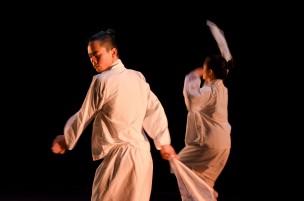
    “Fever Dreams” by Suh incorporated elements of Korean dress, dance, and music. Dressed in white hanboks (traditional Korean semi-formal clothing) and armed with silk scarves, the dancers moved in ambulatory circles similar to a Korean traditional folk dance. While this piece used four performers, the choreography divided the group into partnerships of two, which created fascinating vignettes, so to speak, as the partners touched, met, and guided each other throughout the stage. This element appeared unconventional at times, with dancers supporting each other’s near acrobatic poses and balances.

    Closing the show, Jonas’ “inside voice” mixed the cast’s own spoken word with a musical soundtrack, Her piece was a physical and emotional triumph. Relying only on a single lightbulb, the dancers followed the light and moved either as a whole or in groups of two. The mixing and matching of these dancers enabled some of the most interesting, brief partnerships and lifts, in turn creating a communal, almost familial voice, as evidenced by the continual loops of the dancers wishing each other love and happiness. There was a beautiful sense of symmetry as dancers transitioned on and off stage before returning to dance again with each other.

    Despite being works-in-progress, the performances at the Fall Senior Dance Thesis Concert were delights to behold. The second halves of the theses will surely delight at the upcoming Spring concert.

  • “Fleur d’Orange” Explores Moroccan Womanhood Through Energetic Dance


    The latest installment of the Center for the Art’s “Muslim Women’s Voices at Wesleyan” program, “Fleur d’Orange” tackles the complexities of being a woman in contemporary Moroccan culture. More narrowly, the work draws from choreographer and performer Hend Benali’s experience growing up in Casablanca, Morocco, and training as a ballet dancer from a young age.

    Coming from a culture where women aren’t allowed to dance publicly, Benali incorporates a large range of emotions—sorrow, frustration, happiness—into this astounding work.

    Personally, I came to the performance interested in seeing how Benali’s dance training would translate into such a piece. While there were no definite ballet-like movements—Benali never employed the traditional turnout, for one—I was able to catch glimpses of a “porte de bras,” or elegant carriage of the arms. Regardless of whether or not she chose to harken back to her original training, Benali is, by no doubt, a tour de force. She was a sight to behold onstage, captivating the audience with every movement she mustered forth. She was a fireball of energy, sometimes exploding into seemingly frantic contortions and other times tempering this intensity and curling herself into a small ball.

    Appearing onstage initially in a traditional Moroccan headdress and a long tulle skirt (not dissimilar from a Romantic tutu), Benali manipulated the fabric to create fascinating and captivating shapes. She began with the tulle draped over her head, hiding her face. She later tucked the parts of the skirt into waistline before going into a rousing belly dance. Later, she employed an enormous, long, white cloth, contorting and wrapping herself in it until she she essentially constructed a burqa. Benali used fabric both as a tool and as an intimate dance partner, often pouring her feelings of frustration and agitation into it.

    However, Benali also knew when to employ minimalism, and she spent a good majority of the work’s length in a simple tank top and shorts. She luxuriated with time, showing herself putting her hair back; instead of this seeming like a waste of time, she made it a piece of its own, a singular moment. She later incorporated this theme of singularity in front of a video projection. There, she invited the audience to study and consider the poses she made. Benali isn’t shy with sharing her other talents as well; she often sang and hummed as she danced. She would create music herself, stamping a beat of her own.

    Joining her onstage were fellow dancer and collaborator Souifane Karim and composer-musician Mochine Imraharn. Karim complemented Benali and had his own moments to shine. Incorporating elements of hip-hop, Karim also moved with deliberate precision. He manipulated his own body, moving a leg with an arm or vice versa, responding perfectly to Imraharn’s musical arrangements, using every beat to make his body seem to pop. Though not himself particularly kinetic, Imraharn used live instruments and recordings to create a fascinating atmosphere, further weaving contemporary and traditional Moroccan culture.

    “Fleur d’Orange” asked viewers to consider what it is to dance and, more specifically, what it is to dance as a Moroccan woman. There is definitely joy in it, as demonstrated by the early belly dance. However, there is also pain and a feeling of defeat from having to hide this kind of joy. When Benali contorted, she seemed to contort with the need to move but without any outlet to do so. Karim emphasized this sense of restriction by demonstrating its opposite: He moved easily on stage with open activity. Benali’s multiple costumes illustrated the says in which she must grapple with several identities; she took popular images of women in burqas and women washing clothes and employed them to show the humanity of these unsung dancers.

    Benali and her cast will continue to tour the United States with “Fleur d’Orange” thanks to the Center Stage program, which brings international dancers and musicians to perform in the United States.