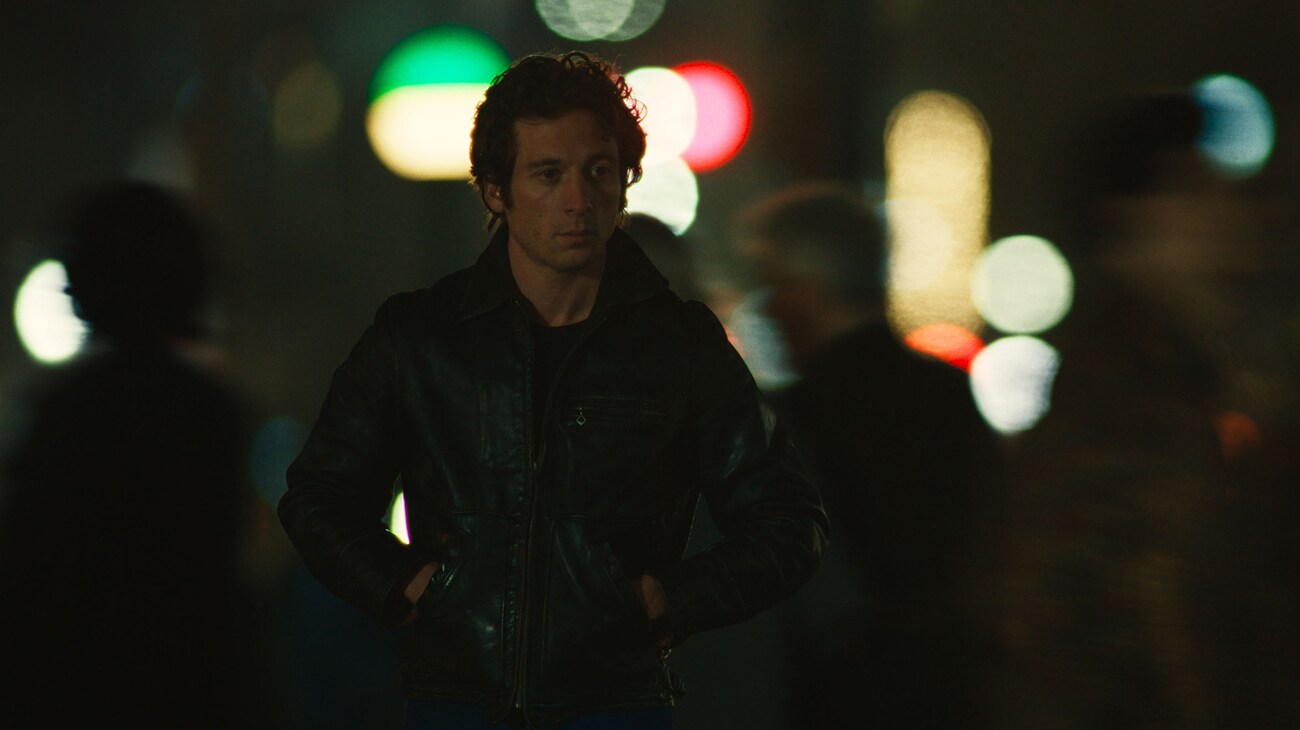
Anyone expecting a cover-to-cover story of Bruce Springsteen in “Springsteen: Deliver Me from Nowhere” will be sorely disappointed. What viewers will find, though, is a desolate year in the life of the arena-rock superstar, when his sorrow and searching were concentrated enough to fill a lifetime.
It’s not often that a big-budget biopic devotes itself to meditations on anguish. But in 1981, that’s exactly where we find Bruce Springsteen—adrift, hurting and unsure of his place in the world. He’s breaking through the charts yet feels increasingly cut off from the working-class America that shaped him and his songwriting. Struggling with that widening chasm, he turns back to his muse, the weary American Dream: dead-end roads, runaway lovers and blue-collar Americans running out of time and luck. These themes not only shape his landmark acoustic album, Nebraska, but also form the emotional core of “Springsteen: Deliver Me from Nowhere.” Unique in its smallness and quietness, “Deliver Me from Nowhere” isn’t just a paean for Nebraska—it’s an evocative exploration of what it means to hurt so deeply it consumes everything.
Jeremy Allen White’s Bruce is lonesome and capricious, exhausted after finishing a thunderous tour for The Riverand not comfortable with the fame his first top 10 single, “Hungry Heart,” has brought him. Spiralling into depression and desperate to get away from the spotlight before he completely burns out, Bruce packs up and heads to Colts Neck, N.J., where he’s famous enough to be sick of hearing his voice on the radio, but not enough to feel out of place. When a local car salesman recognizes Bruce, telling him that he knows who he is, Bruce smiles glibly. “That makes one of us,” he says.
In his search to find himself, Bruce goes through the motions of mundane life: regularly playing local clubs, frequenting diners and watching TV. Inspiration fatefully strikes him out of the blue after he flicks on the TV and stumbles upon Terrence Malick’s 1973 crime drama “Badlands,” based on a real tale of young and aimless American killers. The next day, Bruce buys a multitrack cassette deck and starts laying down Nebraska.
The film powers through the recording of the individual tracks on Nebraska, which appear only for expository’s sake. This is a real shame, since it blows past a chance to peer further into the cracks in Bruce’s soul and to see the rawness he bled into the album, which White conveys with an earnest, unshowy confidence. In the second half, when the film occupies itself with the arduous process of producing the album, we’re offered a second and more substantial glimpse into what these songs mean to Bruce as his manager Jon Landau (Jeremy Strong) and his team struggle to capture the electricity of Bruce’s home demo reel on a record. The strength of Bruce’s conviction and the ensuing tug-of-war between honesty and commercialism push the film toward something genuinely affecting.
Punctuating the 1981 narrative are black-and-white flashbacks of Bruce’s childhood with his vice-ridden, mercurial father, Douglas (Stephen Graham). Douglas is a difficult and domineering figure who tries to instill a sense of good ol’ American masculinity in Bruce, thereby becoming the source of his repressed trauma and hurt. The two are not so dissimilar—with age, Douglas becomes as lonely and lost as his son. Occasionally, these nostalgia-tinged flashbacks come across as unnecessarily artsy flourishes, but in the moments when the two simply share icy silence and when the past blends with the present, the vision sharpens.
The women in Bruce’s life are not afforded the same narrative grace, largely serving as saintly figures who do little other than further the plot. Single mother, waitress, and composite love interest Faye’s (Odessa Young) dates with Bruce are superficial, where they talk about nothing more than their shared music taste and play house together. Jon’s wife, with whom he shares his worries about Bruce, exists for no reason save to be an audience stand-in about as compelling as a piece of tissue paper. At least Bruce’s mother (Gaby Hoffmann) is granted the ability to feel both feverish anger at her husband and real love and concern for him when the chips are down.
The quiet strength that “Deliver Me from Nowhere” possesses shines through most when Bruce is allowed to sit with the swelling, rolling darkness in his mind. When the film bypasses this—speeding through Bruce’s songwriting, his romantic merry-go-round meetups with Faye—the narrative turns cliche and anodyne. But when Bruce drives by his abandoned childhood home and the field in which he used to play and just stops the car to stare, you believe that he’s truly seeing ghosts.
“Deliver Me from Nowhere” is not a success story, though viewers will know from history that the risks Bruce took with Nebraska and with himself will prove themselves justified in the end. This is a portrait of a man at his lowest, who turns away from the promise of quick stardom to take an untrodden, untested road. This is Bruce falling with no one to catch him but himself, and this is the story of how he pulls himself out of a black hole until, at the very end of the tunnel, he is able to face up to his past and his present.
Bruce opens the film looking for “something real in all the noise.” Only at the climax, when he breaks down and cries, does the film finally give it to him.
Wesleyan has multiple programs aimed at promoting local food sourcing, from Bon Appétit’s Farm to Fork initiative, to student-run Local Food Co-op, to student visits to local farms. Still, students have called into question what defines local sourcing and what Wesleyan can do to further support dining sustainability.
Cato Corner Farm Visit
Last Thursday, dozens of students learned about cheese production and met local head cheesemaker, Mark Gillman. Rory Joslin ’28, an Environmental Fellow and fellow at the national Real Food Challenge, organized the event, hoping to inspire a larger interest in the movement for locally sourced food on campus.
Joslin explained that the event was inspired by a class on food systems, which emphasized the importance of supporting local economies.
“I think it’s important to put food money back into a local economy,” Joslin said. “It’s [also] a much better quality normally, because if you have this industrialized agriculture, it’s much more carbon intensive. It’s the practice. It’s really not humane for the animals.”
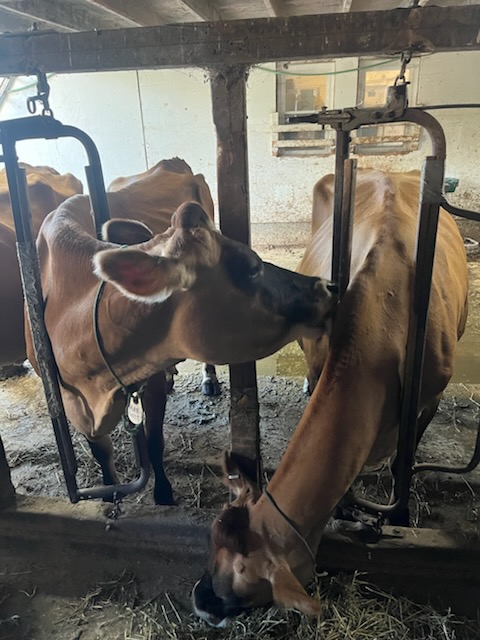
At Cato Corner Farm, Joslin said he saw systems which treated the animals with respect and dignity. Cows come to be milked when they want, he said, and graze from an open pasture.
Students then explored inside the cheese factory and observed the process of cheese creation. They also pet cows.
Cato Farms argued that higher quality animal treatment translates to a higher quality of products, warranting higher costs.
Local Food Co-op
Since 2011, the Local Food Co-op has operated a student-run farm-to-fork meal organization that connects Wesleyan students with local farmers in exchange for meal plan points. Zoe Sonkin ’26 is the Co-op’s operations manager.
“We have bread from Sweet Sage Bakery, eggs, meat, and some produce from Cold Spring,” Sonkin said. “We also have produce from Starlight Garden. And then we get jarred goods from Cold Spring. We got our coffee from Purgatory and our cheese from Cato Corner.”
This semester participants also had the option of choosing jarred goods, which include pickles, jams, and salsas.
“Our goal is to connect Wesleyan students with local farms and producers,” Sonkin said. “And [our goal is also] to push money [from] Bon Appétit to local communities and farmers.”
After Sonkin confirms price points with each farm and delegates how much one share equals, Co-op release a form for swipe night. At the beginning of each semester, students can split shares with up to six people, picking from eight co-ops. Around 400 students participate in a semester. The next sign-up date for Co-op will be in the first week of February.
According to Sonkin, there is also a noticeable quality difference between WesShop and Co-op produce.
“We can get leafy greens or like onions and sweet potatoes and then another week have like, radishes, turnips, squash,” Sonkin said. “So it’s kind of like, you also have to be kind of spontaneous with what you’re cooking and try out new foods.”
Local Co-op is entirely student-run, from communication with the farms to budgeting and delegation.
“All the students do all the stuff,’’ Sonkin said.
Sonkin argued that local farms are slowly getting phased out by corporations, which, she said, care more about capital than the food produced.
“Working conditions are definitely better on smaller farms, and there’s just more respect for the human and the non-human,’’ Sonkin said. ‘‘Just a lot more respect when capital isn’t at the center.”
Because Co-op sells food to students using Wesleyan meal plan points, Bon Appétit manages the finances, taking 20% of revenue from Local Co-op’s earnings in processing fees. Bon Appétit has capped Co-op budget’s to $75,000, limiting the number of food shares they can sell to students. New farms, Sonkin said, are also dissuaded by Bon Appétit’s required extensive forms.
Bon Appétit is owned by Compass, a multinational corporation that produces billions of dollars in revenue each year.
While Wesleyan has committed to a minimum of 20% of the school’s food originating from local sources, Sonkin questioned that local label.
“[Wesleyan’s Farm to Fork program] has a lot less regulation than [Co-op] does for our farms. We like them to be within a 45-minute driving distance.”
Bon Appétit defines locally-sourced as within 150 miles.
While 20% of the food is locally sourced, the other 80% comes from companies including Sysco, Broadliners, and Wesleyan’s produce purveyor. These companies provide large-scale rebates for bulk purchases of their food. Half of Bon Appétit’s parent company Compass’s profit comes from corporate rebates.
Michael Strumpf, the Resident District Manager of Bon Appétit, explained the Wesleyan’s contract with food companies.
Strumpf started in kitchen management in 2004 and has been working at Bon Appétit for over 25 years. In 2007, he began at Bon Appétit management.
Strumpf says they’re always looking to expand into locally sourced items.
“All the tofu we buy is from The Bridge in Middletown,” Strumpf said. “Every Friday, the fish we get is coming right from Red’s Best, out of Boston, and it’s probably less than 24 hours out of the water when we get it. So that’s a farm-to-fork fisherman. It’s really cool.”
Feeding everyone at Wesleyan (118 full and part-time union employees, student workers, and 3000 students on a meal plan) can be tricky, however.
“You can’t please everybody every given day, right?” Strumpf said. “Especially with food, it’s very subjective. A huge challenge these days is food allergies, you know, and it’s something that keeps me awake at night. And it takes a lot of eyes on what’s going on, and making sure you’re keeping everybody safe.”
Strumpf says he sees an effort in student activism for sustainable sourcing of food.
“I also oversee operations at Stonehill College in Massachusetts, and the students there [are] nothing like the students here,” Strumpf said. “They’re not engaged. They don’t have the same level of interest as the Wesleyan students. That’s for sure.”
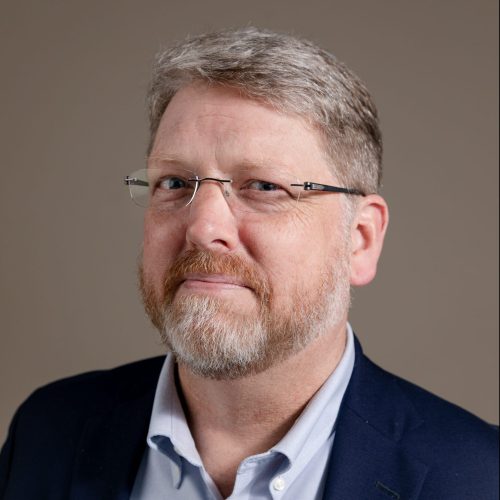
Stephen Busemeyer has worked as a journalist for over 30 years. Today, he is the managing editor at the Connecticut Mirror and the University’s current Koeppel Journalism Fellow; his introductory data journalism course attracts everyone from STEM students to Argus writers. This month, The Argus sat down with Busemeyer to discuss his early years as a reporter, holding the government accountable, and the role of emerging AI technology in journalism.
The Argus: How did you discover data journalism? What brought you to this career?
Stephen Busemeyer: You know how there’s always one person in the room who knows how to work the printer or unjam the copy machine? That was always me. Years ago, when I was an editor at the Hartford Courant, the managing editor had an idea. On the front page of USA Today every day, they had a little statistical item, just some dumb, random statistic. So the managing editor said, “Hey, I think it would be a great idea to do something like that in the Hartford Courant. Let’s ask Bus; he knows how computers work.”
So, I started this weekly column called CT Stats. This was probably in 2005, 2006, so it was before there was any good software. The best websites were where you click on a link and get text. So I did this weekly statistic on Connecticut. The first one I did was: How many leaves are there on a tree in Connecticut? And I called somebody at the Agricultural Extension office. They went out into the woods and collected thousands and thousands of leaves in bags. They took a thousand birch leaves and weighed them to get an average birch leaf weight, and maple leaves and oak leaves, and so on. And they did the math, and they came up with 72,000 some odd leaves per tree on average in Connecticut. I was kind of hooked after that.
I was basically self-taught in this very rudimentary way. Just here’s a spreadsheet; find a story in the data. Find a stat that’s relevant to the news. What’s the story in the data? And that’s what I ask my students. That’s what I ask my reporters every day, when we’re looking at election returns or whatever it happens to be. There are all kinds of ways to present data interactively to the readers. Finding the story of the data is ultimately about getting the readers closer to public policy, closer to understanding what’s going on in the world, and giving them that other avenue instead of just words.
A: How has the rise of technology changed the nature of your journalistic work?
SB: In very important ways, it hasn’t changed. The story’s the same: what’s the story in the data? I worked on a team at the Courant that looked at the 2000 decennial census. We found some stories in the data, and we wrote 10 different stories about them. And then as time went on, I had a program that let people get interactive with the data to see how many people were in their town this year, or what the population increase was in their town. The data tells the same story; you can just access it in a different way, make it a little bit easier for the readers. The goal of journalism is to let you ask more.
A: What kinds of stories do you enjoy covering most?
SB: I love catching bad guys, especially dirty cops. Sometimes that is a data story. The movie “Spotlight” is about how the Boston Globe broke the story about the Catholic Church shuffling around predatory priests. It was a data journalism story. They looked through rosters of where priests were relocated. I thought that maybe it was possible that Connecticut did the same thing with police officers who were not necessarily fit for duty and had a bunch of disciplinary issues in their personnel file. Maybe they got quietly shuffled from department to department. So we looked at it as a data question. There is something in Connecticut called the Post Police Officer Standards and Training, and they file forms every time a police officer is moved into or moved out of a specific department. It’s the same thing as “Spotlight,” when they’re looking at the priests who are moved around different parishes. We did not find a big pattern of behavior. We found a few police officers who were clearly moved around because no department could deal with them after a while, but not enough to do a big statewide policy story saying Connecticut’s got to get its act together because all these bad things are happening. I love doing stories like that, finding out the things that people don’t want to be found out and sharing them with the world.
For years, the state had an obligation to print and report all the unclaimed property that it collected that belonged to its citizens, and it did that by taking out massive advertisements in the newspaper that listed everybody who was owed money by the state of Connecticut. The problem was that the list ran into millions of people, and most of the people were only owed one cent or two cents. The legislature changed the law so that anybody who was owed under 50 bucks wouldn’t have to be printed. This goes on for years. Newspapers evolve, and the internet shows up. The Treasury Department starts posting this list online. They got the law changed. On the State Treasurer’s website, you could search for your name, and if the state owed you money, they would send you a check unless it was $50 or less. They still didn’t report on $50 or less. We find this out. We believe there could be millions of dollars the state is keeping in its pocket.
Eventually, we got them to print out a list of everyone who was owed any amount of money. Guess how many pages the PDF was, how many names per page? How about a 330,000 page PDF? We returned millions and millions of dollars to state taxpayers, who before the story, had no way to see if they were owed money. I was owed $10.47 and got it back. That’s the kind of story I love to see.
A: How much has AI changed the journalistic landscape? How much of a role is it playing in your work, and how much of a role do you believe it should play?
SB: We are aggressively adopting AI in the “Connecticut Mirror” newsroom. We use it daily, not to write stories, but to do simpler tasks, like asking it to scrape my website to give me a list of stories we published today. I had a couple of PDFs that I needed scraped last night, and I just dumped them into ChatGPT. There are 169 towns in Connecticut, each with their own governments. If we want to know if there are similar issues being discussed in each town, we can’t go to every meeting. But I can ask ChatGPT to look at all of them. We’re using it as much as possible. We’d be silly not to, and all of journalism should be going that way.
A: How do you navigate your various roles—managing editor, reporter, and professor—at once?
SB: I’ve been teaching on and off since 1993 when I was a Ph.D. candidate at the University of Colorado. I taught public speaking and organizational communication. I left for journalism and reporting. A lot of it is just asking questions and thinking clearly. Any sort of writing is pursuing a theory, pursuing a hypothesis. You need the clarity of thought to figure out exactly what you’re doing, how to structure a study, a research project, anything like that. Even abstract writing is the same as writing a story, writing a piece of code. Then, in a way, teaching in a classroom, the performance art part of it is similar. Every night I have a narrative arc. I like teaching. It’s been one of the best parts of my professional career. It’s the same reason I’m in journalism: I have found something out about the world, and I want you to know about it.
A: What advice would you give to aspiring journalists at the University? Is the industry harder to break into than it once was?
SB: It’s extraordinarily difficult, but it’s also exactly the same. Journalism has always been about finding things out that nobody knows and writing it down. The industry has changed; obviously, there are many fewer newspapers. Attention is under more pressure than ever before from the unbelievable amount of channels that we’re all forced to deal with. Social media takes up a lot of time. Life takes up a lot of time. Competing for people’s attention is tough.
It’s difficult to expect a college student like you, or a mom with two kids, a dad with two kids, trying to navigate life, trying to keep the house in one piece, trying to keep the cars running, trying to take care of their children, trying to keep their relationship intact, trying to keep up with national politics, being bombarded with all these opinions, and then being asked to vote in your municipal election on issues that you have you have no idea about: That is hard. Our challenge as journalists, more than ever, is to make news as easy as we can. That means mastering social media, having video chops, having audio chops, and understanding your audience.
A: You’ve worked for decades as a journalist in Connecticut, but you also had stints at newspapers in Wyoming and Colorado. What were those experiences like? What differences have you observed when reporting within varying political contexts?
SB: Reporters, by nature, have certain biases. They think it’s good for people to know things, and they abhor authoritative governmental figures. We take our watchdog role seriously; that naturally will bring you a bunch of malcontents as reporters: people who are more willing to challenge authority.
In my very small newsroom in Colorado with four reporters, we didn’t really talk about politics that much among ourselves. And it was the mid-90s, Newt Gingrich was the Speaker of the House. Politics was a kind of a different situation back then. There were a lot of very religious folks in northwest Colorado, including a lot of the presence of the Mormon church, and a lot of Christian church folks. There was a very strong Republican Party, a lot of guns, a lot of beef, kind of what you would expect. But the tenor was much different than what it is today. Everybody got along. Everybody’s cattle had the same problems. And if your cow was having trouble, everybody went and held your cow. I think the sense of community out west was always very strong.
My time in Wyoming was colored by the murder of Matthew Shepard. He was a young gay kid who went to the University of Wyoming. That was a real turning point that led to a lot of hate crimes legislation. At that moment, the Casper Star Tribune, which was known as a fairly loyal paper and fairly conservative, put its editorial neck out there a little bit. But there was no pushback. There were no death threats or anything like that. Politics was—it was okay. Everybody had political differences: You went to this church, they went to that church, they rooted for the Broncos and you rooted for this other team. Of course, we all had differences, but not so much compared to the huge differences today.
A: Who’s the most interesting person you’ve interviewed and why?
SB: I can’t categorically say that he was the most interesting, but it was a very interesting interview: John Kasich. He was a Republican, one of the people who ran against Trump.
This is when I was on the editorial board at the Hartford Courant. He was one of the candidates who stopped in to be interviewed by us. This tells you how quickly things have changed since then. Not even ten years ago, political candidates visited editorial boards, and editorial boards took their role very seriously, vetting candidates, asking hard questions, and making endorsements and recommendations. Kasich was interesting. He was a Republican, but he wasn’t a Tea Party Republican. He was very thoughtful, very smart, and very decisive. One of those guys that made me think, “Oh, maybe this guy’s got the sauce that could make a good president.”
Al Gore Jr. was an interesting interviewee. He wrote to Tesla to argue that Connecticut should have different laws regarding direct sales to consumers. You can’t buy a Tesla in Connecticut directly. You have to go to New York in Connecticut: There’s a law here with your dealers. And he and somebody from Tesla came by to argue that it was bullshit. I think I editorialized in their favor, actually. He was funny. I made him laugh.
This interview has been edited for length and clarity.
This piece is part of Letters on Pragmatic Hope, an essay series in which Wesleyan professors and administrators reflect on a daunting question: How can students act with purpose and efficacy amid an increasingly authoritarian environment? The series aims to gather responses from a diverse group of Wesleyan faculty, offering a vision for how students can turn despair into pragmatism and action.
After being asked to write about “pragmatic hope,” I felt the usual professor’s impulse to question the premise. I’m wary of indulging in this and dodging the issue, yet there’s something in the term itself that seems worth exploring. “Pragmatic hope,” on the face of it, sounds like a coping mechanism: a way to steel yourself in bad times and build resilience to carry on. That’s a valuable attitude to have. When students are feeling powerless and resigned, when there’s a culture of fear and apathy taking hold on university campuses and the daily news cycle brings fresh reasons for despair, we absolutely need ways to deal with that and not give in to paralysis.
I wonder, though, whether there’s also room for thinking about hope a bit differently, as a search for and response to the good, not just as a response to the bad. Let’s call this “aspirational hope,” so we have a label. I don’t mean to put it forward as a substitute for pragmatic hope. I mean it as something complementary that involves actively seeking out and embracing the good in the world and in other people, rather than simply guarding ourselves against what’s bad.
For me, this sense of hope originates in the classroom. It’s something I feel consistently as a teacher, but its roots are in my own experience as a student. My first encounter with philosophy as a subject in college was the first time in my education I felt genuinely respected as a thinker. The expectation that I engage with someone else’s ideas so deeply and try to read even the most distant and imposing figures in the history of philosophy on their own terms—that this was all they asked of me, really, that I come to understand their views (as it were) from the inside—this was a totally different habit of study for me. Learning was no longer a form of preening or about memorizing doctrines and reciting bits of knowledge to claim a badge of status. It was about thinking alongside these texts and their authors with others.
This was liberating and it continues to thrill me. Philosophy done right is invitational rather than instructional: it doesn’t tell you what to think; it invites you to think. It treats you as someone capable of grappling with difficult views and the reasons behind them, of seeing their force, of raising questions about them. It assumes your perspective matters, that your confusions and objections and insights are worth taking seriously. And through that invitation, by participating in a practice of shared inquiry, you exercise your capacity to engage seriously and playfully in the give and take of ideas, to analyze and evaluate them, to have fun with them, and to forge new ways of thinking for yourself.
An invitational approach to learning isn’t unique to philosophy as a subject. I now see it as central to a college education in general, and really to education as a whole. Over the last few years I’ve been discovering the work of bell hooks, who makes this point wonderfully in “Theory as Liberatory Practice”—an essay everyone should read and reread! What hooks means by “theory” in this piece isn’t some jargon-laden academic exercise removed from practical life. She sees it as an activity and a site of healing, born from a spirit of relentless questioning and the desire to understand. She also depicts it notably as a political activity, viewed broadly as the practice of seeking out a way to belong in the world with others.
hooks describes doing this kind of theorizing even as a young child growing up in the segregated South, seeing things differently than her parents, “wanting to comprehend—to grasp what was happening around and within me.” She writes about “desperately trying to discover the place of my belonging.” The work of theorizing and understanding, on this view, is an intensely human activity, something we do from our earliest years in trying to make sense of our experience, in navigating our relations with others and figuring out where and how we fit in. It begins long before any college seminar room.
What education does, at its best, is provide the tools and the space to do this work thoughtfully in community with others. It recognizes and respects the human need to comprehend the world and find our bearings in it. Such work is shaped by questions, disagreements, perplexity, and moments of deep wonder. It develops in real time and gradually, often in fits and starts. And because it has these features, despite what our tech overlords might claim, the work of understanding cannot be outsourced. An AI bot cannot do your thinking for you; it cannot do theory in hooks’ sense. The classroom remains the most essential space for what she calls the “lived experience of theorizing.”
All of this also makes the classroom a threat to authoritarianism. For the work of understanding requires that you think for yourself, and the best independent thinking is formed through collaborative thinking. The social habits that a classroom fosters make this work vibrant and deliberate. They’re habits of perception and engagement that demand the devotion of attention. In the classroom, you develop the ability to listen to and consider different perspectives charitably. You test hypotheses and interpretations carefully. You recognize and sit with confusion instead of rushing past it. You ask questions to open up rather than shut down discussion.
So when authoritarian voices speak of universities as the “enemy,” there’s more truth to that claim than they care to admit. Universities present a threat to authoritarianism because of the practices they sustain. What an authoritarian regime requires is incompatible with what’s formed in the classroom. Authoritarianism needs closed thinking, mistrust of difference, impatience with complexity and confusion, the acceptance of easy narratives. To create the conditions of fear in which it operates, it marshals the language of exclusion and isolation.
The classroom, however, is a space of maximal inclusion. It cultivates capacities that authoritarianism can’t accommodate. Most authoritarian rhetoric works by trying to box us into either/or modes of reasoning. Binary framing devices of this sort are effective since they’re part of how we’re conditioned to see the world. When you’re in a classroom space, you’re asked to move beyond such conditioning. Before adopting an either/or framework, you’re invited to see things in both/and terms. Or even as neither/nor! That’s the kind of reasoning that can spark your imagination. Along with independent thinking, it promotes creative thinking.
This means that the first move in resisting authoritarianism may be surprisingly ordinary: stay curious. Be interested in people with different outlooks and experiences than yours. Be wary of narratives—both comforting and alarming—that confirm your convictions without friction. Seek conversations that require patience instead of certainty, nuance instead of slogans. In over fifteen years of teaching, I’ve seen how the classroom enables the formation of these capacities as part of the collaborative work of understanding.
Know, too, that doing this work requires trust. The portrayal of universities as leftist enclaves out of touch with real-world concerns is a shallow caricature, easily weaponized to provoke public suspicion and agitation. But what’s more concerning is the way this portrayal reshapes academic life itself by provoking a climate of self-censorship on campuses. In such a climate, students cut short their own lines of thought preemptively, afraid that their unformed and perhaps unorthodox ideas might be misinterpreted or make them targets. Faculty likewise find themselves hesitating in approaching sensitive topics, subtly recalibrating syllabi and discussion plans out of an abundance of caution. University administrators worry that unless they adopt restrictive disciplinary policies and are perceived as doing something, their institutions will suffer repercussions.
So the next move in resisting authoritarianism is to resist the politics of provocation. And that means developing trust. The classroom relies on a culture of hope for shared inquiry to work. A culture of fear deforms that work. The hope I’m referring to is an implicit compact and feeling of confidence that in the classroom we attend to one another generously without policing each other’s thinking, trusting in our mutual commitment to explore ideas together without knowing where we’ll end up. When that trust’s in place, you’re motivated to ask questions and follow arguments where they lead. The quality of discussion lies in the quality of attention you give others and believe you’ll receive from others, rather than in performing the right answers and having conclusions scripted in advance.
I see this sort of hope as aspirational and not just pragmatic because it’s more than mere resilience during bad times. Authoritarian movements succeed primarily by hollowing out shared visions of the good. Their power grows when the language of politics becomes purely oppositional and people are united solely by what they reject. Aspirational hope insists instead on what draws us toward one another: the need to understand and belong, the prospect of living in a common world. We should encourage this at all times, from a sense that when we address differences wanting to comprehend things better, we bring out the best in ourselves and each other.
None of this is to downplay the assaults on democratic values we’re currently facing. On the contrary, I’m arguing that the capacities the classroom cultivates are the ground on which durable democratic life depends. Universities remain one of the few environments where young people from diverse backgrounds get together to ask fundamental questions about how to interpret the world and their place in it. But to view this period as a pause before the “real world” or as separate from political life is (again) a type of binary thinking. If we think of education alternatively as a mode of democratic life itself, then the classroom’s invitations—to listen, to inquire, to imagine—extend naturally into how we build communities beyond campus. This is because the habits of classroom life are the habits of genuine citizenship: the ability to think with care and appreciate complexity, the willingness to engage with perspectives unfamiliar to your own. They’re the habits that hold a diverse society together. To defend one is to defend the other.
Tushar Irani is a Professor of Philosophy and Letters. He can be reached at tirani@wesleyan.edu.
On Saturday, Oct. 11, Wesleyan women’s soccer lost a 0–1 nail-biter to no. 9 ranked Williams. After a ferocious start to the season, the loss was a blow to the Cards during a difficult stretch of important conference games.
“Williams was a wake up call,” captain Molly Brumbach ’26 said. “Any loss, especially a loss where you think you can do better, gives you an opportunity to really learn about yourself and why you’re not able to maybe perform as well in certain games.”
In their final non-conference game of the regular season against Rhode Island College on Tuesday, Oct. 14, the Cards looked to get some momentum. And after only 10 minutes of scoreless soccer, they defined their sense of momentum. Maria Utz ’27 dished a cross to captain Riley Buehler ’26 at the top of the box, and Buehler put it in to get the scoring started. Two minutes later, Utz got on the board herself with a beautiful left-footed goal. Then, only three minutes later, Utz was setting up her teammates once again, giving Stefanie Stoj ’26 a great look from the goal line to net another. In a ridiculous five-minute stretch, the Cards went up 3–0. While the Anchormen were able to get one back, Utz put her last mark on the game with 22 seconds to go, netting her second goal for a 4–1 final score.
The offensive outburst freed up the Red and Black to try different rotations and gain confidence.
“That definitely is a confidence-boosting game,” captain Tori Rideau-Winds ’26 said. “And I think games like that are really important in terms of allowing everybody on the team to play, and giving confidence to the people who don’t always see the field. Making sure [that] as a whole, we are able to stay at a high level and know that we are all contributing.”
While the resounding win boosted confidence around the team, the Cards still sat at 2–2–3 in-conference, and would need to make the most of their three remaining NESCAC games to secure a spot in the playoffs.
On Saturday, Oct. 18, Bowdoin came to town to try and spoil the party. The Red and Black put up a solid attack in the first half, outshooting the Polar Bears 12–6, but the game remained scoreless. The Cards got even more chances in the second half, but were not able to convert on them. The Polar Bears, on the other hand, were able to, scoring in the 49th and 85th minutes to hand the Cards a 0–2 loss.
While it was a tough loss to take, the Cards knew that at this stage in the season, they just had to keep moving and trust the work they had already done.
“They had two lucky chances that they were able to put in, but that was kind of a difficult one,” Utz said. “We knew we really needed those NESCAC wins in order to make the NESCAC Tournament. So that was unfortunate, but going into that week of practice, we just wanted to keep the intensity high, look forward, and not focus on the past.”
On Saturday, Oct. 25, the Cards took the six-hour bus ride to Waterville, Maine, to face Colby. From the Red and Black, there was no love lost for the team that ousted them in last year’s NESCAC Semifinal, their only conference loss of 2024.
This game was the mirror opposite of their battle with the Polar Bears. The Cards’ offense did not get nearly as many chances as Colby, but when they had an opportunity, they made the most of it. In the 23rd minute, Wes was awarded a free kick. Sheridan Snow ’28 did not hesitate and put the ball past the Mules’ goalkeeper to give the Cards a 1–0 lead. From then on, the Mules pushed with everything they had, putting up 14 shots in the first half and 20 in the second—including a stretch of 10 shots in 11 minutes—but the Wes defense turned away all 34 attempts. Brumbach turned in her seventh clean sheet of the season with eight saves. For anchoring the Cards’ defensive masterclass, Brumbach was awarded the NESCAC Player of the Week, her third career honor.
“In soccer, the tightest games are the most focused games,” Rideau-Winds said. “Everybody is giving their all to come out with a win. And I feel that trusting your teammates, with margins so tight, that they are going to do their job, is the whole point of playing a team sport. You build that throughout the season and in preseason, and in moments like that, it shows.”
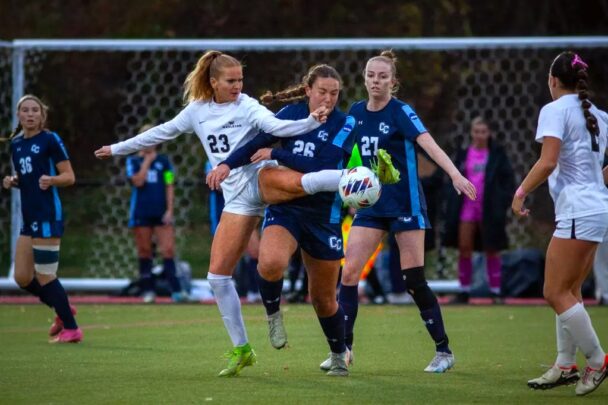
For their final regular-season game, the Cards hosted Conn. College for a midweek battle on Tuesday, Oct. 28. Although the Camels came in at a dismal 1–8–0 in conference, they had been a consistent thorn in the side of the Cards for years. Apart from a double-overtime thriller, which the Cards won in the NESCAC Quarterfinal last year, you have to go back to 2015 for a Wesleyan victory over Conn., with three losses and five draws during the intervening nine years. The Cards wanted to do away with any notion of a curse, and Buehler had what it took to do just that. She scored in the 17th minute to set the tone and then again in the 57th to put the Cards up 2–0. 15 minutes later, Meredith Feiner ’28 put the Cards up by three, and with the defense holding off a mild Camel attack, the Cards secured the win. This win brought them to 4–3–3 in NESCAC games for the year, good for the no. 8 seed.
c/o Finn Feldman
“That was a really fun game,” Brumbach said. “Conn. didn’t have that good of a year, but we haven’t won [against] Conn. in my four years here. They’ve always been a really physical team. We kind of did ride over them, but to remind ourselves that we do have a really good base of soccer and a really good foundation. That can fade away in games like Williams and Bowdoin, when you’re focusing on the loss itself. So I think Conn. was a nice reminder that we’re a really solid group.”
The Red and Black traveled to Medford, Mass., to face Tufts in their NESCAC Quarterfinal match. Their regular-season match ended in a scoreless draw, but, in this one, that was not to be the case. The Jumbos got on the board early and continued to press well, with the Cards only getting off three shots in the first 30 minutes of play. However, they continued to push, and in the 37th minute, Utz tied the game with her 10th goal of the season. The game went to halftime tied, but in the 63rd minute, the Jumbos were able to net what would be the game-winner, sending the Cards packing. This was not the result the Cards hoped for, but they had confidence it would not be the end of their year.
“[Head coach] Eva [Meredith] and [assistant coach] Emily [Ribatt] did a really good job of being like, ‘We are practicing like we are already in the tournament,’” Utz said.
On Monday, Nov. 10, during the NCAA Tournament selection show, the Cards heard their name called, receiving an at-large bid. They could not celebrate for too long, as they prepared to take on the No. 21 ranked New York University Violets in their first-round match.
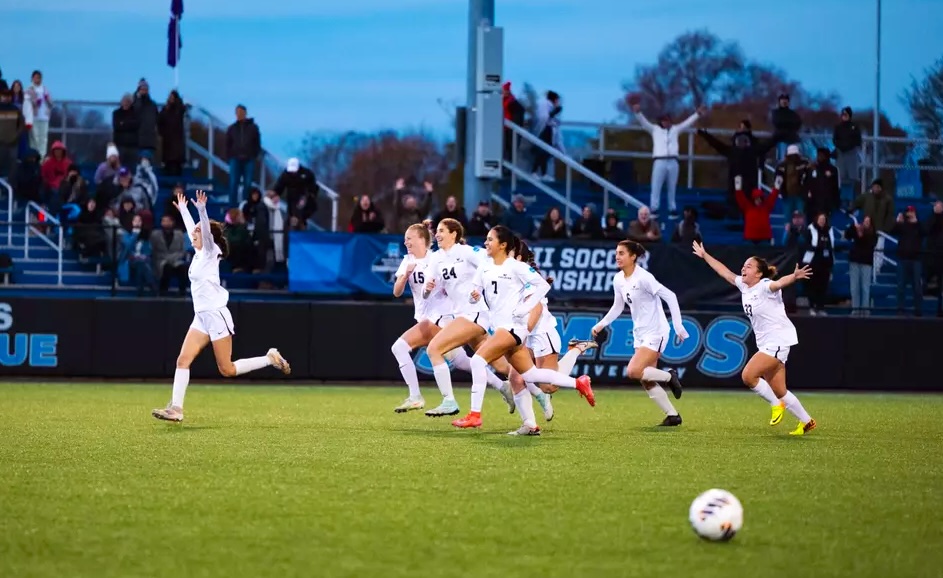
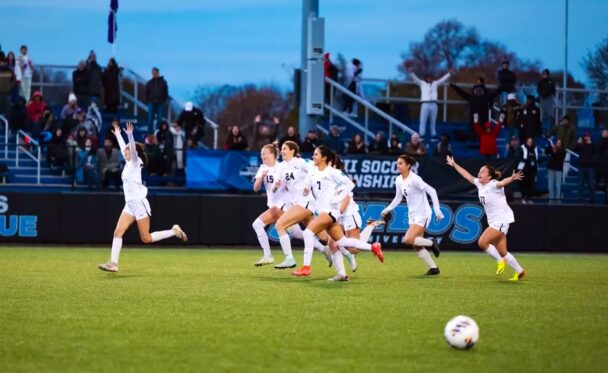
The first half of the Nov. 15 game was a defensive battle with both teams attacking tentatively and turning away all chances. But, in the second half, the Violets drew first blood, scoring three minutes after the break. The Cards gathered themselves and started to press more. In the 63rd minute, they turned up the intensity, putting up four shots, each turned away, before Buehler tied the game in the 68th minute. From then on, the defenses held strong through regular time and 20 minutes of overtime, sending the match to penalty kicks. With a missed chance from each team through the first nine kicks, NYU had a chance to extend the match with a goal. The kick screamed towards the top of the goal and bounced off the crossbar for a Cardinals win. The Red and Black stormed the field, celebrating the win and extending the season.
“PKs [are] an opportunity for me to contribute to the win,” Brumbach said. “I’ve been able to train them a lot in my four years here. It’s such an emotional part of the sport in tournament play. It’s so special to have that moment with your team where everything’s riding on this one moment, and you’re able to celebrate. That is something that you can’t put into words for how good that feeling feels.”
The next day, the Cardinals took on the No. 3 ranked Jumbos, looking to get into the third round. While the Cards fought against the Jumbos’ offensive push, it was not enough as Tufts scored a goal in each half, ending the Wesleyan season with a 0–2 loss.
“It always comes to an end unless you win the national championship,” Brumbach said. “So I think looking back on the career that we had, and the opportunity that we had to play for four years together, we’re all like a group of best friends. And I think reflecting on the bus home, the competition was like kind of a bonus, but the friends that we made along these four years was really what mattered.”
For their outstanding play, Brumbach and Utz were named to the All-NESCAC First Team, while Rideau-Winds, Snow, and Buehler were named to the Second Team. In 26 years of All-NESCAC awards, this is only the second time five Cards have made the list (six were named in 2024).
On top of this, 2025 is the fifth time in program history—as well as the fifth consecutive year—that the Cards have made the NCAA Tournament. The 2020s have been a remarkable period of growth for the program, as it solidifies itself as a national contender at the highest level and one of the top destinations in all of Division III for young players to bring their talent.
“Our class, specifically, has been really happy about the legacy that we’ve left behind on this program, and how we’ve been able to be a part of so many significant moments,” Rideau-Winds said. “It’s made us very prideful about being part of the Wesleyan women’s soccer team. When you’re in this athletic world, it’s nice to also share those moments with your friends, who are also kind of changing their programs and seeing their programs grow. So it’s been a really cool collective experience for the athletic community within the past four or five years.”
The bar of what success means for a Wesleyan team is rising by the semester, but women’s soccer has the talent, determination, and culture to meet and raise those expectations even further.
Walking into the Lucid Color Showcase, it’s immediately apparent that every piece on display is distinct: unique not only in medium, but in the aims, intentions, and interests of the artist who created it.
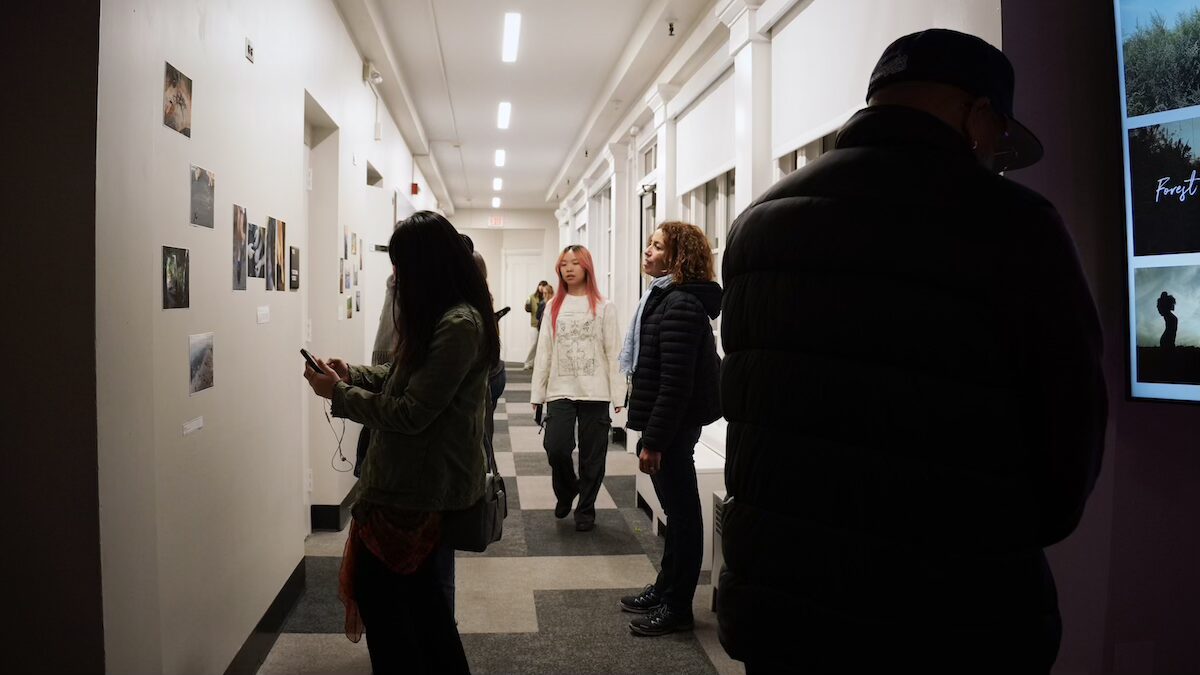
On Friday, Nov. 14, the student-run Lucid Color Collective showcased a multimedia art exhibit in the Digital Design Commons. The exhibitions, which ranged from painting to photography to film, all worked together toward the collective goal of creating a space where artists of color at the University were highlighted and celebrated. This aim manifested itself not only in the showcase’s artwork, but also in its collaborative community of artists and coordinators. No single aesthetic dominated the showcase, allowing students to curate their own form of artistic expression.
Lucid Color Collective was founded in 2014, but initially served as a campus film club aimed at engaging students of color in Wesleyan’s film scene. During the COVID-19 pandemic, however, the club completely disbanded. In Fall 2023, it was brought back for one semester as a visual arts collective, but it didn’t last. This semester, it has been revived once again, aiming to continue providing a space for visual artists and filmmakers of color.
Ronald Ceesay ’27, one of the re-founding members, recalled how at the end of his sophomore year, a professor approached him about revamping and restarting the Lucid Color Collective.
“This is very important now, when artists of color across the nation are being erased, diluted, and diminished,” Ceesay said. “[It’s a] time on Wesleyan’s campus where we don’t really have that many showcases, and even though we have art—we have a very vibrant art scene—it isn’t the best it could be.”
c/o Dianne Cernal
Lucid Color Collective, in spotlighting the work of artists of color, hopes to push back against such suppression and erasure. It calls into question the culture of museum curation, a white-dominated field where artists of color have historically been significantly underrepresented. Ceesay argued that, historically, artists of color have had to work disproportionately hard to have their art recognized, and emphasized the significance of the Lucid Color Collective space.
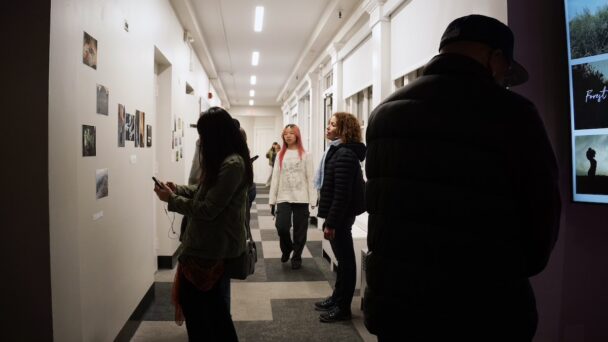
In one of the hallways in the Digital Designs Commons, curators displayed photography from four different artists. Each photographer had a different focus to their art. Olivia Kong’s ’28 collection of photographs, titled “Limb by Limb,” focused on the fragmentation of bodies. Another artist, Melanie Sabino ’29, showcased photographs of public graffiti she had come across, a commentary on the disregard for this artistic medium within the art world.
Another room housed paintings, drawings, bound books and monotype prints. Dianne Cernal’s ’28 art book “The Taste of Becoming” carefully examined the process of bookmaking by deconstructing how its physical structure produces meaning. On another table, Shekinah (Glory Peter) Mba’s ’26 painting “The Space Between Us” explored the interconnectedness and tension between species and ecosystems.
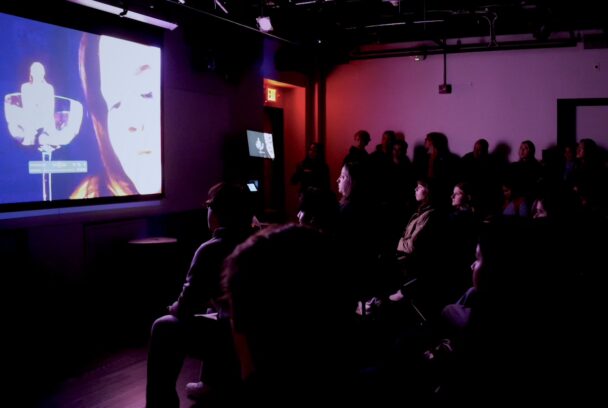
Later on in the evening, attendees were invited to a screening of students’ short films. Six different short films were presented, ranging from topics such as the University’s annual student of color fashion show in a documentary short by Lucas Buu-hoan ’26, to a comedic short about washing dishes by Richard Xiong ’28.
“There’s so many variations of what artists can look like and what artists can be,” Ceesay said. “And I think if you’re a well-adjusted human being, or a human being that’s [at all] intellectually curious, you’re an artist. There’s nobody who can’t create art.”
Lucid Color Collective invites anyone who is interested in art, no matter their level of experience, to create. Ceesay is right: Even considering the wide range of presented media, what ties all these artists and their works together is being a part of this collaborative community.
Amelia Haas can be reached at ahaas01@wesleyan.edu.
As the November cold starts to seep in, you might begin to realize that the holiday season is right around the corner. For the world of ballet, the holidays only mean one thing: “The Nutcracker.” On Nov. 14 and 15, the student-run ballet troupe, Wes Arabesque, performed “The Nutcracker,” directed by Scarlett Albertson ’28, Leela Chauhan ’28, and Lael Blackmore ’26 in the Patricelli ’92 Theater.
As the lights dim down and Tchaikovsky’s iconic soundtrack began, the audience was seamlessly transported into the iconic party scene opening of “The Nutcracker.” Parents, girls, and boys filled the stage, each wearing vibrant expressions that lured us into the atmosphere of a lavish party room on Christmas Eve. “The Nutcracker” follows the adventures of the main character, Clara (Francesca Carnovale ’26), as the nutcracker doll she receives as a present comes to life.
After the party scene, the story moved into the Waltz of the Snowflakes, led by first-year Amelie Zosa ’29, who took center stage as Snow Queen. The snowy pale-blue lighting accentuated Zosa’s and the six other performers’ vibrantly delicate and synchronized moves.
“I had a lot of difficult sections in [Waltz of the Snowflakes] that I had to practice over and over again to get good at, but the hardest part was really building enough stamina to get through the whole show,” Zosa said. “We ran through the show so many times during tech week that I felt like my legs were going to fall off by the end.”
Nini Hayes ’26, who played the Sugar Plum Fairy, also recalled the importance of stamina in her performance. “During one of the full run-throughs of the show, my watch told me that my heart rate went up to 192 bpm,” she wrote.
During the Dance of the Sugar Plum Fairy, Hayes and Henry Ewing-Crystal ’26 danced together, immersing the audience in the snowy dreamscape. They displayed effortless lifts and elegant, unified moves, which received numerous cheers from the audience. The biggest challenge for Hayes, however, was the wooden floor of the ’92 Theater.
“For dancers, the best floor [surface] to dance on is called marley,” Hayes said. “It provides the perfect amount of slickness for pirouettes, but also friction to prevent slipping. I grew up dancing on marley, so encountering the extra challenge of performing difficult choreography while dancing on a slicker-than-normal floor was challenging.”
She eventually overcame this challenge by moving to the Fayerweather studios, where the floors are also wooden.
“With water on our shoes [to add friction] and lots of practice, we gradually got used to the floor,” she said.
What makes theater in the ’92 special, performers said, is how personal it can be for both the performers and the audience.
“[The ’92] is also such an intimate space, and it was really special to be able to make out the faces of my friends and family in the audience,” she said. “It was comforting to pass by them as I was running on and off the stage.”
As performers navigated the challenges of being on stage, directors had to navigate a different obstacle: time. As the club fair only happened in mid-September, the group only had six weeks to dedicate to rehearsal time. While most traditional ballets are choreographed by a single director, at Wes Arabesque several Wesleyan students are part of the creation of the choreography. In an email, artistic director Scarlett Albertson ’28 described the ways in which this element present challenges under time constraints.
“Choreographers often have different views about what certain scenes, as well as the overall story of the show, should look like,” she said. “[I had to] mediate these differences of opinion and to work alongside Lael and Leela, the stage and financial directors, to bring to life a “Nutcracker” that makes sense as a cohesive story.”
The world of “The Nutcracker” ballet required extensive original choreography to bring the enchanted winter wonderland and Christmas atmosphere to the audience.
“The hardest part was balancing our imaginations with realistic financial limitations,” Chauhan said. “[But we were] blessed with incredibly talented choreographers and directors, so with some creative brainstorming we were able to find workarounds to our daydreams. Sometimes those alternatives actually led to better costuming than what we originally envisioned.”
Stage manager Lael Blackmore not only scheduled rehearsals and served as liaison to the tech crew; she was also one of the many choreographers. She expressed that when choreographing, she would “focus entirely on the music and the feeling behind it.”
“To me, dance is an embodiment of music,” she said. “I also look for ways to showcase the beautiful dancers, and to create a balance of different steps for them, with moments of rest in between.”
The finale of “The Nutcracker” concluded with each dancer making their way onto the stage to take their bows and a well-deserved standing ovation. Cheers and applause filled the theater, celebrating the hard work and passion that brought the performance together. Overall, the show’s charm and energy left the audience eager to find out what Wes Arabesque will bring next to the stage in the spring semester.
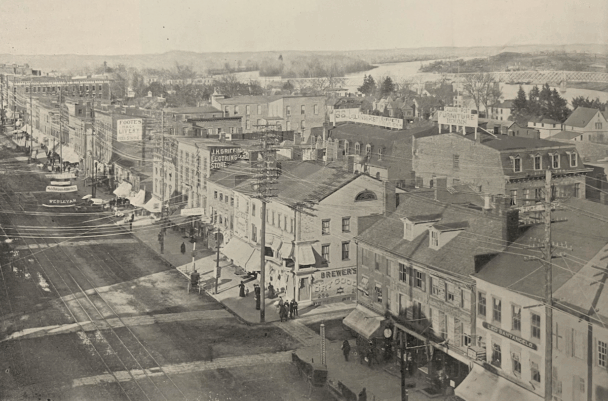
How many trolleys have you seen on campus? One hundred years ago, the rumble and rattle of sunflower-yellow streetcars was impossible to miss. These cars circled about Middletown at state-of-the-art speed on steel tracks that outlined the city. At the heart of this system stood the red-brick Middletown Street Railway Car-Barn (now home to Perkatory Coffee Roasters) that connected the local trolley line to an interurban railroad. Given the former scale of Middletown’s transportation network, it is no surprise that the Argives are full of its stories. Picking up at the dawn of the 20th century, we’re bringing last week’s trolley history into the station: first stop, Foss Hill.
1904: Wesleyan Gets Wired In
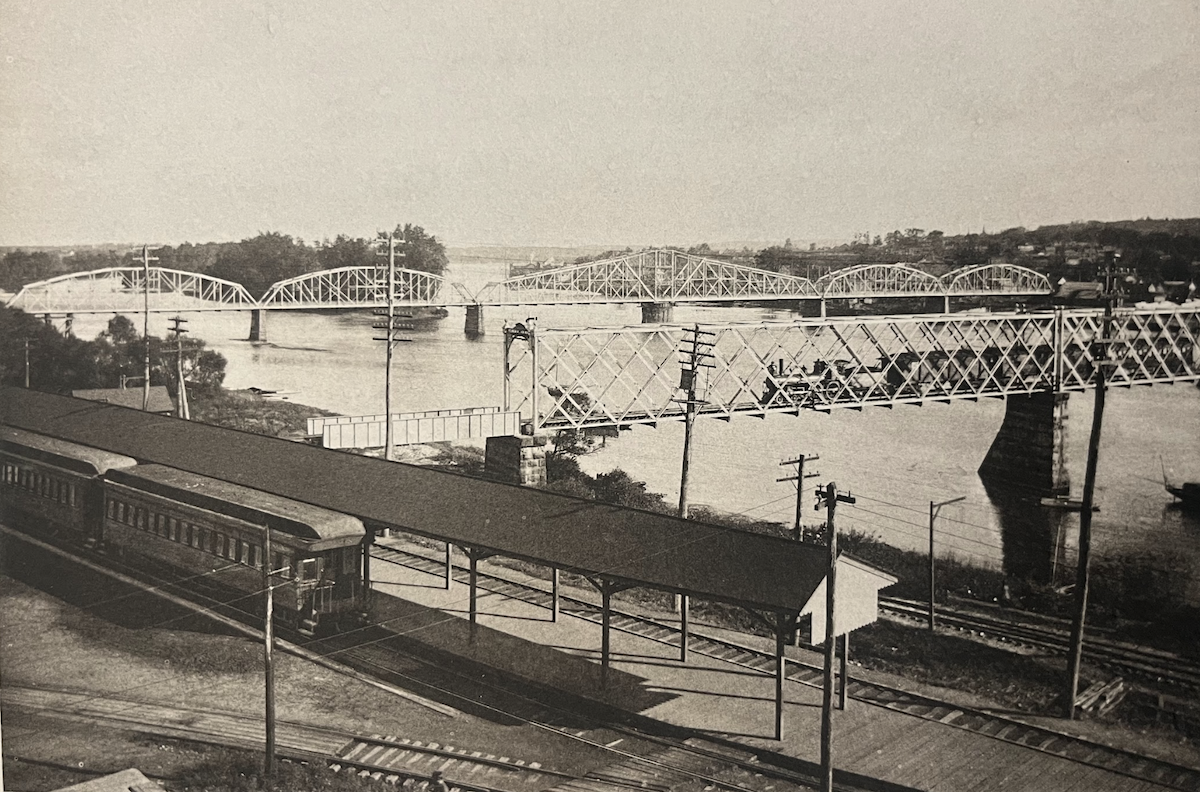
In 1904, a trolley line finally extended up from Main Street to several stops on Wesleyan’s campus. The tracks followed Mt. Vernon Street as it traversed the base of Foss Hill (before the street’s removal in 1956) and terminated at the junction of Pine Street and Miles Avenue. Now, a passenger arriving from a distant city by railroad could board a trolley at the train depot and, in a matter of minutes, arrive at Clark Hall.
c/o 1896 Middletown Tribune Souvenir Edition 2
Despite the expansions, the Middletown Street Railway Company remained unprofitable. Thus, in the same year, the Connecticut Company bought it in the process of consolidating local trolley lines into a statewide system. The Connecticut Company then merged its acquired trolley lines into a giant statewide trolley network that was then connected to other companies’ own trolley networks. The result: a passenger could board a streetcar on Main Street in Middletown and ride it as far south as New York City and as far north as Vermont.
1905 to 1926: Campus Athletics and Cannon Antics
Back when the Cardinals were the Methodists (Wesleyan’s mascot prior to 1932), sports teams used the trolley as their main form of transportation to away games. A sidebar in The Argus published Jan. 10, 1906, reports that the football team spent a whopping $596.87 on railroad and trolley costs during the 1905–06 academic year, equivalent to $21,485.83 today.
Wesleyan students also used trolleys to attend away games. On Jan. 7, 1926, The Argus posted a notice: “A special trolley has been chartered for the Trinity basketball game next Tuesday.” All traveling teams relied on this system, zipping across Connecticut alongside their loyal fans. In 1926, the total cost of the two-way trip to Hartford was 85 cents, equivalent to less than $16.00 today. The Methodists went on to beat Trinity that night, 43–10, and celebrate on the snowy ride home.
Students were often involved in more mischievous matters with the trolley. To these pranksters, the Douglas Cannon scrap was the perfect opportunity. Starting in 1859, Wesleyan first-years woke up early on George Washington’s birthday to fire sunrise cannon volleys from the Douglas Cannon. The annual cannon scrap took off in 1867, when “sophomores repeatedly attempted to foil the frosh efforts to fire the cannon,” according to Wesleyan’s Douglas Cannon blog. This ignited an interclass rivalry that grew “more elaborate, and dangerous, with each passing year.”
By 1907, the cannon competition had evolved into a full-scale tactical operation, according to The Argus’ enthusiastic report of that unforgettable night. “On the 27th of December, during the Christmas vacation, the freshmen had the cannon shipped from the Douglas factory to Highland, N. Y.,” The Argus explained. “About the first of February, it was reshipped to New Britain where it was enclosed in a sharp pointed, wooden box.”
However, the first-years weren’t content to just roll up with the cannon. They had planned for too long to undergo a proper match, and what’s a cannon scrap without a spectacle? “Two ‘fakes’ were also built…identical with the real cannon in regard to shape, size and weight,” wrote The Argus. The students stashed one fake by Pameacha Pond and stored the other fake in a barn in Portland, on the other side of the river.
The night of Feb. 21, cannon scrap eve, “a special freight trolley car brought the cannon and the…fake across the river.” The first-years deposited this fake cannon at the corner of Cross and Mt. Vernon. Then “the [trolley] car was run back,” picked up the fake cannon from Pameacha pond, and dropped it off at Wyllys Ave. A flock of first-years who had been hiding with the Douglas Cannon in the barn “had come over on the [trolley] car” to push the two fake cannons to campus. However, after hours of struggle and a handful of crowd crush injuries, the “1909 was victorious over 1910,” albeit “by a very small margin.”
The complexity of the 1907 cannon scrap proves the reach, efficiency, and reliability of the trolley system. Today’s XtraMile may hesitate to transport a gang of first-year students and three functioning cannons.
On March 14, 1921, The Argus published “The Red Hats Pass: Freshmen Doff Distinctive Headgear and Don Soph Pajamas for Evening,” a report on a ritualistic first-year revolt. (For context, Wesleyan has a long history of traditions meant to explicitly distinguish class years. For decades, first-year students were mandated to wear red hats at all times on campus grounds.) One night, when the sophomores were off “banqueting in Hartford,” the red-hatted first-years decided enough was enough and made for Andrus Field. “[The] freshmen, dressed in sophomores’ pajamas, solemnly laid their red hats upon an altar of burning barrels,” The Argus wrote. The stolen pajama–clad class snaked down to Main Street in “a long, impressive, white line, looming ghost-like in the flaring light” of the flaming hats.
Now on Main Street, the real antics began. Although the first-years were “abashed by the cold welcome” of the Middletown residents, they promptly “proceeded to adorn the Main Street by hanging their sleeping apparel on the trolley wires,” according to The Argus. “With interest and enthusiasm, and occasionally the addition of a finishing touch, the frosh viewed the effects of their innocent diversion upon passing trolley cars.” The sophomores did not comment.
As for the trolley wires themselves, they proved to be too great a temptation for other groups of Wesleyan students looking to play pranks on the town. “Years ago, the great outdoor sport was unhooking trolley wires,” recalled one unnamed resident in an interview with The Argus. “The students would come downtown in a big group and proceed to strew the sidewalks with trolley wires. Just how they got them down without being electrocuted is a question, but they never seemed to have much trouble.”
“Nope, there ain’t been much happenin’ these days,” the resident observed. “The old college’s been pretty quiet.”
An alternative to the trolley arrived: the bus. Because buses did not require the infrastructure of tracks, electric wires, and a trolley barn, they were much cheaper to operate, and therefore preferable to executives in a floundering industry.
Public transportation companies across the nation began to replace streetcars with buses. Now, instead of chartering trolleys, Wesleyan students took buses to away games. On Oct. 27. 1932, The Argus printed a notice that read, “If enough men wish to go to the Williams game a bus will be chartered for the trip. The round trip fare will be $2.75,” nearly $65.00 in today’s money. “It is hoped that sufficient support will be given by undergraduates to make possible the sending of several busses to the game,” the article states. There was no longer a trolley for Wesleyan to lean on.
Though buses were cheaper to run, Wesleyan students did not always see these savings. On Oct. 25, 1923, The Argus advertised two-way bus tickets to an upcoming game at Amherst. Tickets cost $5.00 each, equivalent to $91.86 today. According to The Argus, the Amherst trip would use “the standard yellow auto busses that the Connecticut Company uses on its passenger lines.” The same Connecticut Company that built Middletown’s trolley now filled its streets with bus passenger lines.
The Connecticut Company’s parent corporation, the New Haven Railroad, saw its finances decline during the 1930s, ultimately facing bankruptcy in 1935. The decline in popularity of the trolleys and the better operational economics of buses must have also impacted the Connecticut Company’s decision to ultimately cease operations of the trolley system in Middletown during the 1930s. Trolleys had become a part of the past.
1938 to 2000: Drifting into the Car Century
The Arrigoni Bridge opened in Middletown in 1938, replacing the Old Iron Bridge as a connection between Middletown and Portland. Unlike its predecessor, the Arrigoni Bridge contained no trolley lines, but four lanes of roadway. Buses had won for now. With car culture on the rise and bus programs stripped of funding, the world of public transport hung in the balance.
As Middletown and Wesleyan settled into the new nationwide norm, The Argus had little to say of railways, trolleys, or buses. C.W. Snow Jr. ’47 authored the paper’s next public transport survey in 1943, titled “Suggestions to Naval Cadets.” Snow’s article catered to the Naval cadets—stationed at Wesleyan’s V-5 and V-12 Naval Training Units on campus during World War II—looking for the best ways to spend the weekend around Middletown.
“The Legion Hall in Cromwell, where the dances are held, is situated approximately two miles north of Middletown on the road to Hartford” Snow suggested. “I think that you will find the ‘bumming’ very good, but if you run into hard luck there is always the Hartford bus which runs ‘on the hour.’” Streets full of automobiles made hitchhiking, what Snow calls “bumming,” possible.
The network effects of public transportation systems make them difficult to erase entirely. “[Hartford] is easily accessible by bus,” Snow wrote, outlining a system of buses that allowed one to travel from Middletown to Meriden, Waterbury, or New Haven.
2007 to Present: Concepts of a Plan
In recent years, the idea of constructing a new trolley system in Middletown has resurfaced. On Oct. 31, 2008, an Argus article by Katherine Yagle ’12reported that the Middletown City Council was considering putting down money to put up new trolley lines on Main Street. “Funded by federal grants, the plan is part of an $18 million project to study and improve parking and transportation downtown,” Yagle wrote.
The final report of the city’s plans, titled “Parking and Traffic Study for the Central Business District,” envisioned a “tracked, steel-wheeled streetcar operating on the inside travel lane of each side of Main Street.” Despite the potential benefit of decreased congestion, the report predicted a streetcar system would cost “$7.6 million per track mile and [have] annual operating costs of $600,000 per year.”
In 2013, Middletown resident Jonathan Willetts sent a public letter to the Middletown Director of the Department of Planning, Conservation, and Development, making the economic case for the trolley’s return. “In city after city across America, light-rail systems are making a dramatic comeback,” Willetts wrote. “Initially reluctant in some cases…once people began using the light-rail systems, they quickly accepted them and did not simply love them, they couldn’t get enough of them!”
Willetts acknowledged the high costs of putting up the long-lasting infrastructure of a trolley line. “Expensive? Yes, but it will never be less expensive than right now,” he wrote. “Would future value justify the initial outlay? You betcha! In spades!”
“From the Argives” is a column that explores The Argus’ archives (Argives) and any interesting, topical, poignant, or comical stories that have been published in the past. Given The Argus’ long history on campus and the ever-shifting viewpoints of its student body, the material, subject matter, and perspectives expressed in the archived article may be insensitive or outdated, and do not reflect the views of any current member of The Argus. If you have any questions about the original article or its publication, please contact Head Archivists Hope Cognata at hcognata@wesleyan.edu and Lara Anlar at lanlar@wesleyan.edu.
Michael Steinberg ’83 is the director of the Civil Rights Litigation Initiative at The University of Michigan Law School. Prior to joining the faculty at Michigan Law, he was the legal director of the Michigan chapter of the American Civil Liberties Union (ACLU) for 22 years.
But years earlier, he came to Wesleyan from a small town in Maine. Steinberg said the school gave him a greater understanding of what it meant to pursue justice.
“I had a political awakening when I came to Wesleyan,” Steinberg said. “I felt strongly about justice, but I was not very aware of social justice movements. Wesleyan was transformative for me. I never would have been an ACLU lawyer had I not gone to Wesleyan.”
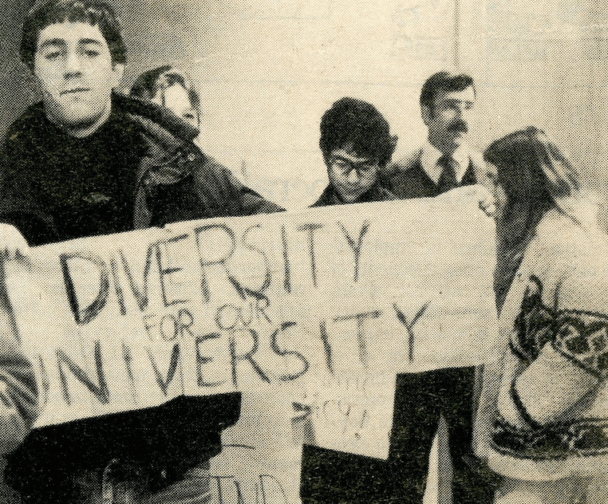
In his sophomore year, Steinberg got involved in the anti-nuclear and peace movements gaining steam amidst the backdrop of the Cold War. Along with a friend, Danny McCormick, Steinberg transformed Wesleyan’s Nuclear Resistance Group, a student-run club focusing primarily on nuclear energy, into an organization dedicated to stopping the nuclear arms race between the United States and the Soviet Union.
“This group grew,” Steinberg said. “We had 40 people at our weekly meetings, worked on having conferences and ballot initiatives at the University, and even brought three buses of people to Washington D.C. to lobby for an end to the nuclear arms race.”
Steinberg outside of Woodhead Lounge in 1982. He told The Argus that this was his first-ever protest.
Following his graduation from Wesleyan, Steinberg spent time at Oakwood Friends School, a Quaker boarding school in New York, where he taught history and coached and advised the school’s nuclear disarmament committee. He moved to Michigan when his wife, also a Wesleyan alum, was accepted to graduate school in Ann Arbor.
After earning a law degree from Wayne State University Law School in 1986, Steinberg worked as a solo practitioner focusing primarily on civil rights cases. His biggest private practice suit involved a police misconduct case in Ann Arbor. Police officers, who suspected that a Black man was behind a serial rape spree, established what Steinberg described as a “dragnet” to attempt to coerce as many Black men as possible to give blood for DNA testing.
“They eventually caught the rapist, not through this DNA dragnet, and then they refused to return the blood samples to 162 people who, either through coercion or voluntarily, gave blood,” Steinberg said. “So we sued to get the blood samples back, not just for our client, but for everybody, and to get a ruling that this, this racial profiling, was unconstitutional. There was just a documentary that came out about the case.”
In 1997, Steinberg joined the Michigan ACLU as their legal director, where he litigated numerous cases, many of which reached the United States Supreme Court.
“I was probably at the Supreme Court eight times,” Steinberg said. “I wasn’t arguing, but I kind of put the case together, and I was often at the counsel table. The first one that I was involved in was Grutter v. Bollinger in 2003, when the ACLU, the national and state chapters, and the NAACP intervened in an affirmative action lawsuit against the University of Michigan that was brought by two white applicants. We intervened on behalf of 17 Black and Latino high school seniors who had the most to lose if affirmative action was abolished. When that went up to the Supreme Court, we had a pretty good result. Affirmative action was saved.”
In June 2023, the Supreme Court in the cases Students for Fair Admissions v. University of North Carolina and Students for Fair Admissions v. Harvard, struck down race-based affirmative action in college admissions as unconstitutional.
Steinberg also won a case under the Americans with Disabilities Act, in which a child with cerebral palsy was prohibited by her school from bringing a service dog with her, despite having a doctor’s recommendation.
“The school was not allowing the service dog,” Steinberg said. “We thought, ‘This is silly, we’ll take care of it with a letter.’ It ended up going all the way to the U.S. Supreme Court, and we won that one, eight to nothing.”
Following a long career at the ACLU, Steinberg joined the faculty at the University of Michigan Law School seven years ago. Seeing a lack of a civil rights clinic at the law school, he proposed the idea, and the school agreed to establish one. The school chose Steinberg to lead it.
“It’s a dream job. I work with students who have come to law school to make a difference, and they want to do civil rights or some sort of public interest work, and we are able to work on some important cases while they are in law school,” Steinberg said.
At the Michigan Law Civil Rights Litigation Initiative, Steinberg said the most important case that he worked on dealt with a Black man who was arrested by the Detroit Police Department using facial recognition technology, which is notoriously bad at recognizing people of color.
“We sued on behalf of the wrongfully arrested man and got a great result, a really amazing settlement as well as a protective policy that will ensure this technology is not misused and will not lead to additional wrongful arrests,” he said.
After Roe v. Wade was overturned, Steinberg sued to strike down a so-called zombie law that sprung back into effect, which re-criminalized abortion in Michigan. “We challenged the 1931 law, working with Planned Parenthood and the ACLU. We argued that law violated the Michigan Constitution, and we won,” he said.
When asked what advice he would have for Wesleyan students interested in a career in social justice, Steinberg had a simple answer: Call him.
“I have spoken to a bunch of Wesleyan undergrads who are thinking about going to law school, who want to do social justice work. Now, even with a Supreme Court that is hostile to civil rights, we need lawyers committed to making the world a better place. You can make a huge difference in people’s lives by doing public interest law,” Steinberg said.
Steinberg noted that there are many pathways for students who want to pursue a career in public interest law. “When you go into law school, you can very easily be sucked into a big corporate firm because the high salaries are tempting. But if you go with the goal of using the skills that you’re acquiring to advance social justice, it’s very rewarding,” Steinberg said.
For students who want to learn more about the Civil Rights Litigation Initiative, they can visit this page or watch this video.
The Foster Connection is a student-run organization that provides remote tutoring and mentorship to foster children of all ages across Connecticut.
The Jewett Center for Community Partnerships (JCCP) has historically funded work-study positions for eligible student staff members at the Foster Connection. In the wake of a budget reckoning that forced the JCCP to make sweeping cuts to affiliated student organizations, the program has been forced to downsize its leadership and tutoring capabilities.
The Argus sat down with Foster Connection Coordinator Aryana Galdo ’28 to discuss the group’s mission and how cuts to JCCP-funded student groups have impacted the organization.
The Argus: What are your day-to-day responsibilities as a coordinator?
Aryana Galdo: Right now, we’re operating at a smaller capacity. A lot of what I do is very much on my computer. [There’s] a lot of email work. I take intakes from the Department of Children and Families (DCF) throughout Connecticut. Every day, I look through all of the referrals I get, which are foster children, what their needs are, who their contacts are, and then I file those away.
I also do intake and recruitment with Wesleyan students. We are trying to get people to come in and be tutors; the most difficult part of that is that we have to get people registered. Students are going to be doing a lot of background checks and forms and then [pushing that] through our DCF contact. I’m the point of contact between the student, the social worker, our DCF contact, as well as the tutor, who is another Wesleyan student. I manage any communications between myself, our DCF contact, and any of the social workers.
A: What are some memorable moments you’ve experienced in your time with the Foster Connection?
AG: I started as a coordinator last year in October [when] I was a freshman. I’m a sophomore now. I will see kids who have intakes and we’re getting constant communication from their social worker that the students are really pushing to get more and more help. Then at the end of the year, I get that really happy email, “[this] student will not need tutoring anymore,” [and I am] able to move them down on my Excel spreadsheet and say the student doesn’t need tutoring because what we’re doing is working.
A: What have you learned from your time working in the Foster Connection?
AG: I learned that people can be more reliable than you think. If you want to work as a team and work together with a lot of different people, you have to trust that everyone can be as reliable as they can.
I’ve learned this before, and I keep learning it every single day: how much of an impact students here at Wesleyan can have on the community. I stay in contact with a lot of these families, students, and social workers. Like the first email, I’m getting from a social worker saying, “This student really needs help.” Then the last one: “Thank you for working with me.”
A: What are some positive changes you’ve seen in student volunteers after they’ve spent some time tutoring children?
AG: I’ve seen a lot of people go through tutoring. It is a very remote type of job, but I’ve really seen the mentoring skills come into play. When you first start, it’s like, “We’re gonna do this piece of homework,” but then you get to see that kind of connection and get those mentoring skills to blossom. Then it’s: “We’re gonna talk about homework, but what problems are you having? How can I help you?” And then [they take] that extra step.
A: How has the program had to adapt as a result of the cuts to JCCP-funded organizations?
AG: In two big ways. One, we had to downsize our coordinators and our coordinator work. I’m a coordinator, we have one other coordinator, and we originally had three. We had someone fielding the recruitment side at Wesleyan. We had somebody fielding the matches, and then we had somebody else fielding at the DCF side, making sure background checks are clear, checking them over, things of that nature. I mentioned we are a middleman, but everybody is interacting with the middleman of different spaces, and now it has me and one other coordinator, but a lot of that has just fallen onto me to coordinate.
On top of that, it is just a lot harder to get students involved and there’s a lot of, like, supplementals put in to compensate for the fact that they’re not paying people, but it is making my life harder because I’m getting tutors in, and they’re like, “Well I don’t want to take this class. Do I tutor? Do I not tutor?”
A: Has there been any communication between The Foster Connection and other impacted organizations regarding how to move forward amidst JCCP cuts?
AG: Yeah, totally. I’ve talked a lot with the Traverse and the Wesleyan WUMSTP [Wesleyan University Middle School Tutoring Partnership]. How are we getting more people? What are our tactics to entice more people to do this as a volunteer? Are we using CSPL290 [Community Impact Residency, a community impact program for course credit]? How are we going to use it? There’ve been a lot of questions that we’ve been ping-ponging off each other, trying to figure out how to go forward, because, at the end of the day, it’s a bunch of students running some really consequential programs. I have social workers emailing me day in, day out, “This foster child really needs tutoring. We want them to continue in the next grade.” And we have college students fielding those questions, while also fielding the question, “How this group is going to continue?” We’re just kind of taking it day by day.
A: What do you think are the best ways in which students can help organizations like the Foster Connection in times like these?
AG: We’re always looking for people to tutor. The programs don’t come to Wesleyan; we go to the programs. It’s not like we could send a bunch of people to DCF, which is unfortunate.
At the end of the day, even with the hour cuts, even with everything that’s going on, I know for myself—and I can confidently say for everybody else running these programs—that they care about [what] they’re running. For a lot of people, this is a passion project. It’s a lot of work, and it’s really [about] putting that work and channeling that energy into something that you want to make great, but you need students to do that.
A: How do you think this JCCP budget cut has impacted the ultimate mission of the Foster Connection to reach all of Connecticut’s foster children?
AG: I think it limits it. We cut down on our coordinators. There was a suggestion for us to cut down to one coordinator because it has been done in the past. The issue is that The Foster Connection was a mere fraction of what it was when there was only one coordinator. The suggestion to go back to that is just limiting the idea of tutoring Connecticut as a whole. We’re trying to get more people in, and it’s harder, and I can’t blame them. It is really hard to dedicate that much time and not be paid. It also inhibits the idea of us trying to go from just online to in-person [tutoring], and we have had to nix that idea, because we can’t do that if we can’t get people to go out and get fingerprinted and go that extra mile, because that’s the nature of our program.
Whenever you have foster kids [involved], people are getting background checks to be on Zoom, so imagine the extra steps that have to be taken to go and do this in person, which we would love, and I think would make a real impact on the tutors and the kids, but we can’t make it happen with the current budget cuts. It’s a lot harder to entice people when there are not only budget cuts, but these added extra steps in order to get people in, when, at the end of the day, all that we want is Wesleyan students, helping Middletown citizens and helping Connecticut citizens.
A: What does the future look like for the program, in your opinion?
AG: Hopefully bright. I’ve talked to a lot of representatives from the JCCP. They really mentioned, “We’re trying to get some extra funding here. We’re trying to make it work.”
Every program is different. We are a much smaller program than Traverse, for instance, and we can’t do as much. There’s a very specific coordinator who has been doing this for years, who has really dedicated her time and her energy for years upon years, as a senior now, to building this program up. My hope is we can build upon that, and we can have Wesleyan students tutoring the foster kids continue with these kids for years upon years and be mentors. I’m hopeful for that. I just don’t know how feasible it is.