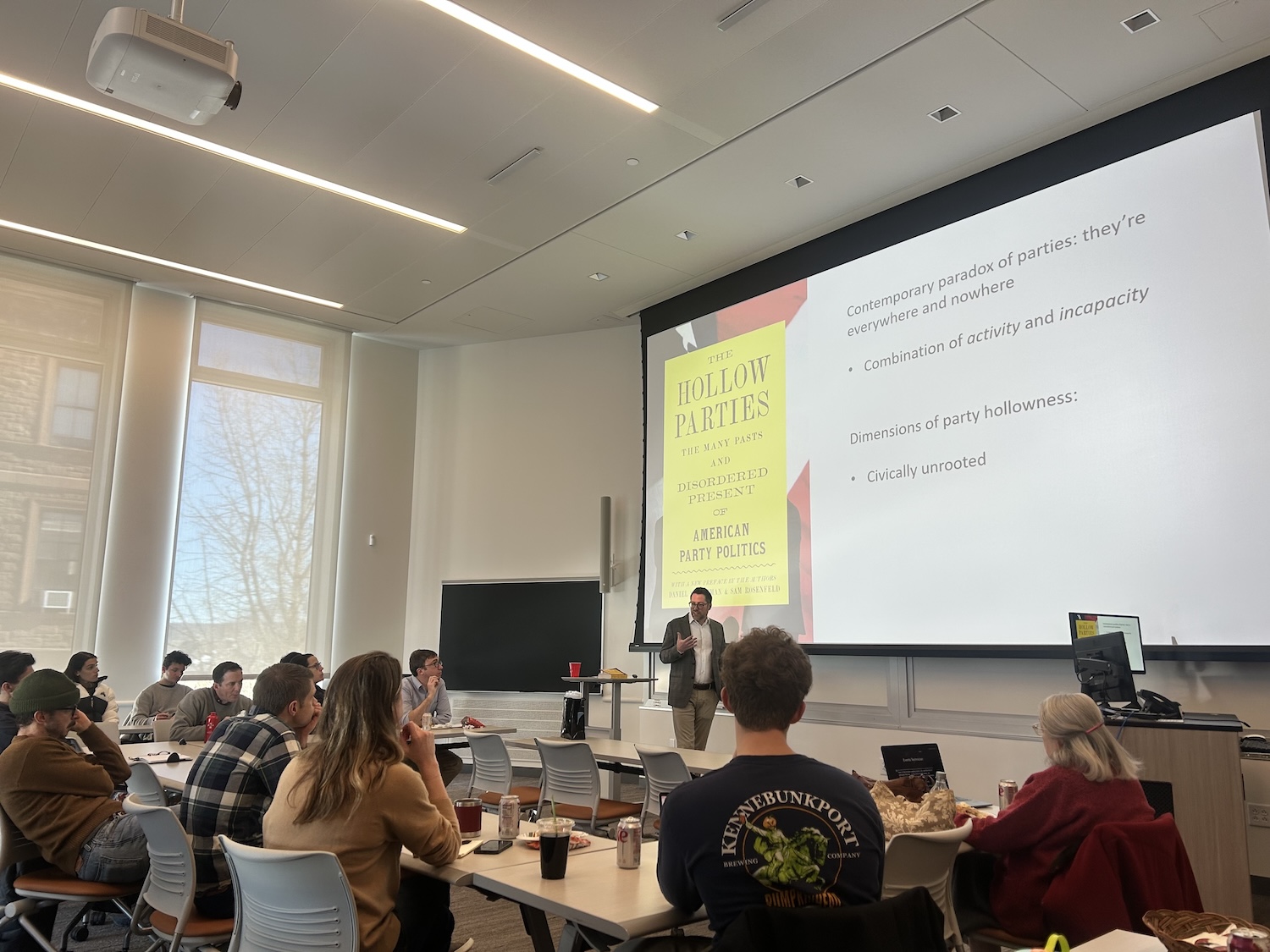
Associate Professor of Political Science at Colgate University Sam Rosenfeld delivered a lecture titled “Hollow Parties and Democratic Crisis” at the Frank Center for Public Affairs (PAC) on Friday, Feb. 13.
Moderated by Logan Dancey, Associate Professor of Government and Faculty Fellow at the Allbritton Center for the Study of Public Life, the event was sponsored by the Government Department, the Allbritton Center for the Study of Public Life, and the PAC. 30 students and faculty members were in attendance.
Rosenfeld’s work explores the development of American political parties, the relationship between social movements and institutions, and the politics of social and economic policymaking in the United States. Additionally, he is co-author of “The Hollow Parties: The Many Pasts and Disordered Present of American Party Politics,” which traces the evolution of American parties from the Jacksonian Era to the present.
Rosenfeld was a Visiting Professor of Government at the University in 2015–16, and his return to campus was not without demand. Dancey arranged the lecture after a student read “The Hollow Parties” and suggested that the University host Rosenfeld for a talk, unaware of his past affiliation.
In the talk, Rosenfeld expounded on the book’s thesis, contending that the polarized and ineffective state of today’s parties is the byproduct of competing traditions that stretch back to the nation’s founding. He began by describing the paradox of strong party polarization and weak party organizations in contemporary American politics, an indicator of “party hollowness.”
“By party hollowness, we mean an incapacity to organize collective action both internally, in terms of making parties’ own decisions in their own name, and externally, in terms of shaping the conflict around them in the broader political arena,” Rosenfeld said in the lecture.
Rosenfeld traced the origins of such hollowness back to the 1970s, highlighting the political and economic transformations of that era. These included the breakup of the New Deal coalition, the rise of economic inequality, the transformation of financial regulations, and the rise of ideological advocacy groups that competed with formal party organizations. Though this affected both the right and the left, it most substantially resulted in the consolidation of a historic conservative movement.
“An array of new advocacy organizations that come loosely to be referred to as the New Right consolidate control over the Republican Party,” Rosenfeld said. “This leads to, out of the kind of world that the transformations of the 1970s make, the dissipation of the process of civic rootedness of parties over time.”
Rosenfeld then elaborated on how this manifests in today’s political landscape, contrasting the experiences of the Democratic and Republican parties in dealing with party hollowness. Specifically, he discussed the former’s struggle to maintain organizational and civic connections with working-class constituencies, and the latter’s failure to police boundaries against extremism, as well as its vulnerability to capture by anti-democratic forces. All this has induced a broader crisis of legitimacy and trust in the United States, which affects both engaged partisans and the mass public.
“I think we’re obviously at a critical moment nationally, and I think it’s important for us to think about some of the themes from this talk,” Dancey said. “Figuring out ways to be involved at the local level and help politics be more community-based can help address national problems.”
Students also appreciated the historical traces mentioned by Rosenfield.
“I wasn’t really anticipating the historical lens through which he talked about things,” Government Majors Committee member Katherine LoCascio ’26 said. “National politics is obviously a big part of everybody’s life, especially here at Wesleyan, and so it was really nice for him to lay out what has changed throughout history and what brought us to this present moment.”
These phrases are variations of a meme that has become very popular on American social media. Every time, the punchline is the same: “Chinese.” On the surface, these sentences don’t mean anything, which is why many non-Chinese people find them acceptable to say. To make one thing clear, you probably shouldn’t say you’re “becoming Chinese” if you’re white, even though this has become the fashion.
But though “Chinese” may seem like an empty signifier, it actually does hold significance. That is, a newfound Western interest in, or even bewilderment towards, an emergent global superpower.
The word China or Chinese appears the way a ghost does in a Gothic fiction, an implacable anxiety of something looming on the horizon: the hegemony of China.
The robust online presence of Chinese citizens, as well as American media personalities flocking to the country, has no doubt sparked a new interest in the country’s culture and society. Last year, Twitch streamer IShowSpeed visited China, where he was welcomed by flocks of fans. (There he has earned the popular nickname Jia Kang Ge (甲亢哥), meaning Hyperthyroid Guy, a reference to his energetic personality and bulging eyes.)
Speed’s experiences joyriding around the country became an internet sensation in both China and the U.S. In his streams, Speed gawked at Chinese technological development and deemed the country to be “on another level.” Chinese media outlets dubbed his visit a “soft power win”; indeed, it gave Americans a candid look into a country so often viewed as a threat to America.
Instagram personalities like Ryan Chen (瑞哥英语, @trumpbyryan) have also helped build the cultural bridge. Chen has been praised for his remarkably accurate impersonation of President Donald Trump, often starting his videos with the byline, “I’m in Chongqing, China,” the city he hails from. He then eats a local dish, his way of introducing Americans to a foreign culture in the only way they will understand—in a Trump voice.
To be sure, literature by (Northeastern) Asian-American writers has been calling attention to this “new Asia” since the end of the 20th century. The technological leaps of the Pacific Rim can inspire awe, exhilaration, or terror, depending on who you ask. In “Science Fictionality,” his book on Asian-American fiction, literary critic Christopher Fan calls this the indescribable feeling of being from China, Japan, Singapore, etc., and gazing back at your homeland only to see a stranger.
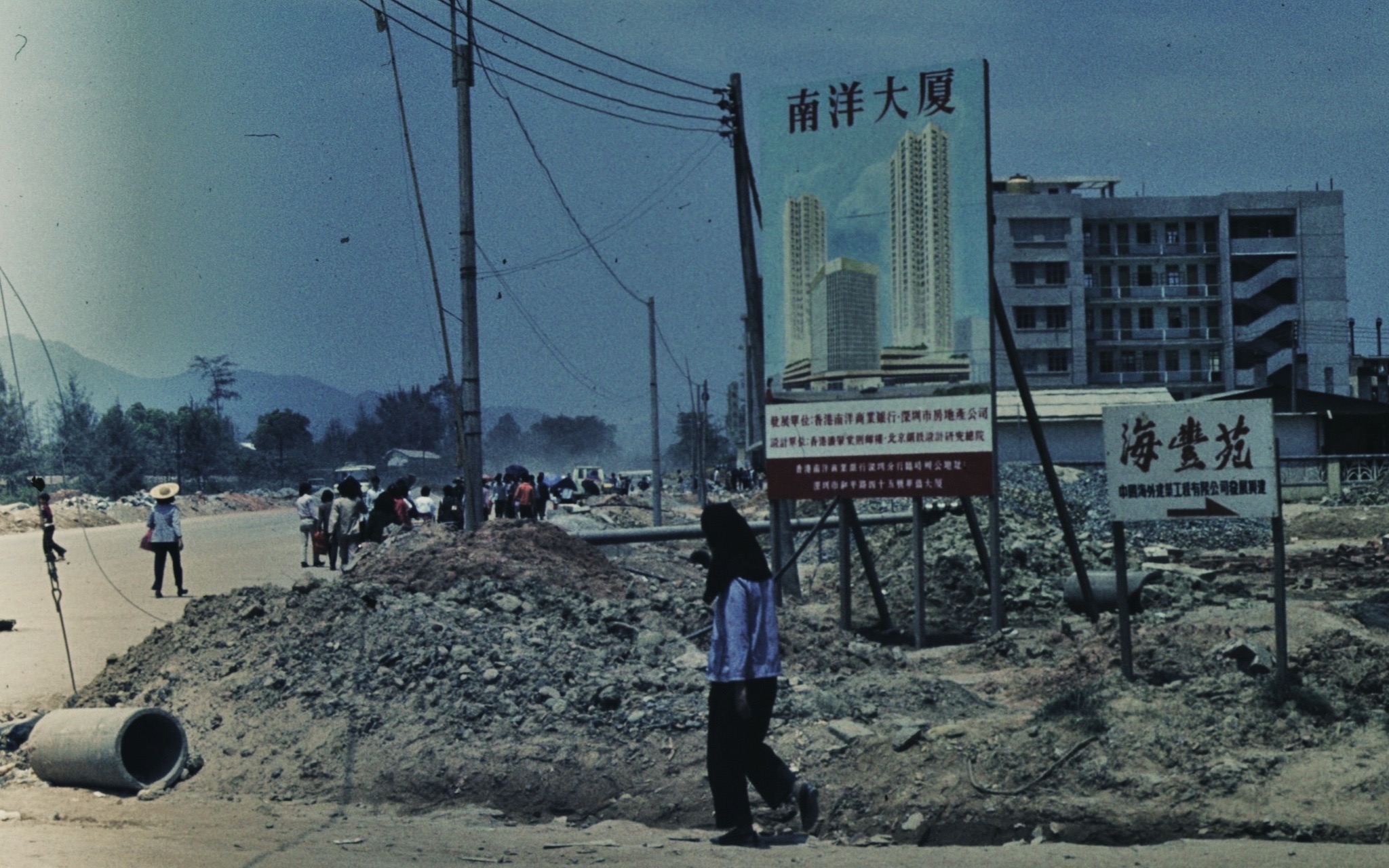
In Amy Tan’s 1989 novel “The Joy Luck Club,” Jing-Mei Woo, the protagonist, is the American-born daughter of a Chinese immigrant. At the end of the novel, she visits China for the first time, and she undergoes a strange transformation. In her own words, she “becomes Chinese.” She can’t help but notice “the skin on [her] forehead tingling, [her] blood rushing through a new course.” She begins to develop “a syndrome, a cluster of telltale Chinese behaviors” like “haggling with store owners [and] pecking her mouth with a toothpick in public…” It is no wonder that these feelings come about when Jing-Mei enters Shenzhen, a city that has undergone a dizzying transformation in the 1980s from a tiny village of 30,000 to one of the world’s largest hubs for manufacturing, technology, and finance.
Speaking for myself as a young person, there is certainly an element of fascination and, frankly, envy in seeing images of China’s high-speed rail, breathtaking skylines, and bustling public scenes. There is an inescapable feeling that preceding American generations left us the scraps, when better things are clearly possible.
Though, as comments on these sorts of videos have pointed out, the GDP per capita in China is still much lower than in the United States. The flowers of modern China were watered by the sweat and blood of laborers working in dangerous conditions for substandard wages, producing goods for global consumers. Still, China’s war on poverty is tremendous, and arguably unrivaled in history. From 1990 to 2020, the rate of poverty in China (defined by the World Bank as people living on $3 per day or less) fell from around 80%—about 900 million people—to zero. In the United States, it increased from 0.5% to 1.25% over the same period. Four million Americans continue to live on $3 a day.
Moreover, the authoritarian activity we commonly attribute to China, like abducting people off the streets, is being carried out by the Trump administration right before our eyes.
In recent years, policy institutes have also levied contentious claims of genocide against the Communist Party of China, citing the construction of special re-education camps in Xinjiang for erasing ethnic identity.
Ironically, every administration from Obama to Trump II has carried out the very same policy, with covert immigration detention centers dotting the U.S. border. The difference is that these centers are a well-documented fact.
If we use China hawk logic, the United States is committing grave human rights violations, and it should be toppled.
No doubt, China has much improved its image in Western eyes in the last five years. An Oct. 2025 report from the Chicago Council of Global Affairs found that the average feeling towards China across all Americans was 35% positive. That was the highest result since the COVID-19 pandemic began in 2020, and a sharp increase from just 24% in August 2024. Also, whereas 58% of Americans in 2023 viewed China as a threat to the United States, now only 50% do, a decline that has occurred across all partisan affiliations.
Despite the unspeakable hate crimes that resulted from the pandemic and the great share of blame China received for its outbreak, China’s response to COVID-19 was a major victory. This meticulous response meant the country of 1.4 billion reported five million infections and 100,000 deaths by the end of the pandemic.
In the United States, by contrast, the pandemic response was disastrous. State and federal power repeatedly clashed as some states allowed lenient regulations, while others did not. Washington, D.C. found itself up against a wall trying to find a middle ground. The one-time “stimulus check” for $1,200, which was followed by paltry economic measures to help the American people, was nothing short of a national embarrassment.
It should be noted that there is also a pervasive element of Orientalism in journalistic sentiments of the Chinese government. In his book “Orientalism,” Edward Said summarizes common stereotypes of the Oriental: they are “inveterate liars, they are ‘lethargic and suspicious,’ and in everything oppose the clarity, directness, and nobility of the Anglo-Saxon race.”
The stereotype of the Orient is of a mysterious, backwards land that needs rational, Western intellect to step in. The common tagline among China hawks, “It’s the government I oppose, not the people,” belies the civilizing mission underneath U.S. criticism of foreign governments. Do these self-proclaimed “China watchers” care about “the people,” or is it simply the profits to be reaped?
Indeed, this is not the first time the United States has used rhetoric of liberation, freedom, and democracy to justify imperialism, not in the interest of the native population, but itself. One need only turn to the United States’ bloodied history of occupation and intervention in the Caribbean, Latin America, Africa, and Southeast Asia for proof of this contradiction. Guantanamo Bay, the illegal abduction of Venezuelan president Nicolás Maduro, and the arrest of former Bolivian president Luis Arce all attest to the persistent evils of colonialism, despite our living in a so-called “post-colonial” world. With the United States’ aggressions in the international sphere becoming more blatant and absurd—Greenland being the latest thrilling episode—I think more and more Americans are waking up to these contradictions.
But what about Hong Kong, or Taiwan? They are false equivalencies. Hong Kong is a part of China—albeit a “special administrative region” (SAR)—and the Republic of China (a.k.a. Taipei) formally agrees with the People’s Republic of China (a.k.a. Beijing) that mainland and island belong to the same nation. They just disagree about which polity controls it. Claims of aggression in the South China Sea are justified, but unlike the United States, the People’s Republic of China has not invaded a foreign country since 1979.
The United States’ recent blunders on the international stage have unraveled the hypocrisy of its foreign policy, revealing “human rights” as a byword for yellow peril and a pretext for imperialism. The anti-China polemic in the United States, persistent racist attitudes, and rampant hate crimes against Chinese people during the COVID-19 pandemic have left a scar on the Asian-American community nationwide. Call it admiration or fetishism, online memes about China reflect evolving attitudes about the country in light of its economic and cultural ascendance.
Conrad Lewis is a member of the class of 2026 and can be reached at cglewis@wesleyan.edu.
Basketball has a tanking problem. The case could be made that the problem has existed since around 2010, but it has really caught on in the last five years.
Don’t believe me? Contributing writer Matthew Mish ’29 and I wrote an article last week about the biggest moves from the NBA trade deadline. Three of the four we discussed were deals towards long-term success rather than win-now moves.
Jaren Jackson Jr. was dealt to the 13th-placed Utah Jazz, which proceeded to shut him down for the rest of the year with a knee injury. Anthony Davis was sent to the last-place Washington Wizards and was expected to sit out the rest of the year until the general manager recently said otherwise. Ivica Zubac was dealt to the 14th-place Indiana Pacers, who are expecting to build a core around their rehabbing superstar Tyrese Haliburton, Zubac, and whoever they end up with in a top-heavy NBA draft. For this reason, they are playing the long game with Zubac to return from his ankle injury, and while it’s not likely that he rests for the entire season, it shouldn’t be ruled out.
Outside of James Harden to the Cleveland Cavaliers, the big names were not dealt to win-now teams like expected. They were traded to teams looking to combine their injured stars with their traded assets, hoping that they lose enough in the second half of the season to earn a high draft pick in the lottery and develop a core for the future. Just in case that doesn’t work, they could always dish off their high assets for serviceable pieces and do it all over again.
Since the NBA has a draft lottery, there’s still a level of uncertainty around whether or not teams will get a top pick. But, since a worse record gives a team a higher likelihood at the top pick, teams are incentivized to lose as much as possible once they know they aren’t making the postseason in an effort to increase their probability of hitting it big when April rolls around. This leads not only to players checking out past the halfway point of the season, but it minimizes fan engagement with teams. If a fan knows their team is going to try to lose, there’s no point in wanting to see them succeed. That’s not how sports should be.
It’s not just a basketball issue, but it seems to be most prevalent on the hardwood. So what can be done to prevent teams from doing this year over year? Women’s hockey may have the antidote.
The Professional Women’s Hockey League (PWHL) may only be three years into existence, but it’s revolutionized the draft lottery process. Their draft system goes by the “Gold Plan,” named for its creator, statistician Adam Gold, which presents a compelling way for teams to continue to compete even after being mathematically eliminated from the playoffs.
Here’s how it works: Once a team is statistically eliminated from playoff contention, they enter a new “competition” where they can earn points based on wins. In the PWHL, they “award three points for a regulation win, two points for an overtime or shootout win, one point for an overtime or shootout loss, and zero points for a regulation loss.” The team that earns the most points under the Gold Plan by the end of the season is awarded the first overall pick, and the teams that follow get the second, third, fourth, and so on.
Even though teams are eliminated, they still have to compete and win to get the top pick. It incentivizes players to compete for the sake of their team’s future success, even when they aren’t striving for the playoffs.
While there would be certain teams that would be in contention more than others, the amount of time they would spend would be conducive to how poorly they competed over the course of the season. For example, say the Sacramento Kings (who are currently last in the Western Conference) were the first team eliminated from playoff contention and had 20 more games to play. Because they were the first team out, they have the longest period of time to accrue points towards the draft.
At the same time, if the Memphis Grizzlies (currently 11th in the West) were mathematically eliminated with two games to go, they would get less time to earn points because they were closer to competing for a playoff spot. The system simultaneously gives ample time for the worst teams to earn their way towards a strong slot while not skewing the top picks towards the teams who compete for a while before being eliminated from postseason eligibility.
While the PWHL, consisting of eight teams, has shown how this works for smaller leagues, it would work equally well—if not better—in a league like the 30-team NBA. The rules would change slightly; for example, there would probably be fewer specifications for overtime games. But even as simple of a system as one point towards the Gold Plan for every win after you are eliminated from playoff contention could get players back into competition mode even when it’s not going towards the postseason.
The plan also gives teams who consistently find themselves in a rebuild an opportunity to play meaningful games where they’d be trying to win, not to lose. In years past, we’ve seen teams go through mass exoduses of their talent in an effort to tank for a couple of years and come back stronger to compete for championships.
Personally, I grew up a Philadelphia 76ers fan, so I was thrust into basketball fandom as Philadelphia began to experience “The Process” under Sam Hinkie. While I loved watching Tony Wroten and Hollis Thompson lace up every night for the red, white, and blue, my childlike joy for watching abysmal hoops was not shared by the rest of Sixers fans.
Athletes want to win. They want to succeed at the highest level, and tanking for the future year takes that away from the world’s greatest players. Basketball fans young and old want to see their teams win, too. We all initially hope that our favorite team’s actions lead towards championships, and while we can accept a bad season as a rebuilding year, some of us can only take it so long. Philly fans like myself were relieved when the team finally made the playoffs in 2018 after a five-year drought including a repugnant 10–72 record in 2015–16.
A change in the draft lottery process would get players on teams good and bad alike to compete during the NBA’s least popular period of the season (post-All-Star break to the end of the regular season in April) and drive up ratings for the NBA overall. The league experienced a 2% drop in ratings last season, as it looks to rebound from a slight decline since 2020.
While the ratings are back up this year with the new NBA on NBC and Amazon Prime packages, getting viewership up during the latter months of the season could significantly help the league as it prepares for the future. Getting players and fans invested late in the season, whether they are 1st or 15th in the conference standings can help revitalize the league and its popularity among the biggest sports.
Quincy Segal ’26 is a history and film studies double major who truly tries to make the most out of his time at the University. Whether he’s singing with the Wesleyan Spirits, working in Olin Library’s Special Collections & Archives, or directing productions, staying busy is part of the plan. Last week, The Argus spoke with Segal about balancing a demanding schedule and ultimately working towards a film career.
The Argus: Why do you think you were nominated for WesCeleb?
Quincy Segal: I feel like I pervade and exist in a lot of different spheres on campus. I’m a film major. I’m a history major. I’ve done theater here. I’m part of the radio station at WESU. I’m part of the Alpha Delta Phi Society. I’m part of the Wesleyan Spirits. There are a lot of different communities that I inhabit, and I think I just know a lot of people.
A: Wow, you are a jack of all trades. How do you even begin to manage all of that?
QS: That is an excellent question and something that I often ask myself when checking my calendar before I go to bed. I think it’s all about the Google Calendar in a lot of ways. For me, I really like being busy, and I like having a lot of things to do and go to. I mean, it’s obviously a double-edged sword. If I have a day filled with classes and meetings and all that sort of stuff, I don’t have time to do much else. But I try to fill my time with stuff that I really enjoy doing. Being at Wesleyan, there’s a finite period of time, and so I try to make very conscious decisions about what I’m going to participate in.
I think, coming into my senior year, I was really on the wavelength of wanting to participate in as much stuff as I could. And so I was like, “All right, what are the things that I haven’t done at Wesleyan so far?” Last semester, I did a stand-up comedy set for the first time, which was really fun, with Awkward Silence. I was part of this random orchestral performance of the Bill of Rights with the Music Department: I read the Fourth Amendment for it. I think I have really adopted a kind of “just say yes” mentality when it comes to a lot of stuff. There’s only so much time that you have, and I feel that there’s so much great stuff to do here, and there are so many great people to meet. I think it’s a crime not to be able to do as much as you can.
A: You’re a film studies and history double major; can you tell me more?
QS: Yes, and I’m doing a capstone for each of my majors. My history capstone—which I did last semester—was a documentary I made about Wesleyan during the World War I period. There was all this crazy training that was happening during World War I at Wesleyan. I was in this class, Wesleyan and War, and there was a lot of archival material we were looking at. A bunch of photos of literal soldiers in full uniform on Andrus Field digging trenches for the military certificate, which was a thing at Wesleyan back in the day. I learned a lot of really cool stuff about Wesleyan lore and history and stuff like that. And so as a result of that, I actually now work in the archives in Olin Library, which is pretty cool.
This semester, I’m working on my film capstone, and that is a short film about this college guy and his friend. They both end up being art thieves, and the main guy actually ends up falling in love with the detective who’s investigating his case. So it’s this sort of dynamic between him and the detective. That’s been a great process.
I really strive to find people who are great at what they do and people who are passionate about collaborating. This team that I’ve put together for this movie is some of the best people. The great thing about Wesleyan is that everyone loves doing what they do. I worked on a bunch of capstones and a thesis last semester, and the people who are the only ones getting any sort of credit or anything are the directors. Every single other person is just doing it for the love of the game. That’s really, really cool. They are giving their time and their energy and passion for a project, just to help somebody else and work together with other people, and I think that’s been one of my most rewarding takeaways from Wes.
A: Speaking of being a director, you directed Falsettos last year with Spike Tape. How was that experience?
QS: For me, that was my favorite artistic work that I’ve ever done. It was my whole semester, Fall 2024, and I worked with the best cast and the best crew. We had something like over 40 people working on that show, and most of that was crew, because we only had seven actors working on it. But it was a really wonderful process. I worked with some of, I think, the most talented actors, actresses, and crew members at Wesleyan. I want to be a director, career-wise. And so I think for me, having that experience was incredibly invaluable to know that this is something I can do, this is something I can pull off. Obviously, I could not have done what I did without everyone’s diligent help. It’s a lot of work, and I am appreciative of the fact that I know how much work it is now. But, if anything, it sort of reinforced this idea of like, “yeah, this is cool.” “This is a path that I’d love to go down.”
My whole reasoning for wanting to put on that show was just so I could see it. I love that show, it’s my favorite musical of all time. I’ve been involved with a number of theater productions here every semester. Before the show, I was acting in one or two shows a semester. I think the theater community here is really, really great. And people, again, like Spike Tape, which is the organization, put it on even though nobody gets credit, nobody gets paid.
A lot of the time, you’re sacrificing your own money, and everyone’s sacrificing their own resources to put on something like that. And so being able to put on a production like that was awesome. I didn’t really consider the audience or how it would be received. I just thought, let’s do this for us. Let’s do this to have fun, because we like making theater, and we like making art, and we like performing and hanging out with each other, and all that stuff about public reception comes afterward.
As it ended up coming about, it sold out super fast. It sold out in like seven minutes or something like that in Ring Hall, which is a pretty big venue. And so we were really, really, really excited about that, considering how much time and effort and energy that we put into it. [President] Michael Roth [’78] was there. He gave me a hug after the show because he liked it so much. He posted on Instagram, and everything was wild. I mean, that’s not why I do it, but it certainly was nice to see it well-received
A: You’re truly taking advantage of opportunities to get involved at Wesleyan; tell me more.
QS: I’ve been an orientation leader all three years that I could at Wesleyan. I’m a big fan of this school; there are pros and cons to Wesleyan, but I’m always just so pro-Wesleyan, and I think it’s such a great space. When I came to Wesleyan, I had such an amazing orientation experience, and I met some awesome people. I wanted to do that for the incoming freshmen, the years after that. I tried to create a really welcoming and friendly environment.
I generally think I’m a pretty upbeat, energetic guy, and so I tried to bring up energy when new students were feeling maybe uncomfortable or nervous. People are coming from all different backgrounds, across the world, and you don’t know what the person next to you has been through for the last 18 years of their life. I’ve had a great time, not only working with new students, but meeting a bunch of new people whom I still say hello to when I walk around campus. It’s great that those sorts of friendships continue and remain. And my goal as an orientation leader has always been to be a friendly presence.
Then there’s also the Alpha Delta Phi society (ADP), which has been an interesting journey for me. I joined my freshman spring, and I think that, with a lot of organizations on campus, the vibe is made up by the people who are in it. So the turnover from year to year is crazy. And honestly, I’ve met some of my favorite people ever through ADP; some of my best friends and people I respect so much are part of the society. I lived there for two years, and that house on campus is a place for students to gather, make music, party, and hang out. I think ADP kind of exists and is a haven for students. You got the Star and Crescent [eating club], and you got the Grotto. Stuff is always happening there, on any given week. On a Tuesday, there’s maybe a poetry reading for The Lavender; on Wednesday, there’s an a cappella kegcert; on Friday, there’s a band concert; and on Saturday, there’s a huge party. I think that space is so beautiful, and I think that being able to bring so many people to campus is also so great. I’ve really enjoyed my time there, and I’ve appreciated that step in my journey as somebody who’s been part of that society.
A: Plans post-grad?
QS: Directing is the dream. I would love to direct. I’d love to produce movies and television. I think there are a lot of people in New York who are Wesleyan grads, and I would love to get there in the future, but for the time being, I work freelance on film sets, commercials, documentaries, TV shows, and stuff like that around New England. I’m hoping to continue doing that until something really enticing comes my way.
A: Reflecting on your time at Wesleyan, is there anything you would have done differently, or are you content with how you did it?
QS: I’m pretty content. I think everything happens for a reason. If anything, I would have gotten more involved in film earlier. But I’ve been doing a lot of it this year, and I think I’ve been really appreciative of the people I’ve met and the connections I’ve made, and so yeah, no regrets.
A: Describe your Wesleyan experience in three words or phrases.
QS: Energizing, inspiring, and impassioned.
A: Any other comments?
QS: Rock on.
This interview has been edited for length and clarity.
Love, longing, and lament lend themselves well to poetry, as the Argives know well. Valentine’s Day is approaching, and there is no better time to revive the most passionate verses of The Argus’ bygone poetry column, a cornerstone of the paper’s earliest days.
Week by week, students’ sonnets recalled their reeling love plots; successful, sorrowful, and scandalous alike. The unfamiliar, arguably stilted style of these poems certainly reveals their age, and their content makes the absence of women from Wesleyan University’s student body (save 1872–1909) abundantly apparent. Even so, these colloquial, jocular pieces provide a unique look into the earliest days of Wesleyan’s campus culture, and the Valentine’s Day conversations that may have been taking place.
If Cupid is making this February a lonely one, you can always air out your woes in the pages of The Argus. This seems to be a long-standing tradition among students at the University, especially popular around Valentine’s Day. On Feb. 18, 1888, The Argus printed a number of uncredited poems lamenting unrequited love.
One poem titled “A Bill(e)t Due” reads as follows,
“The day of good Saint Valentine, As ancient tales relate, Was once the time when every bird Chose for itself a mate. So I that day, in ardent mood, By way of Valentine, Sent to my girl a billet-doux, Asking her to be mine.”
All seems well so far.
“Next day, the postman brought to me A dainty envelope, Enclosing, as I doubted not, Assurance of my hope. With eager hands I opened it To feast my eyes upon The precious words—to my disgust It was a tailor’s dun.”
A tailor’s dun, whatever its meaning, was certainly a disappointment.
“Alas! alas! that cruel fate Should thus possess the power To change a hoped-for billet-doux Into a billet-sour.”
Still, the brave poet stuck the landing with an apt summary of his situation.
“Sum folks gits valentines And sum gits nun; Last year I cent a norful thing; This year I don’t send Ⅰ.”
“A Billet Doux,” dreadful as it may be, was not enough trouble for The Argus’ 1888 Valentine’s Day issue. Another uncredited poem ran in the neighbouring column:
“There was a young girl at De Pauw Got mashed on a student of Lauw; She always cried ‘Cæsar’ When he tried to sqæsar, And smashed him right under the jauw.”
The Argus published a similar languishing “love” poem on Dec. 19, 1887, which described another unsavory interaction.
“‘Give me a kiss, my darling, do,’” the poet wrote, “He said as he gazed in her eyes so blue, ‘I won’t,’ she said; ‘you lazy elf, Screw up your lips and help yourself.’”
The Argus also included another student’s work titled “Understood” in this issue, which spoke from a woman’s perspective on these fraught romantic relationships. The Argus did not name the poem’s author in the paper, so it is unclear whether the writer was indeed a woman.
“He was surprised at my nay, but I’m sure I looked yea: How provoking men are when they’re going away. I know I was pretty—why did he delay? He was surprised at my nay, but I’m sure I looked yea. Some men are so dense—but ’twas different next day, When I shyly said yes as he was going away. The horrid wretch! What did he say? ‘Last night you declined; now it’s my turn for nay.’”
Wesleyan was one of several universities publishing this genre of pining poetry. The Argus reprinted one such piece from an unnamed author at Yale University in the same Dec. 19, 1887 issue:
“Eyes half reproachful on me bend, And in those true eyes tear drops glister; But when she said I might enlist her As my adviser, champion, friend, I couldn’t help it,—I just kissed her, You think ’twas wrong? Well, she’s my sister.”
However, The Argus focused on poems from Wesleyan students and showcased their writing in practically every issue from the 19th century. During this time, women made up an exceedingly small proportion of the Wesleyan student body, which is more than apparent in “The Bell(e)s,” the poem featured on the front page of The Argus’ June 11, 1868 issue, written by F. D. H. (whose full name is not given).
“See the ladies so-called belles! Pretty belles! What a storm of merriment their prettiness impels! How they te-he, te-he, te-he, At a silly little sight, While they sit and chat so freely On a subject e’er so silly With a wonderful delight.”
The poet warned, however, of a kind of belle far less delightful.
“See another kind of belles, Spinster belles!” the author wrote. “What a world of happiness this cross old class dispels! Never bear the horrid sight That’s the pretty belles’ delight […] What a rush of gossip most slanderously wells! How it swells! How it dwells On their neighbors! How it sells Them to the De’il who impels To the sinning and the ringing Of such belles, belles, belles.”
Despite what this trove of tragic works suggests, The Argus featured cheerful love poems just as often as these sorrowful sonnets. “An Autumn Leaf,” for instance, published in the Dec. 19, 1887 issue, includes some swoon-worthy lines sure to woo anyone’s Valentine.
“‘You are the autumn leaf,’ said he,” wrote Williams Weekly. “‘And my arms are the book, you know, So I’ll put the leaf in the book, you see, And tenderly press it, so.’ The maiden looked up with a glance demure And blushes her fair cheeks wore, As she softly whispered, ‘The leaf I’m sure Needs pressing a little more.’”
Clearly, the Argives boast a wealth of wisdom in the art of wooing. On Oct. 24, 1876, The Argus praised a poem written by an anonymous undergraduate student, which was packed with advice for Wesleyan singles.
“We would like to introduce our pet poet,” The Argus wrote to preface the poem, “in a few verses containing some very sage advice—advice which we are bound to believe is both sounder and more likely to be eagerly followed…[than any poems] running the rounds of the comic and tragic press alike.”
“Kiss, boys, kiss; kiss with care,” the author wrote, “Kiss every lass that is debonnaire; Kiss all the cheeks that are plump and fair, And give the rosy lips their share. Let prudent mammies fume and flare[…] Let doting daddies curse and swear, But kiss, boys, kiss, what need you care? Then kiss, boys, kiss, if kiss you dare[…] And give the rosy cheeks their share!”
The Argus’ editors were thoroughly impressed.
“Are not our praises just?” The Argus wrote in an appendix to the poem. “Boys, take the advice, and follow it to the full!”
The Argus’ earliest editors were, in a way, Wesleyan’s top wingmen, and were willing to leverage students’ love lives to boost readership of The Argus. The editors published a note on Nov. 25, 1884, promoting The Argus student body.
“The Argus is pained to see the strange lack of interest in literature manifested by ’[18]88,” the editors wrote. “Is it a fact that the class is to be known as muscular instead of intellectual? We fear so.”
The editors cited statistics indicating The Argus’ dwindling popularity.
“Only about 50 per cent of the freshmen have yet subscribed to The Argus,” the editors wrote, “[…]and in the case of the seniors (oh, men of brain!) more than 91.5 per cent are subscribers.”
A solution was clearly needed.
“Perhaps ’88 has not realized that The Argus is a most powerful agent for mental and moral improvement, the promotion of good health, and the consummation of love plots,” the editors wrote. “Let us explain: The mental benefits of reading The Argus are obvious. Again, our subscribers learn patience as they wait for delayed issues[….] From laughing at the jokes, a good digestion is promoted, ensuring health.”
But what does good health matter without someone to share it with? Fear not, Wesleyan: The Argus is at hand.
“Send The Argus to your girl,” the editors wrote. “We can write up the incidents of college life in better style than you can; our print is easier for her to read than your flowing hand; the time you have been spending in writing these things can be put on the ‘sweet nothings’ which every girl loves to read. Do this, and be happy.”
If The Argus (somehow) fails to ignite your Valentine’s affections, the paper still makes for a handy bouquet wrap.
It’s a good thing February has Valentine’s Day; if you’re anything like me, you’ve had enough of the bitter cold biting at your face on the walk across campus, of snow in your shoes and ice on your car, and want to be filled with the warmth that comes with an entire day meant to affirm love.
I remember going to Stop & Shop to buy flowers last year and being embarrassingly touched by the long line of people with the exact same thought, people from all walks of life who used their lunch break to do something with the sole purpose of making someone else smile. I dare anyone to be cynical about that. With the wind chill factor outside, however, your plans for the day may just revolve around staying inside and putting something on for your beloved (or maybe just yourself).
There’s no judgment if you want to go with a classic; they’ll probably love “Say Anything…” (1989) or “When Harry Met Sally…” (1989) (and their accompanying ellipses), though I may look askance at you if you put on, say, “Juno” (2007). Just maybe, however, you’d like to watch something a bit off your radar; maybe, even, you’d like to watch a love story that tends towards being a little more bittersweet, potentially even barbed. Let this list of film recommendations serve as a guide; I’ve organized the following films into three categories (Delightful, Bittersweet, and Caustic), though all of them, to me, attest to the existence of immutable love between two people.
If it’s a first date, you may want to stick to the first two tiers; don’t blame me if you get ghosted.
Delightful
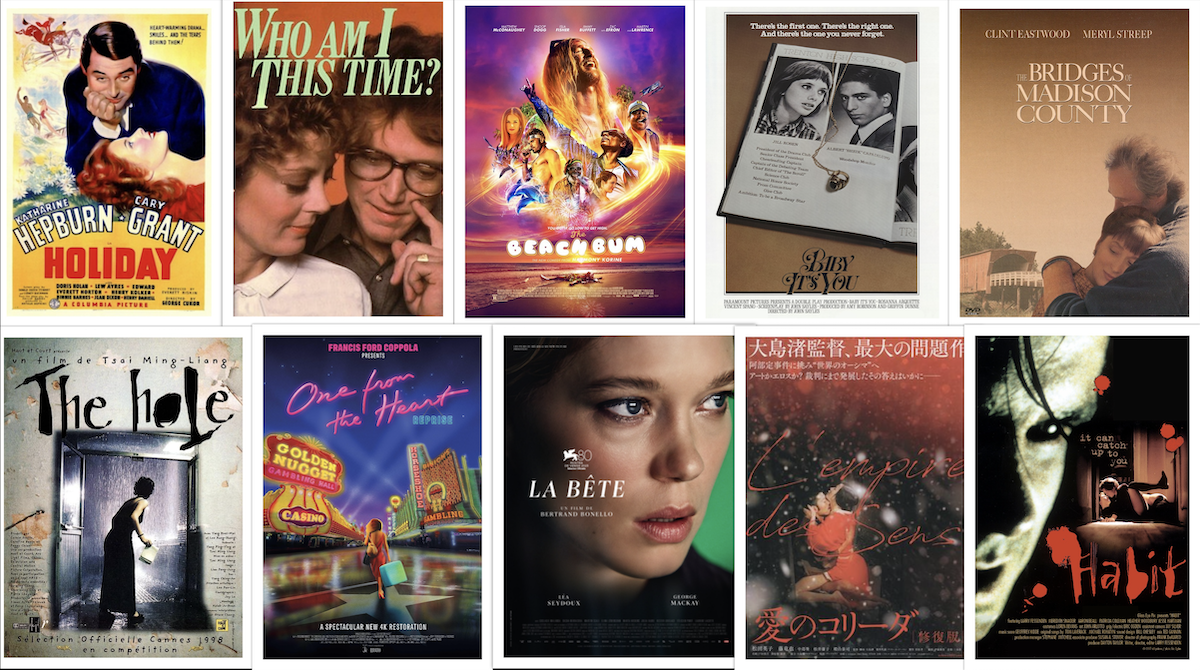
“Holiday” (1938)
“Holiday” (1938) is my favorite screwball comedy. Noted winning personalities Cary Grant and Katharine Hepburn make the film’s patter exhilarating, even before they know they’re flirting with each other. The knots in the film’s plot are inspired, but not as important as the maneuvers of, say, “The Lady Eve” (1941). Instead, “Holiday” is perfectly content to become a hangout movie for long stretches, particularly during a scene when the film’s leads sequester themselves upstairs at a New Year’s Eve party. I love the trope of joyful moments happening between a small group of people trying to avoid a larger social gathering, and this film’s iteration of that is a true “the party’s in here!!” moment. Above all, it’s a film about the thrill of doing bits with someone you love, even if you don’t even know you love them. I doubt even the most cold-hearted among us could get through “Holiday” without smiling.
“Who Am I This Time?” (1982)
A wonderful pairing with the seduction-by-riffing of “Holiday,” “Who Am I This Time?” (1982) isn’t really a movie. Alright, it’s a 50-minute episode of “American Playhouse,” but despite that, it remains one of the most tragically underseen masterpieces of the career of Jonathan Demme, one of the most unerringly empathetic filmmakers of all time. An adaptation of a Kurt Vonnegut short story with the ever-wonderful Christopher Walken and Susan Sarandon, this film is a profoundly moving version of a type of love story I always adore: one in which the romantic spark appears by way of two people performing with each other (other films potentially in this subgenre include “A Mighty Wind” (2003), “Drive My Car” (2021), Clint Eastwood’s “Bronco Billy” (1980), and, sure, the 2018 “A Star is Born”). Sarandon’s character becomes infatuated with Walken’s on the stage but is let down by his socially incompetent offstage demeanor; what can the two do, then, but keep playing opposite each other? Their love story is told through fragments of other plays, from “Romeo and Juliet” to “The Importance of Being Earnest.” Anyone who has seen Demme’s “Stop Making Sense” (1984) will recall that the filmmaker already believes that performance is the ultimate conduit to making 1 plus 1 equal 3, and this short, lovely film is the ultimate evocation of that idea. It’s 50 minutes long; you have the time.
“The Beach Bum” (2019)
Cards on the table: This isn’t really a romance movie. The love story between Matthew McConaughey’s stoned poet Moondog and his luminous wife Minnie (Isla Fisher) takes up only the first stretch of the movie and ends tragically. The rest of the film chronicles Moondog’s quixotic journey from character to character, tasting everything life has to offer before, Odysseus-like, he returns home. But the love floats over the whole film; Moondog’s openness to his surroundings is evidence of it. Even if the film doesn’t spell it out— this is a Harmony Korine movie where Zac Efron’s head is shaved to look like a panini—Moondog lives for his love. It’s how we should all be, and the early scenes of McConaughey and Fisher soar as depictions of love as a near-literal state of intoxication, which is about as romantic as it gets.
Bittersweet
“Baby It’s You” (1983)
A film which initially seems like a hyperspecific conjuring of a specific time and place (1960s New Jersey, complete with a mostly Springsteen soundtrack), John Sayles’ undersung masterpiece gradually becomes a portrait of how two people can change based on the circumstances of their lives. Not unlike Ingmar Bergman’s “Scenes from a Marriage” (1973), it’s a film about how every passing day that two people spend together (or apart) makes an irrevocable change in their relationship, where the love that remains between them constitutes a sort of miracle. It is not purely romantic; there’s a great deal of heartache in Sayles’ film and plenty of moments when the two lovers act selfish and cruel. Still, when they stare at each other and slow dance, I can’t help but be bowled over by how many permutations they have gone through just to end up in each other’s arms. A line from the last episode of Bergman’s series explains it pretty well: “We love each other in an earthly and imperfect way.”
“The Bridges of Madison County” (1995)
If there’s any film that nails the spirit of the Sirk-ian romantic melodrama in a post-New Hollywood world, it’s this one. Tenderness isn’t necessarily the first word that comes to mind when you think of Clint Eastwood, that stoic tough guy who has blessed our screens with his scowl for 60+ years, but “The Bridges of Madison County” (1995) is resplendent with downright erotic, sensuous moments between a grizzled Eastwood and an Italian-accented Meryl Streep. The air in this movie is hot, and every moment of their burgeoning romance buzzes with the sort of charged romantic potential that can’t be faked; if I were either’s spouse seeing this movie, I’d hire a private investigator. The film has a lighter touch than might be expected from Eastwood—it’s sort of an “oops, all grace notes” film for a while—but the spell it casts is irresistible. By the time the regret and “what ifs” of the film pay off, I’m typically left a blubbering mess.
“The Hole” (1998)
From Taiwanese slow-cinema master Tsai Ming-liang, whose shots typically go on for minutes on end without moving, “The Hole” (1998) plunges into a world ravaged by a mysterious virus that seems to make the infected act like cockroaches. It’s not exactly a premise that lends itself to comedy, let alone to romance. Yet in the dilapidated apartment complex that serves as the setting for Tsai’s film, the virus serves as the backdrop to two lovely, often comic performances from Yang Kuei-mei and Tsai-regular Lee Kang-sheng as neurotic neighbors whose apartments become connected by a hole in the floor. Against all odds, and despite its lack of dialogue, it becomes an apocalyptic romantic comedy, complete with startlingly upbeat musical numbers. The unique spell of Tsai’s cinema and the all-consuming bleakness of the film’s environment make the film’s final romantic gesture, an outstretched hand, a purely magical movie moment that reveals the warmth at the film’s core.
“One From the Heart” (1982)
Almost the direct opposite of “The Hole,” this legendary Francis Ford Coppola plot wears all the trappings of a classic Hollywood musical romance, with richly designed neon soundstages and kinetic dance sequences. In a move not dissimilar to Martin Scorsese’s “New York, New York” (1977), however, the central romance is uncomfortably toxic and commanding. There’s a punch of uncomfortable realism in this artificial world, which makes it a deeply weird watch (listen to the soundtrack’s titular song, sung by Crystal Gayle and Tom Waits, to get a sense of the uncanny melding of glitz and grime that Coppola attempts here). Undeniably, it’s an experiment, but the images speak for themselves; one in particular, of Nastassja Kinski tightrope walking above a matte painting of a junkyard, has always stuck in my mind. It’s a polarizing film, likely by design, but one of my true enduring favorites.
Caustic
“The Beast” (2023)
Bertrand Bonello’s latest film seems to carry an enduringly romantic premise: Each of us lives many lives, yet in each one, you’re bound by the universe to find the love of your life. In the 1920s, Léa Seydoux’s Gabrielle and George MacKay’s Louis come close to an ideal romance before the universe cruelly rips it away, only for them to be reincarnated to try again in 2014 and 2044. The pain of Bonello’s film, however, is that no matter how many lives the two live, there’s only one world. As the two find themselves hurdled into the future, the forces of capital and privatized emotion conspire to keep them away from one another. It’s gutting, but ultimately a truly modern film that takes for granted that love is the greatest thing that we do. The way it positions artificial intelligence as the death of art, affect, and love also makes it worth cherishing as one of the greatest movies of the decade so far.
“In the Realm of the Senses” (1976)
Banned and censored for many years across the world, this film from renegade Japanese New Wave master Nagisa Ōshima is by far the film on this list with the most sex. If you were to skip to a random part of the film, you would more likely than not land on some deeply perverted (and unsimulated) material. The film isn’t porn; however, set against the backdrop of Imperial Japan in 1936 (a hugely charged year for the nation), behind the sex is a profound political stimulus. The film’s lovers sequester themselves in an attempt to remain untouched by power at a point in time when there is little other recourse for them. I’m always drawn to love stories in which the lovers have to hide themselves from the world (the enclaves of “They Live by Night” (1948) and “All That Heaven Allows” (1955) come to mind), and Ōshima’s film is devastating and poignant on that count. If you’re squeamish, it’s worth spoiling the gruesome ending of this film for yourself, but “In the Realm of the Senses” (1976) is one of the most punk films ever made, a furious display of sex and love as a tool of rebellion against fascism.
“Habit” (1995)
An aggressively DIY slacker-vampire film from underground horror legend Larry Fessenden, “Habit” (1995) goes all in on the idea of love as addiction. In the vein of Claire Denis’ “Trouble Every Day” (2001), “Habit” is a film about appetite. It’s not the most positive representation of lovers who can’t stay away from each other since one is a literal vampire, but the film’s textures and vibes are sublime, with stretches of the movie consisting of a sad sack walking around New York before his hungry lover takes a liking to him. Frankly, this film probably pushes the limits of what could and should be watched on Valentine’s Day. “Habit” might be enjoyed best by a guy who tells girls on Hinge to step on him, since he likely doesn’t have Valentine’s Day plans.
Everything Frédéric had heard about America so far had been true. The people were arrogant and stubborn; the metro was terrible and everyone preferred to drive; and coffee was not served in delicate, porcelain teacups, but in garish, 16-ounce 7-Eleven cups. His apartment had no bidet, no fleur-de-lis inscriptions on the façade, not even a complimentary pack of cigarettes waiting in the kitchen drawer.
Yet he was glad to have enrolled at a closed-minded university that rejected the dystopian doctrine of “le wokisme,” the revolting disease that had swept over his native France. This, he believed, was the true spirit of America: the freedom to rebel against the woke agenda, choosing to proudly vomit when the government shoves pronouns and lavender lattes down your throat. Though his English was improving, every now and then Fred’s mind would freeze up, and he would have to stop himself from breaking into French. He dared not let anyone know he was foreign, though of course they knew. So maybe he was like the Americans after all, in his stubbornness to deny reality.
It was Monday, the very first Monday of college. Frédéric walked into his Uzbek literature course, “Unraveling the Myths of G‘afur G‘ulom: Critiquing the Soviet State.” Ho hum! he thought, I hope I never have to take another boring humanities class at this blue-hair university. He scanned the syllabus, trying not to gag. At least they have Abdulla Qodiriy, he thought; Qodiriy’s contributions to Uzbek realism are undeniable. But the other selections are pure garbage! Quelle honte! He settled into his chair, preparing to while away the next eighty minutes playing Google Snake by himself. If only he had someone to play a two-player game with! But he hadn’t made any friends yet—how long would he feel such despair and loneliness?
Just then, Marlene walked in. The fluorescent lights illuminated her pasty skin and oily roots. His eyes shot up, and were cast entirely on her. He looked down to see that his snake had crashed into a wall.
Fred learned from the class introductions that Marlene hailed from Bushwick, perhaps the wokest neighborhood in the wokest borough of New York City. She was a graduate student studying Queer Anthropology; her pronouns were she/they; and though Fred didn’t believe in “des pronoms,” he had secretly always longed to bag a she/they baddie. In her undergraduate years, she had taken part in countless campus protests. If she caught a demonstration happening outside of the dining hall, she would just join in, not needing to know necessarily what the cause was for. Her thirst for social justice was unquenchable.
She graduated with a double major in English and Feminist, Gender, and Sexuality Studies, penning a thesis on the latent homoeroticism in Melville’s Moby Dick—though she sharply criticized the novel’s personification of queer men as animals—before continuing her studies by pursuing, as was said, a Ph.D. in Queer Anthropology. The summer after graduating, her exclusive long-distance polyamorous open relationship with her partners, Dick and Jane, ended in misery after the other two decided to close the relationship. Naturally, Marlene was heartbroken and vowed never to date again.
Glancing up at Frederic, Marlene could only think: Ugh, what a fugly chud. His Timothee Chalamet-esque mole rat body barely took up one quarter of his chair, and his pretentious French accent just pissed her off. And yet, there was something so alluring about this skinny croissant-muncher seated across from her. Maybe it was his furrowed concentration on his computer—so committed to his studies!—or the way his wavy brown hair rushed out from under his Anti-Social Social Club baseball cap. But just as the idea of a cishet, monogamous relationship started to glisten in her thoughts, she quickly averted her eyes and turned her head down into her notes. He’s too young for me, she concluded, and put the thought out of her mind.
That Thursday, after his class on Israeli Engineering, Robotics, and AI, he shuttled to Suzdan, the dining hall, where he happened upon the Francophone table. The other students were very impressed by his French and asked him how long he had been learning. Then, they invited him to Night at the Bar at the local bar, Fezzos. Later that night, he looked at his ass in the mirror as he pulled on his denim capris, only thinking, Je suis vraiment cet homme! Like Brie and Chardonnay, his outfit was the perfect pairing: a skin-tight cropped black T-shirt with woven brown sandals. He grabbed a bottle of champagne—one of the dozen he had smuggled from home—and ambled down the street towards Fezzos.
Marlene wasn’t planning on going out that night; there was a protest against the closure of an anti-fascist fro-yo spot in New Haven, and she had intended to go. However, her roommate Madeline begged her to no end.
“You must join me for a night on the town,” Madeline. “Please, we can even go home early!”
So Marlene relented. She pulled on her baggiest, darkest pair of dark wash jorts with a sheer silver top (nips out), put her hair in a messy bun, and headed out.
At Fezzos, the dance floor was vibrating with an indescribable energy. Everybody was gay and merry, with gay meaning both ‘joyous’ and ‘homosexual’ in this context. Meanwhile, Frédéric was in the corner sulking, sneering at the stupid Americans and their clumsy dance moves. He took long sips from his bottle of champagne. He looked across the room when he suddenly saw her. It’s that girl from my Uzbek literature class! He realized. She was swaying her hips to “Velvet Ring” by Big Thief, clearly under the influence of alcohol. He couldn’t tell what it was, but something about her caught his whole interest. He decided that maybe it was time to try his famous French charm on an American girl, and began to walk in Marlene’s direction.
At the moment of conquest, a pack of buff rugby players waddled ahead of him, blocking his path. He stood on his tiptoes trying to see past them, but the strobe lights were too bright, the dance floor too popping. When the horde had dispersed, he saw that Marlene had disappeared, leaving behind a single golden hoop earring. He bent down and picked it up, clutching it in his hand. I must speak to her, or at least send her a DM, he said to himself. But what Frédéric didn’t realize, dear reader, was that Marlene had boycotted Instagram long ago for its use of AI, so he couldn’t find her profile. He knew he couldn’t wait until Monday’s class again, so in a desperate attempt to find his elusive Cinderella, he opened up Rizz, the school’s anonymous social media app.
He penned his love letter thus: “To whoever was the girl in the silver top at Fezzos, I need to see you. Meet me in the BestCo courtyard at midnight. Don’t be late.” Smiling, he began to sway to the rhythm of “Ballad of Big Nothing” by Elliott Smith blaring through the speakers.
* * *
Arms locked with Madeline, Marlene stumbled into their apartment. In between giggles and observations of how drunk the other was, she asked Madeline, “What should we do now?”
“Let’s see what’s new on Rizz!” was Madeline’s response, which is completely normal for a graduate student.
They collapsed on Marlene’s bed and began to scroll mindlessly through the app. It was mostly the usual complaints about the dining hall food and slightly concerning misogynistic comments: nothing too interesting. Suddenly, Madeline’s eyes lit up.
“Marlene!” she exclaimed, “This Rizz post is about you!”
“Really?” Marlene asked, “No fucking way!”
“Yes fucking way,” was Madeline’s response.
And there it was. They both stared at Frédéric’s desperate Rizz post for a moment before Madeline said, “You have to go meet whoever wrote this in the BestCo courtyard!”
Marlene’s first instinct was to roll her eyes and object. After all, she was above this childish hookup culture, and she was writing a chapter about it in her dissertation! But curiosity, that tricky fiend, got the better of her.
“Alright. Maybe I’ll go.”
“Hurry! You’re going to have to run—it’s already 11:55!”
Frédéric leaned coolly against one of the trees in the BestCo courtyard (fondly nicknamed “The Asshole”), smoking one of the last coffee-flavored cigarettes that he had smuggled over from Gallia. He kept an eye on his watch, watching as the minute hand inched closer and closer to midnight. He sighed. Maybe she wouldn’t show up after all. Maybe this place was not for the romantics after all. Suddenly, he heard a rustling noise, and Marlene stumbled out of one of the bushes that framed the entrance of the courtyard.
“Bonsoir,” said Frédéric after a moment.
“Hi, my pronouns are she/they, what are yours?” responded Marlene.
Frédéric resisted the urge to roll his eyes, but he couldn’t deny that something was charming about her woke earnestness. For a second, they stared at each other, not moving, just waiting for the other to say something or do something—when Frédéric leaned in and kissed her.
“I’m glad you made that Rizz post,” Marlene said, wrapped up in the satin sheets in his twin-size bed. The morning sunlight poured in through his window. “I never would have been so brave as to make the first move.”
“C’est simple, ma chérie…I couldn’t resist your beautiful dance moves and even more beautiful…mind,” said Frédéric after a moment of thinking, not wanting to seem like he was objectifying her. Maybe Marlene was already starting to rub off on him, and he decided that maybe being woke wasn’t so bad after all.
In true Ezleyan University fashion, they told their respective friends and acquaintances that they had “hooked up but didn’t have sex.” That was a triumph enough. Nonetheless, they continued to see each other, enjoying Suzdan dates and picnics on Toss Hill before deciding to make it “official” after three weeks of seeing each other.
Frédéric would invite Marlene to France for winter break, where they would do all the traditional French activities of swimming in the Seine and eating croissants at the top of the Eiffel Tower. Slowly but surely, they fell in love, spending many nights together in Frédéric’s tiny BestCo twin XL.
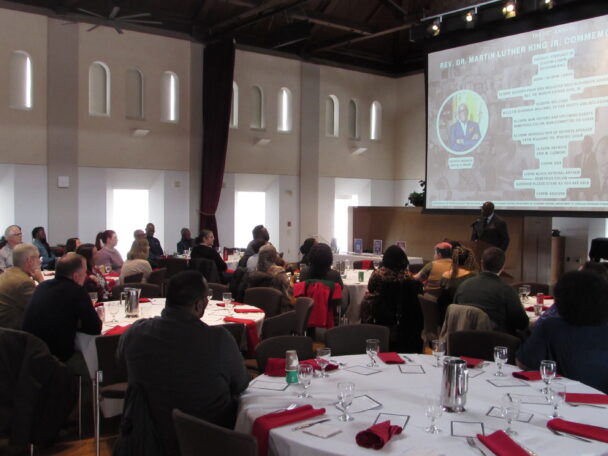
The University hosted its 19th annual Rev. Dr. Martin Luther King Jr. Commemoration on Tuesday, Feb. 10, welcoming keynote speaker Erik M. Clemons for a luncheon in Beckham Hall.
The commemoration was part of the University’s Black History Month programming, which continues with more events through the end of February. Over a hundred people were in attendance.
The event was co-sponsored by the Office for Equity & Inclusion, the Office of Student Affairs, the Office of Academic Affairs, the African American Studies Department, the Center for African American Studies, and Olin Library.
As attendees filed in and mingled, a recording of King’s baccalaureate address given at the University on June 7, 1964, played in the hall. King, who received an honorary degree from the University that same day, visited the campus four times between 1962 and 1966.
This was followed by a talk from Clemons.
Clemons is an entrepreneur whose work is focused on social and economic justice. He is the CEO and founder of two New Haven-based organizations, the Connecticut Center for Arts and Technology and the Connecticut Community Outreach and Revitalization Program (ConnCORP).
Clemons said that one reason he agreed to speak at the University was due to its continuing commitment to diversity, equity, and inclusion (DEI) in the face of Trump administration actions towards eliminating such policies, particularly in higher education.
“The work that they’re doing around DEI, especially now, where you can’t even say ‘DEI,’ you definitely can’t say ‘Black’ now, and the fact that this University has the courage to keep that office in place compelled me to want to come speak,” Clemons said in an interview with The Argus.
Much of Clemons’s speech was focused on ConnCORP’s $200 million economic development project taking place in Dixwell, a historically Black neighborhood in New Haven.
“The thrust of my being, in all the work that I do, is to aggressively address poverty,” Clemons said. “I think poverty is the most insidious thing that has ever been created and ever been allowed to live. It is not racism. I think racism is the weapon of poverty. Poverty itself can easily be eliminated, but the issue is that people who have the power and the resources to alleviate poverty don’t care about the poor.”
Clemons shared several anecdotes with the attendees that have shaped his beliefs. He described his relationship with his late mother, who asked him if he was being honest as she was dying, and mentioned inspiration from King’s 1967 speech at New York’s Riverside Church, where King denounced the Vietnam War in defiance of President Lyndon B. Johnson.
“That speech, as I mentioned, is my favorite, and I think his best, because it was a moment in time that he put it all on the line—his identity, his funding, his relationships, everything—to say these words to the world who needed to hear then, and so he didn’t care about anything else other than telling the truth,” Clemons told The Argus.
Clemons noted that he finds King’s speech especially critical now, at a time when freedom of speech has been contested by the federal government.
“Who’s willing now to risk it all for the sake of truth?” Clemons said.
Clemons ended his speech with the story of Gordon Gundrum, a white U.S. Park Service Ranger from a racist family who served as guard at the Lincoln Memorial podium when King delivered his famous “I Have a Dream” speech in 1963. Clemons noted that Gundrum adjusted the microphone for King before the address.
“The essential question that I have for myself, and that you hopefully will walk away with, is how many times have you created a way for people to be seen and heard at the same time,” Clemons said. “Because that’s what this white man, who was raised as a racist, did, and became a part of history. By simply lowering the microphone, he allowed for arguably the greatest speaker of our time to be seen and to be heard.”
c/o Aarushi Bahadur
Clemons’s message resonated with Wesleyan Student Assembly (WSA) senator and chair of the WSA’s Equity and Inclusion Committee Katie Williams ’28, who introduced the speakers.
“It just really inspired me and really motivated me to make sure I’m lowering the mic and being conscious of myself and my honesty,” Williams said.
The annual King commemoration has been formatted as a luncheon with a keynote speaker for the past six years, a decision made by organizer and Resource Center Director Demetrius Colvin.
“Before I got here, it was already a long-standing tradition, and administrators and people came together as a committee and put on this commemorative event,” Colvin said. “When I first got here, I kind of developed it as a speaker with a reception, and then with [Vice President for Equity & Inclusion] Willette Burnham-Williams coming, we transitioned it into a luncheon, which I think works really, really well as a format.”
Colvin noted that each speaker was chosen to discuss a certain issue relating to civil rights, with Clemons addressing economic justice.
“We try our best to find different speakers that get at different parts of our civil rights struggle today, because it’s not just this old thing,” Colvin said. “This isn’t just about, ‘oh, this thing happened in the past, and let’s remember it,’ but rather, we have an ongoing present that’s connected to that past.”
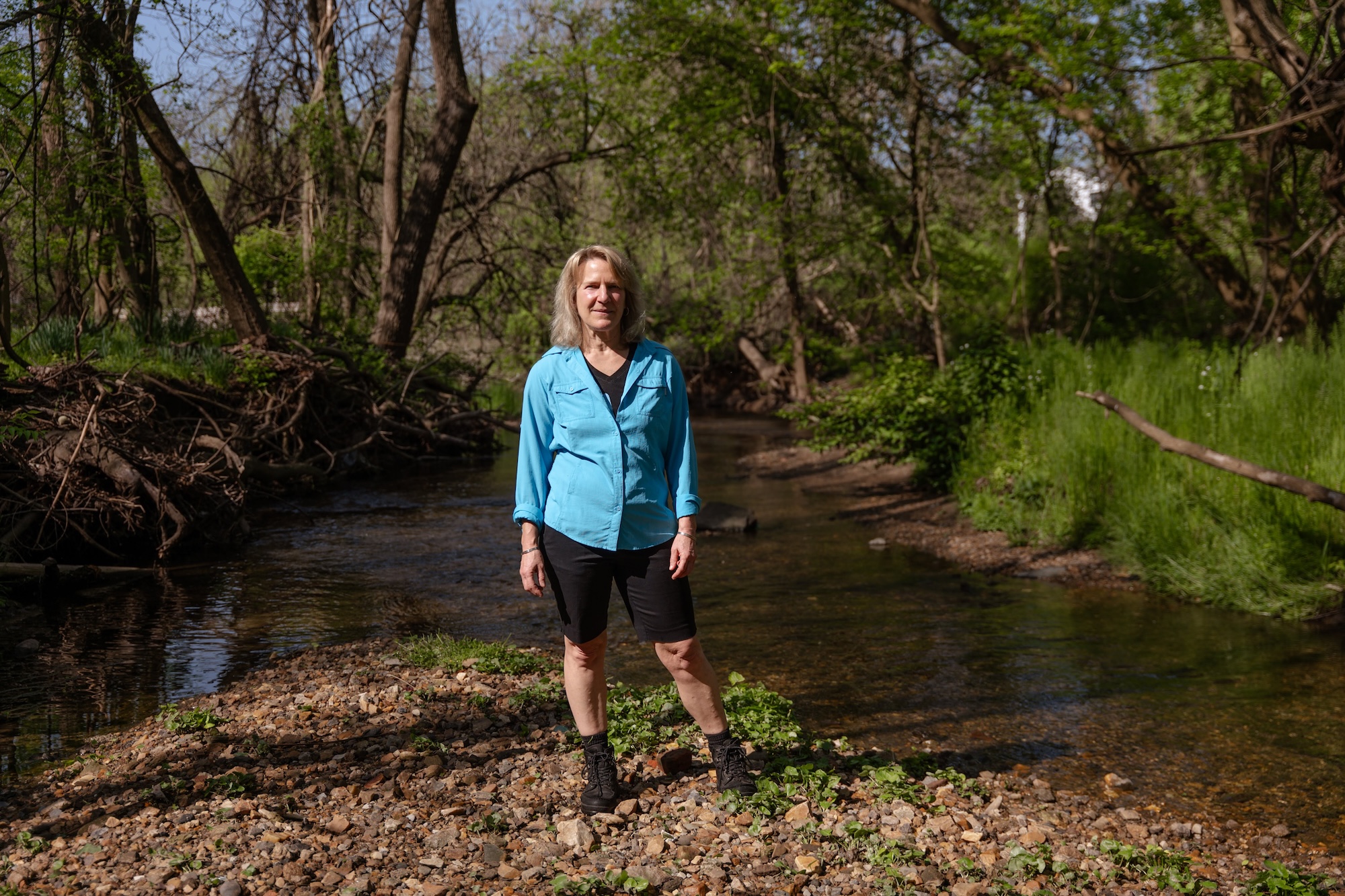
Maya van Rossum poses for a portrait outside, in Villanova, Pennsylvania; c/o Caroline Gutman/Inside Climate News
The Connecticut Environmental Rights Amendment Alliance hosted its third public town hall speaker series at the DeKoven Center in Middletown on Wednesday, Feb. 12.
The alliance advocates for the passing Connecticut Environmental Rights Amendment (CTERA), which would designate the right to clean air and water, a safe climate, and a healthy environment equal to the legal and constitutional status of other freedoms, such as freedom of speech.
The event featured speaker Maya K. van Rossum, founder of Green Amendments for the Generations (GAFTG), a national nonprofit organization focused on including a Green Amendment in every state constitution across the United States, and eventually at the federal level. The two previous town hall speeches respectively took place in Mansfield, Conn. and Stamford, Conn.
“With the passage of the CTERA, we will be ensuring and requiring that all government officials become constitutionally obliged to protect the environmental rights of all the people,” Rossum said. “[That means protection] at every level of government here in the state of Connecticut, not just the state legislature, but the local town council, the attorney general’s office, the governor’s office, all the regulatory agencies.”
Three states, Pennsylvania, New York, and Montana, have already recognized and protected environmental rights akin to those proposed in the CTERA. Pennsylvania’s Environmental Rights Amendment was adopted in 1971, Montana’s Green Amendment in 1972, and New York’s Green Amendment nearly 50 years later in 2021.
“The language in [the CTERA] is by far the best compared to [the other states’ amendments],” Rossum said. “That’s because, over time, we’ve learned a lot of lessons. We’ve taken all of those good lessons learned, and we’ve built them into our CTERA’s language.”
The CTERA is a constitutional amendment, meaning that it must go through a legislative process. The Connecticut General Assembly must agree to pass the proposed constitutional amendment by a 3/4 majority in both chambers, after which a popular vote would occur as it appears on the ballot in the 2028 election cycle.
In addition to the difficult process of passing the amendment, the CTERA also faces many opponents, including prominent Democrats in the Connecticut House of Representatives Chamber. Connecticut House Majority Leader Jason Rojas, for instance, has notably been against environmental bills similar to the CTERA.
Rossum rejected the premise that environmental regulations place restrictions on construction projects or efforts to build more housing for Connecticut residents.
“The CTERA is not going to create an impediment toward affordable housing projects, unless that affordable housing project has really serious environmental ramifications that rise to the constitutional level, which is a very high level,” Rossum said.
Currently, over 40 organizations have signed on in support of the CTERA, including Sierra Club of Connecticut, Sunrise Movement Connecticut, Clean Water Action Connecticut, and the Connecticut Audubon Society. However, although the amendment advanced last year with bipartisan support, prominent House chamber members changed its language so significantly that the organizations withdrew their support for the bill.
As of the writing of this article, CTERA advocates are still hoping the unmodified bill will be passed this year.
Rossum emphasized the potential impact of the bill if it is successfully passed, and the effect it might have on future generations.
“Through this movement, we have a true opportunity to leave a legacy of protection,” Rossum said. “People who will never know who sat in this room tonight and did this heavy lifting and this hard work for them, but they will be forever grateful that we did it, because they will be the beneficiaries of the incredible constitutional protection.”
This piece is part of Letters on Pragmatic Hope, an essay series in which Wesleyan professors and administrators reflect on a daunting question: How can students act with purpose and efficacy amidst an increasingly authoritarian environment? The series aims to gather responses from a diverse group of Wesleyan faculty, offering a vision for how students can turn despair into pragmatism and action.
Why learn and create in and through all that is going on right now? Study? How? Here’s my answer, up front. Humans who pursue learning amidst inevitable death, in the terror of a crisis, do so in a hope practiced amidst the terrors of peace.
That’s it. But it’s not simple. I have actively pondered the How-Now-to-Live question nearly every day of my adult life: It has long been my close companion.
Three weeks into my freshman year I listened, petrified, as my friend’s car radio announced a 7.7 MW tremor had hit Taiwan just 30 miles from where my family lived. Over 2,500 people were instantly killed in what became known as the 921 Earthquake. I was in Los Angeles and supposedly reading “The Odyssey.” I spent a week refreshing the news, hearing about life in tent camps, and catching stories of friends and family taking disaster supplies into the mountains. Why learn?
Two weeks into study abroad I was coming back from the Bodleian Library through an Oxford mall. A crowd was forming around a TV shop’s live news broadcast: Tourists and locals alike stood gasping, moaning, and weeping as smoke poured out of the Twin Towers, and then they fell.
The next day we were taken to Stratford-upon-Avon to watch Shakespeare’s “Julius Caesar.” Little did we know it was an unexpected foreshadowing of the ongoing fall of the republic. You all were born into that aftermath: 9/11 was weaponized into the War on Terror and the PATRIOT Act was used to redefine civil rights. With all that is going on, why learn?
In the aftermaths of those experiences I made terrifying life decisions. I opened my heart to falling irrevocably in love. I took a tutorial in writing poetry. I unwound the faith of my childhood and re-began pursuit of the divine. I passed on a job that would have quickly paid $100k/year. I started to prepare for a vocation teaching and studying the Middle Ages. I chose love, learning, faith, hope.
To many these choices did and do reveal me to be both stupid and privileged. Sure. But while I myself am surely a moron, were these choices unwise? I had realized crises and disasters (both personal and collective) were perpetual, that they would never cease. My question had become: What will I do with my time, anytime?
You know well that many people think everything we do, here, is a waste, the detritus of privilege. Poetry while there is poverty? Dancing when there is death? Singing where there are sick? Astronomy amidst starvation? Many at Wesleyan even hold this view; they find ways to tell you to shut up, grow up, get real. The view calls itself pragmatism and means this: Learn to accumulate money, because money is real and it matters.
There sure are a lot of reasons to think this way. Circumstances ranging from extreme privilege to extreme desperation will incline you towards it. A Wesleyan degree is worth more than my house! I’m not! Going to waste my! Shot! But play it out. At some point in life you will confront the question: How much money (status, power) will I accumulate before I start living out my desires for what matters? The lower that number, the more time recovered for what is truly real.
I want to tell you about one more crisis in my life, but a different kind. One night when I was in eighth grade the auntie I knew as Dodo was over. That night she brought a present: a wooden shoe shine box. It had a drawer for polish, a tray for rags and a brush, and a platform on which to set a foot. Aunt Dodo sat me down in one of my Dad’s shoes, showed me how to shine, and then made me shine her shoes until I got it. Then she said something like this: Jesse. I’m giving you this box so that you never worry about whether or not you will have enough to eat. So long as you can shine shoes you can make enough to feed yourself each day and be okay. Now don’t worry about that for the rest of your life.
Aunt Dodo passed this last year, still living a simple joyful life. And no one ever gave me a more meaningful gift. I still have (and use) the box, but the gift wasn’t the object so much as the lesson. You don’t actually need so very much to get on, so try to get on with what matters. Love, learning, faith, and hope.
Pick a crisis. Inflation. A so-called pragmatist might say, why are you learning to tell stories, read Syriac, study cell structures? Look at the economy! What this pragmatist means is (a) above all protect yourself against the loss of monetary capital; and, (b) if you can, end inflation for yourself and everyone. But this sort of pragmatism is short-sighted and quite literally idiotic. It ignores that inflation is just the most emergent emergency. Will it be inflation that stops you from learning wildly, passionately, and with abandon? When would you restart?
Crises, disasters, and emergencies do not create new life conditions. They demolish our ability to postpone confronting the perpetual terrors which persist even in peace: means of survival, fear of isloation, nature of existence. Will my moment of crisis come today, tomorrow, or next December? It doesn’t really matter, it is out of my hands. The crisis I am really doing something about is the everyday crisis confronting the reality in which I live, and move, and find my being. Why, when bombs may fall, do we find humans writing poetry, painting, reading, or singing? They practiced hope. Death comes for us all. Will we live so that death becomes us—in the sense that we are prepared to wear it well?
Don’t let people convince you that setting your mind alight like this is selfish. Great horrors are fought in everyday choices. Austerities, genocides, pandemics, wars, terrorisms, fascisms: All these are only truly addressed by that which we must always confront: How have we become so separated, and how can we find each other again? Learning amongst others is a path to that fellowship which is real peace—it is our only real means of survival. And learning is a form of life which does something special—it possesses a magic like that of producing, sharing, and eating food together.
Learning is the form of life around which we all at colleges and universities set our table. Given that, wasn’t it astounding that no education institution in the USA decried the slaughter of Gaza’s professoriate and the intentional demolition of its universities? When peace is made, won’t learning be essential? Even after people like Lee Mordechai (my colleague in Byzantine Studies and a professor at Hebrew University of Jerusalem) and Aryeh Neier (a Holocaust survivor and co-founder of Human Rights Watch) published statements that Israel was committing a genocide in Gaza, many still take public offence to ideas like: Innocent people should not be getting killed, or bombing civilians must stop now, or let’s find a powerful but non-violent way to try to stop genocide, or let’s not invest in guns or missiles or drones.
What I and some other professors decided to do, in the face of this particular genocide, was to turn to what we are both employed to do and called to do in the practiced habit animating our every day: Learn together. Some of us are specialists in the histories and societies of the region, some are just good facilitators. Together we sought to help enjoin as many as were interested in studying: What is going on in Israel, the West Bank, Gaza, Lebanon, Syria, and Jordan, and why?
We called this fellowship the Palestine Seminar. Palestine, since that is the historical name for the region over the past millennia. Our community course site explains the seminar as “a non-evaluative collaborative course open to anyone and everyone in the Wesleyan community … whatever your perspective, your backgrounds, and relationships to this topic, and whether you are a student, staff, or faculty member.” We described the controversial normalcy of our activities just like this: “One ‘do what we are able to do and what we are good at’ answer we put together as scholars and teachers: Study, question, learn, educate, and inform one another in our community.” Depending on the semester we still meet twice-weekly, monthly, or quarterly. We’ve had academic readings, sharing sessions, and speakers. We’ve listened, read, watched, eaten, wept, argued, changed minds and hearts, and in all: made community.
For a number of us one memorable meeting was “With Others in Suffering / Solidarity.” All Wesleyan was invited: “American responsibility keeps Palestinian suffering and death at the forefront of all of our minds, even as we also are ‘with others’ in Ethiopia, the Maghreb, Myanmar, the Sudan, Ukraine, and many other places. Come as you are and/or bring poems you have written or read expressing the idea of being with others in suffering/solidarity.” Everyone’s experience was their own, but I can say that some conflicts carried into the meeting that day were carried out in fellowship if not friendship.
Why learn? Can it mean anything to learn about a people while they suffer under terror and genocide? What I know is that learning—like eating and like falling in love—creates community. Or, to put it more spiritually, it generates fellowship. And, as it turns out, fellowship—you might call it humanity—is the only practical, real, material, absolute answer to genocide. You cannot kill them: In every way that matters they are you, and you are them. How can we learn, now? That is how, and why.
Only the quotidian answer (What to do with the remains of every dying day) can answer the urgent cry (What to do in the face of this new horror). Why learn, why create in a time of rising fascism? Why learn, why create in a time when a secret police force is sent into cities on an ethnic cleansing mission under the cover of immigration enforcement? The question is really the same: Why learn, at all, ever? To learn, together, is to open community to every willing other. It is a living out of one very real answer to the fundamental question of existence. Some of you will laugh. But I am not joking. A university claims to be a model society. Not a façade but a real and better society which—so the goal—models a future which graduates try to manifest in the world. As long as that is so you are not (primarily) at university to learn what to do, you are here to learn how to be together with every other. Love, fellowship, community: These are the preconditions for peace. I am here to learn that with you because my habit of hope holds this as our only possible path. Because for me, loving others is the only act of hope that has ever seemed the least bit practical.
Jesse W. Torgerson is an Associate Professor of Letters, History, & Medieval Studies, and can be reached at jtorgerson@wesleyan.edu.